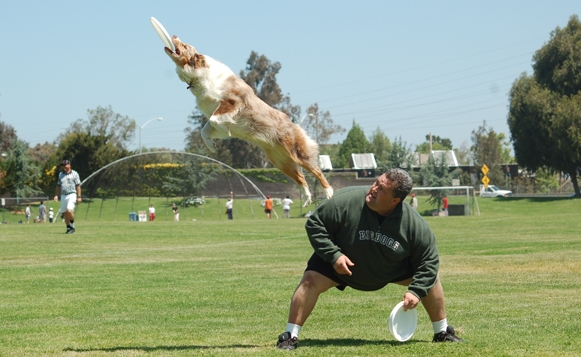
You are happily channel surfing when you spot some dogs racing through an obstacle course. They are leaping over hurdles, climbing up A-frames, crawling through tunnels, and weaving in and out of poles. You can tell this is a timed competition – the dogs and their handlers are running as fast as they can. Fascinated, you set down the remote control.
What you are watching is agility, a canine sport that came to this country from England in the 1980’s and has since become one of the fastest growing dog sports in America.
You notice that not all the human participants are gifted athletes. They are all ages and all levels of fitness. The dogs are not all those black-and-white sheep dogs, either.
When the program is over, you look across the room at Fido and think, “You may not be a Border Collie and I may not be Michael Jordan, but that sure looks like fun!”
Why Agility?
If you decide to explore what this sport has to offer you and your canine partner, you are beginning what could be a very fulfilling journey. Pursuing agility will likely take your relationship with your dog to a whole new level.
During agility training, both of you will exercise your minds and bodies as you learn how to work as a team. This teamwork can strengthen the bond that you already have with your dog, or create a bond that may have been missing.
Speaking of bonds, no doubt you’ve already discovered the bond that dog people seem to share. Folks that get hooked on agility find that their human classmates and training buddies are people they enjoy. Even competitions offer a friendly environment of encouragement and camaraderie that makes the newcomer feel very welcome.
Dogs that have more energy than a walk around the block and a nice chew bone can satisfy might find agility and the training that goes with it a literal life saver. More dogs are surrendered to shelters for behavior issues than for any other reason. A large number of these unwanted behaviors are directly related to lack of physical and mental exercise. Agility could be the perfect “job” for those currently unemployed pooches looking for work.
It does not take long to see that the benefits of the sport go far beyond just having fun with your dog.
Who Can Play?
You may have heard some of the agility rumors that abound: about how much training is involved, which type of dogs can participate, the difficulty of the sport, or the lack of accessibility to training facilities.
Yes, agility dogs have to be very well trained to compete at the highest levels. Handlers at these levels spend many hours teaching their dogs all the subtle cues for running a course in perfect harmony. But this does not mean that your dog has to be perfectly trained to start agility.
Many agility schools offer “Agility for Fun” classes with few or no skill prerequisites. If you want to pursue the sport after this initial introduction, your dog will need to have a reliable “sit and stay” and “come” when called off-leash. The amount of training you will need to do beyond that will be determined by your individual goals and commitment level.
It is true that some specific breeds dominate the sport at the higher levels of competition. It is also true that many different breeds, as well as mixed breeds, compete successfully at all levels, including at the top.
Even older dogs and dogs that are not very physically fit can participate. If you have an older or not-so-fit dog, just be sure that you work with an experienced professional to design a safe training program and that you have your veterinarian’s permission before you start. Then let agility improve your dog’s strength and coordination skills on the road to better health.
Starting School
Finding the best agility school for you and your dog is the next step. A few things to consider are the instructor’s experience in teaching both general dog training and agility handling, the accessibility of the facilities, the instructor-to-student ratio, and the quality of the equipment.
The equipment must be safe and built to standard regulations, and the floors must have safe footing for the dogs to run and jump on. Inquire, too, if private lessons are available, and if there are times that you can practice on the equipment in between your scheduled classes.
Schools should allow you and your family to observe classes. Before enrolling, attend some class sessions at the level you are interested in joining as well as the advanced level. You might also consider booking a private lesson so the instructor can meet your dog before you officially join a class.
It is only fair to warn you that what initially may seem like just an enjoyable pastime to share with your dog could blossom into a full-blown addiction, in just about every sense of the word. You are in danger of having way too much fun!
Sandy Rogers owns and operates Ace Dog Sports, an agility training school that serves San Francisco and the Peninsula. Sandy and her dogs have been seen in competitions on Animal Planet, NBC, and the PAX television stations. Her training articles have appeared in Clean Run, a magazine devoted to the sport of agility and her students at ACE range from the casual enthusiast to top national competitors. For more info: www.acedogsports.com, 415-643-5808.